I have lived in the UK for most of my life, but when young I definitely had wanderlust and even ended up living in South Africa for several years which was a wonderful experience. I now look forward to a long and leisurely retirement doing what I like most - gardening, photography, walking and travelling.
“One for all of us who’ve been hampered by nervousness, clumsiness and much else in the race for success, whatever that is.”
(Note to anyone looking at this post in the Reader or on a phone you may need to visit the actual site to be able to view and listen to the music track)
Lyrics
Before I Fall
I know I can be clumsy / I’m hamfisted as they come
I’m blessed with two left feet / And my fingers are all thumbs
But I can tie my own bootlaces / I can use a knife and fork
I get there in my own time / And if I can’t run I’ll walk
I don’t need a nanny or a minder and if I can’t cope, I’ll call But please don’t pick me up (x3) before I fall
I know I tend to stammer / And my tongue gets tied in knots
I get confused and nervous / Tripping over my own thoughts
But I’ll make up my own mind / If I’m wrong I’ll take the blame
And I can finish my own sentences / Thank you all the same
I don’t need an interpreter and if I ever do, I’ll call Only please don’t pick me up (x3) Before I fall
I’m defensive and I’m obstinate / When things I say and do
Turn out upside down and in reverse / I may get mad at you
As well as me, but I’m sorry / And I hope you understand
I appreciate your putting up / With me the way I am
I’m trying to do better, for you, most of all Only please don’t pick me up (x3) before I fall
credits
from The Old Man Laughs, released February 7, 2022
Words & music, guitar and vocal by David A. Harley.
What can I say about Amsterdam? It was very different to home. Drugs for a start. Lots of drugs. The red light district. Hippies. The emperor of Japan – I kid you not – loud demonstrations, museums, canals, so many bikes. We spent three hours in the Ryksmuseum, it was fascinating.
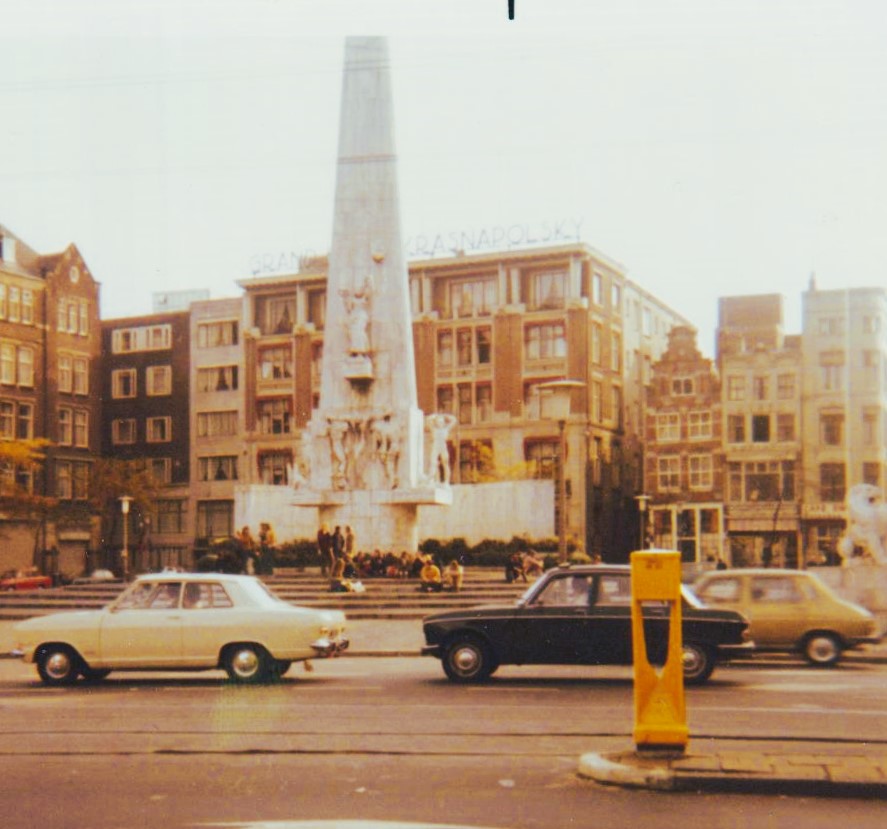
Dam Square in Amsterdam, Netherlands, featuring the National Monument. Anantara Grand Hotel Krasnapolsky: The historical hotel, established by Wilhelm Krasnapolsky in the 19th century, is visible in the background.
The Student Bar was a popular hang out and as we were kicked out of the hostel at 9:30am we spent another day wandering around the capital city. There were no shortage of young men vying for our attention with suggestions of accompaning them to Switzerland, Morocco, Afghanistan. All of which we turned down, of course. Finally we needed to move, the youth hostel was full and so we had to leave, we went to the nearest town of Harlem where we spent a couple of rainy days before setting off for the coast.
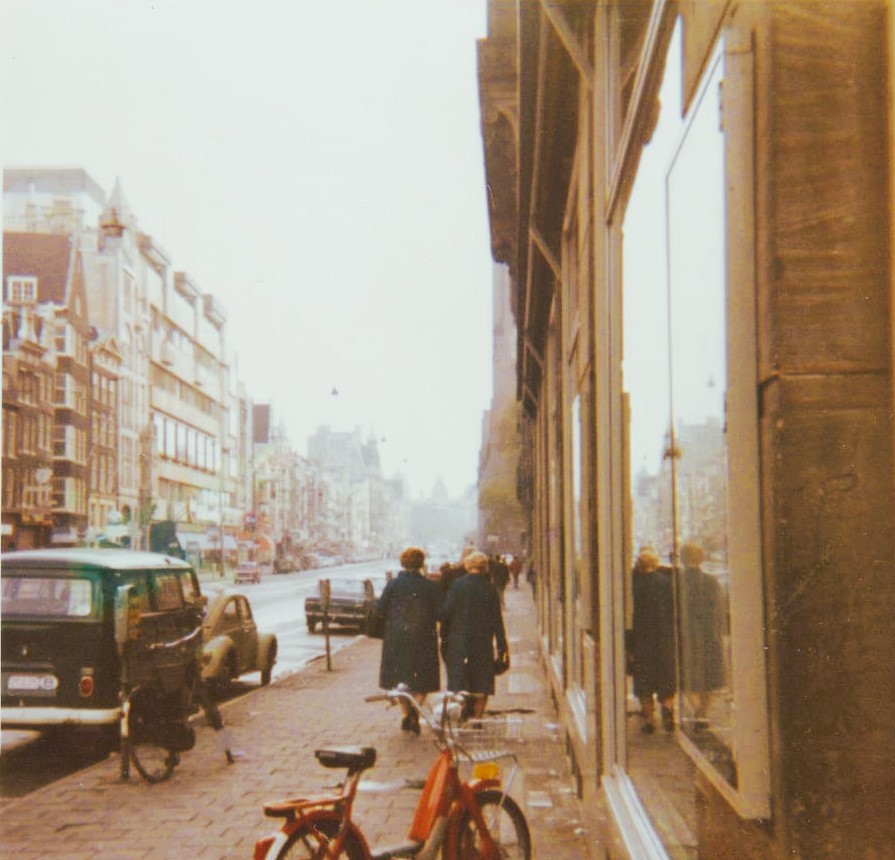
A street scene in Amsterdam – A classic Volkswagen Type 2 transporter and older model cars are parked on the side of the road.
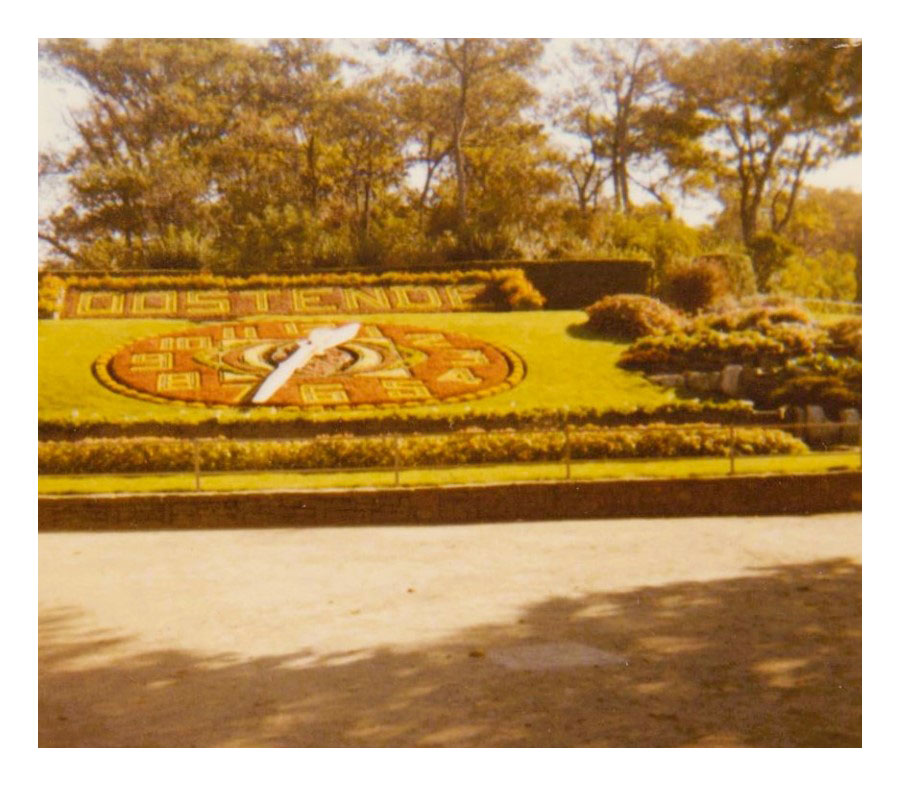
We reached Oostende at 12:30pm this time successfully avoiding Antwerp. It did take a while though with many short lifts, one amusingly crammed into a two-seater Triumph Spitfire. Still raining we found the youth hostel for one last night. It was very clean and also expensive, but dry. We had an enjoyable evening chatting to a couple of Americans and some Canadians who were heading for India.
the Floral Clock (Bloemenuurwerk) located in the city of Oostende, Belgium.
The following day we walked around the city, telephoned home and used up the last of the camera film as the ferry wasn’t until 7pm. On board we got talking to Kim who was from Watford and a folk singer! He apparently had written a poem which had been used by The Incredible String Band on one of their early albums and whether that was true or not he did entertain us with his hilarious tales of travelling in France. He even offered us a lift but his car was full of gear – guitars, amps etc. Plus we were so tired when we reached Dover – the sea was so rough that it took several attempts to dock and by then it was 1:30am. We stayed in the waiting room until daylight before setting off for London.
Not the best of days. It was raining, there weren’t many lorries about and lifts were scarce. It took us all day to get through to the north of London. Calamity stuck when the lift we were in broke down and we were stuck at the side of the motorway waiting for a breakdown truck. Obviously we weren’t in a good location to hitchhike. At Leicester Forest East we finally got a lift by a lorry driver going all the way to Leeds. The relief! By now we were soaked though, cold and miserable. Our time on the Greek islands seemed like a dream.
Total time away: 10 weeks.
Within weeks I was desperate to travel abroad again, but Cathy had met a boy and reluctant to leave him and without any savings this meant finding work. So it was that on 1st January 1972 I was flying for the first time, to Switzerland, to begin my job as an au pair in Geneva.
“The first verse is a recollection of the second time I took my daughter to nursery, and the first time I left her there on her own. I felt like a criminal! Previously released as a single.”
(Note to anyone looking at this post in the Reader or on a phone you may need to visit the actual site to be able to view and listen to the music track)
Lyrics
How to Say Goodbye
Took you down to the High Road
Where I’d taken you once before
Kissed you and left you crying
There behind the nursery door
From the day our children are born Until the day we die We keep on learning to let go And how to say goodbye
Took you down to the station
Waited with you for a train
A kiss and a wave from the platform
Saw you homeward bound again
Took you in from the car
Walked you down the aisle
Kissed you goodbye at the reception
Once more you left me, with a smile
Walk me down to the station
Time that I went home again
Blow me a kiss from the platform to warm
An old man’s heart on the train
credits
from Strictly Off The Record, released October 10, 2021
Words & music by David A. Harley. Acoustic guitar and vocal by David A. Harley.
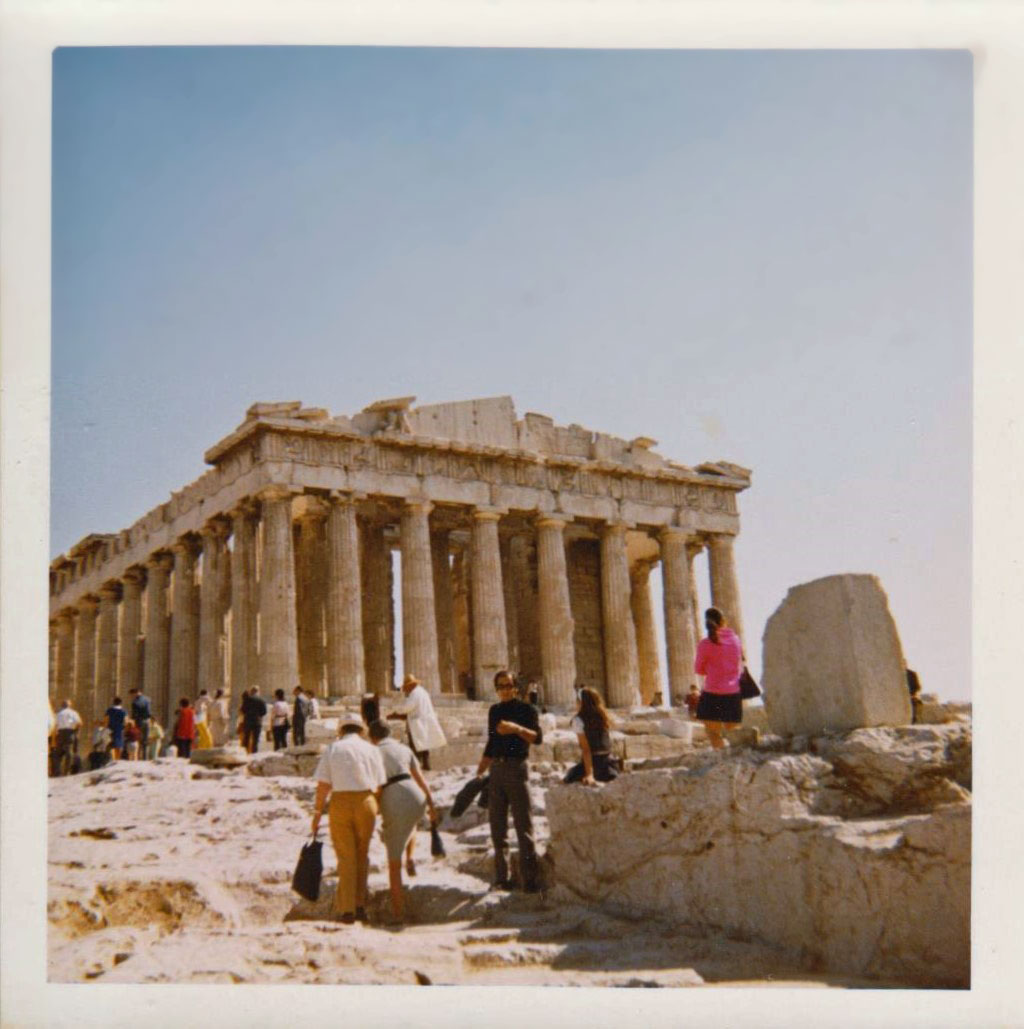
After the peace and quiet of Ios Athens was almost unbearable. Noisy, polluted, busy. We badly wanted to turn round and go back to the islands, but of course we couldn’t. Being rather dishevelled and dusty – hot showers weren’t in abundance on the island – we decided to head to the Youth Hostel No 1. It took us a while to get there and when we did, at 7:30am we found that we needed to leave at 9am. So no chance of sleeping, but at least we could get a shower and change our clothes.
The Parthenon on the Acropolis
We headed back into the city and decided to visit the Acropolis again and the museum. It was another hot day and we were struggling by the afternoon when we decided to head back to the hostel and have a nap. It was also my 18th birthday so we celebrated that night with our favourite Gyros meal.
Early Monday morning we had another shower and got our gear together ready to set off home. We had very little money by then so went via the hospital to donate blood for which we got paid a few quid, enough to get us home. It was a lovely sunny day and by 11am we were on the road hoping for our first lift. We soon got one as far as Larissa where we were stuck. We went to the loos at a rather nice looking petrol station and somehow got talking to a Greek-American older man who said he was driving all the way to Bremerhaven in north Germany and was happy to take us with him. We were dubious about that, but decided we would chance it. By the end of the day we were back in Skopje. It was a huge American car with so much space and we became navigators and conversationalists in return for the lift and food, just like it was with Harry!
Instead of the coastal route this time we went through the centre of Yugoslavia which was a complete contrast. It was dull, the weather was dreary and everything looked so grey. We even saw fields still being ploughed by oxen. The towns we stopped in appeared quite poor. It all looked very bleak. We passed Beograd, Zagreb and Ljubljana and eventually stopped to spend the night in Austria. The driver (whose name I unfortunately did not record) went to stay in a motel, but Cathy and I decided to sleep in the car, the seats were wide enough for us to stretch out. I say sleep, but it was so cold we really only dozed. A loo break at dawn and then we continued until 8:30am when we stopped at yet another pretty Austrian inn where we had a substantial continental breakfast.
At this point we decided that if we did get to Bremerhaven we could possibly have a few days in Amsterdam on our way home. So we continued through Munich through Nuremberg and Kassel, where we decided to hop out and find the youth hostel as we were desperately tired. It was too cold to camp now and we really needed a proper night’s sleep and a decent meal. It was a lovely clean welcoming hostel.
The following day we hitched towards Hannover. It was a slow day of travel, frequent, but short hops and spending more time waiting than actually travelling, but we had no choice, we had to keep some money back for the ferry over the channel. We eventually reached Hannover and then headed towards Osnabruck using a mix of autobahn and other main roads. As the sun was setting we had reached Melle and it was becoming very cold – we weren’t dressed for the cold having left in the summer and spending the last couple of months in the south – luckily there was a youth hostel nearby, a rather beautiful timber framed building and we had the whole female dormitory to ourselves. Another piece of luck was that a group from West Berlin were playing at the hostel that night “Ton Steine Scherber” a political German language rock band who were very much into the works of Marx and Lenin. The songs were mostly protest songs and actually rather good though our linguistic skills were definitely not up to the after show discusions so we opted for our beds.
The morning after another good shower and breakfast we were back on the road to Osnabruck and the Dutch border where we got a lift by a lovely Dutch airman to Utrecht and from there a couple of lifts to Amsterdam where once again we headed to a very popular youth hostel. The journey north had been a lot easier than our southern route, but maybe that was because it was now autumn and there weren’t so many people hitchhiking.
“A farewell of sorts to my brief career as a full-time musician in the 1970s, which was even less glamorous than this song might suggest. Originally recorded in London in the 1980s, but this is a revisit from 2023. The lyric is slightly bowdlerized by request of Ian Semple, so that he could play it on Coast FM, so you could say this is the radio version. It doesn’t change the meaning at all, so I’ll try to remember to sing it this way in future.”
(Note to anyone looking at this post in the Reader or on a phone you may need to visit the actual site to be able to view and listen to the music track)
Lyrics
Ten Percent Blues
Got a seat facing the engine
So I don’t have to face where I’ve been
Luggage on the rack, no reason to look back
At all my wrecked and reckless vagrant dreams
No more bright lights, no more white lines
Or crashing in the back of the van
No more hustling small-time gigs
I guess time has beaten the band
No more deadlines, no more breadlines Mr 10%, you’re on your own No more fine print, no more backstage blues This rolling stone is rolling home
Got a ticket to take me to tomorrow
It can’t be worse than today
So driver, take me home and don’t spare the horsepower
I’m on a ten year holiday
No more missed chances and chickenfeed advances
Cold chips in the back of the van
No more blown tires and fuses, no more broken promises
Time has beaten the band
No more deadlines, no more breadlines Mr 10%, you’re on your own No more fine print, no more backstage blues This rolling stone is rolling home
No more spotlights, no more ups and downers
Absolutely no stage fright
No more superstar fantasies
From today I’m strictly 9-5
No more infighting, no more moonlighting
No more one-night stands
All along while the band was beating time
I guess time was beating the band
No more deadlines, no more breadlines Mr 10%, you’re on your own No more fine print, no more backstage blues This rolling stone is rolling home
credits
from Swan Songs, released June 28, 2023
Words, music, guitar, resonator guitar and vocal by David A. Harley.
 TRAVEL WORDS