sLOVEnia – then and now

I step out of the bus into the bright light and look around. In front of me is the railway station; a good example of Austro-Hungarian architectural style. Across the busy dual carriageway is a tree-lined park with minor streets and avenues leading to the old city centre. Nothing looks familiar: I look around hoping that some kind of recognition will take place, but I have no memory of this place – neither the station nor any of the streets.
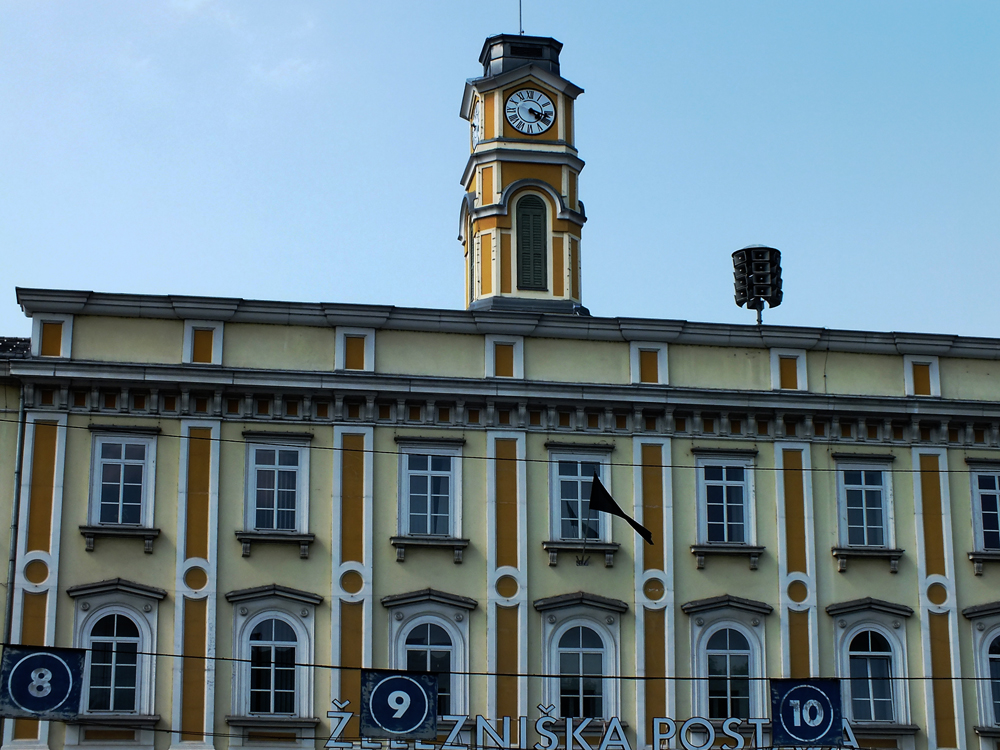
Ljubljana Railway

Usually when I return to a city my memory clicks into place as smoothly as a child’s jigsaw puzzle. Not today though. I sigh. The smells are all wrong, the noises are wrong and the colours are definitely wrong. As the sun burns down on my skin and the noise of the buses and cars fill my ears I remember the last time I stood in this spot…

I stepped out of the lorry and into the gloom of a wet late autumn afternoon. The driver clasped my hand, grinned and bid us goodbye. A part of me was relieved to have reached this little border town of Ljubljana in northern Yugoslavia. The journey through the Austrian Alps with its hairpin bends in torrential sleet and rain, was not the most relaxing, but as the heavy rain ran down the back of my neck and soaked through the shoulders of my jacket I craved the warmth of the cab. We headed to the information booth inside the railway station to try to find a room to stay the night. Camping was definitely out of the question.
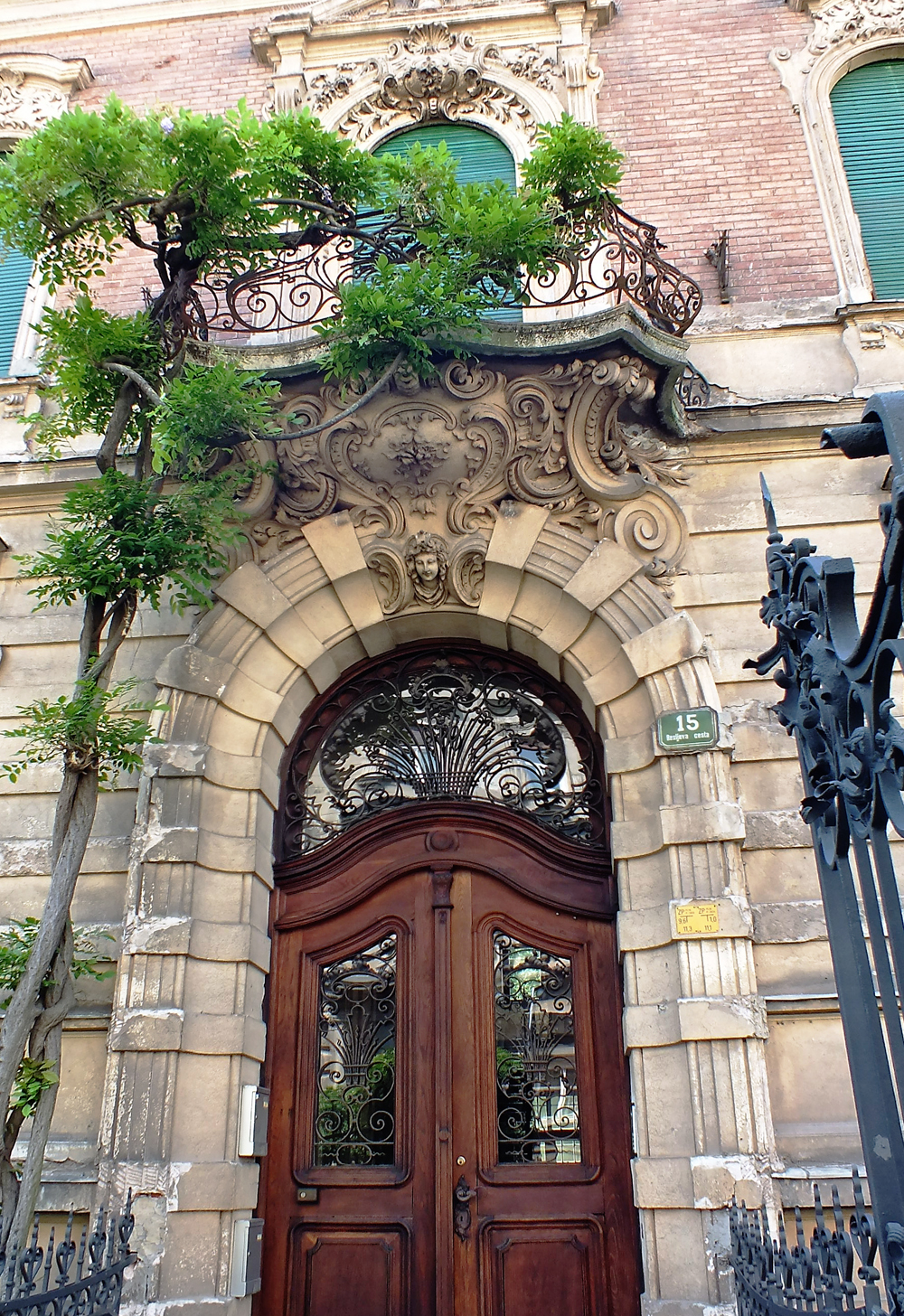
Doorway

A grey-haired woman in the booth gave us directions to a house nearby with a room to let. When we reached the address we looked up at the multi-storey building in dismay. Its concrete façade was black in the rain and the huge solid door seemed quite forbidding. Jon raised the heavy brass knocker shaped like a fish and let it fall. The noise was like a gunshot and startled me. After an interminable while we heard the sound of a key being turned in the lock and the door slowly opened. A diminutive grey-haired woman dressed in black stood before us, unsmiling. We asked her about a room for the night, speaking hesitantly in German and miming laying our heads on a pillow. A brief movement of her head indicated for us to step inside. As we stood dripping onto the tiled hallway floor we heard her locking the door behind us. I shivered: this did not feel good.

The woman beckoned us to follow her up the wide staircase with intricate wrought-iron balustrades to the second floor where she unlocked a drab brown door and waved us inside. The room was huge with high ceilings and a large sash window on one wall. Despite the size of the window the room was very gloomy mainly due to the still falling rain, but also the furnishings – a very large old-fashioned dark brown wardrobe dominated the main wall, twin metal beds with thin brown blankets faced the window, with a small worn rug between them on the brown linoleum floor. The only decoration was a dull painting of a castle in dark browns and greys in a dark wooden frame. My heart sank – but at least it was dry – and cheap.

Not wanting to go back out into the storm, we heated some soup on our little gas stove glad of the warmth it gave out and then climbed into our sleeping bags to keep warm. It was not a great night for sleeping. The rain lashed down onto the windows, which rattled in their sashes. The beds were hard and uncomfortable and someone in the next room had a hacking cough. Eventually an overcast dawn broke through the darkness and we could get up and get on our way. The rain had stopped and a watery sun attempted to shine, but the wind was blowing from the Alps and was tinged with snow. Standing at the side of the main road to Belgrade we shivered in this grey unwelcoming communist country…

Then was October 1973 and we never did get that lift. By mid afternoon we abandoned our vigil and returned to the station to get a train through to the capital city of Belgrade and on into sunny Greece. Neither of us wanted to spend another damp, cold night in Ljubljana.

cafe culture

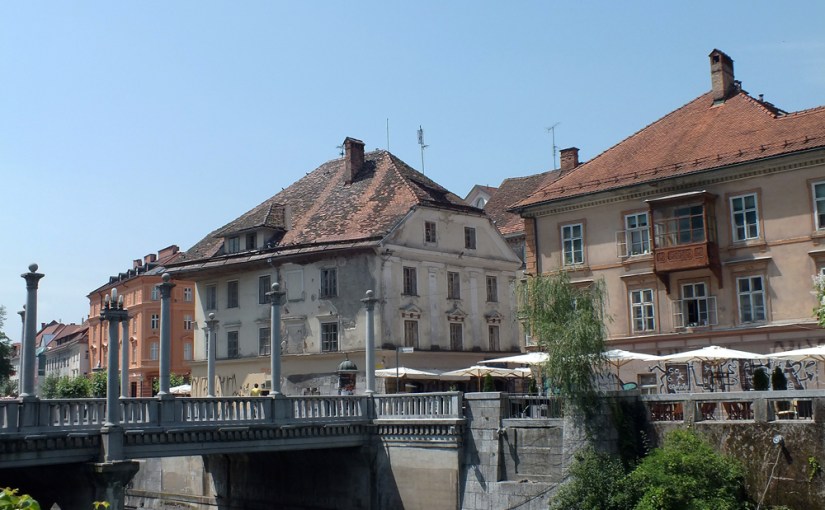
Now is June 2012: a cloudless azure blue sky, the sun caressing my skin and the light so bright it makes my eyes hurt. Walking into the centre of the city I find it to be filled with charming cobbled squares, baroque churches and brightly decorated art nouveau architecture. It is vibrant with pavement cafés lining the riverside and young people sit and drink their coffee and beer. A lot has changed in this region in the intervening years – Yugoslavia is no more and Ljubljana is now the young capital city of Slovenia and even the station got a face-lift in 1980 and the only grey-haired lady appears to be me!
Life is cheap in Africa

Born into the family of a civil servant in the affluent suburbs of Salisbury, Southern Rhodesia he was a middle child and as such suffered from middle child syndrome. Squeezed in the middle unsure of his niche in the world, he became a loner.  As a young man he was drafted into the artillery in the Rhodesian army where he learned that having a beer or three helped him overcome his shyness. He was once chased by an angry hippo and had to hide in a tree until it forgot about him. He never knew before how fast a hippo could move. He rolled his first car and arrived bloody and disorientated on the doorstep of a young white woman who probably saved his life. He gained a third eye.

Drifting south from his land-locked country he found himself in Cape Town where he had not one, but two oceans to play in. He learned to sail. He dreamed of taking his boat, the Jenny Wren, across the Atlantic to South America in the Cape to Rio race.  He was a romantic dreamer.

He married in haste and divorced just as quickly. He started a new love affair with cheap red wine and a young abandoned mother. He had a brief sojourn to Europe where he soaked up the history of the ancient Greeks and Romans, but was less impressed with the Britons. He missed the warmth of the African sun on his face and returned with a new wife and child. His return to South Africa coincided with Mugabe being given his country through the Lancaster House Agreement. His country changed its name and the place where he was born no longer existed.

A few years later Mugabe took away his birthright and he became very bitter about the loss of his beautiful country. His manic drinking consumed his life and slowly, but surely, his friendships died. He hit a blue period and the bottle took away his job, his wife and his children. He almost sank without a trace, but fate wasn’t ready to release him yet.

With nothing left he abandoned the coast and retreated to a  family farm close to his elderly parents and tried to restore his fragile health by meditating under the fragrant orange trees and reading tomes about alternative religions. Sipping gins on the terrace he cast aside his other dreams and headed once more for the city of gold, though there was nothing particularly golden about his life there. Work filled his day and most of his nights as he battled with depression and the meaning of life.

The local township inched closer and closer to his boundaries with marauding bandits breaking in to his house – again and again. Disturbing one such person he was shot in the lung whilst giving chase. An inch away from puncturing his heart. With the surviving lung he dragged his lifeline out of the corridors of the hospital to have a cigarette, even though this resulted in a paroxysm of coughing.

By now the drinking had stopped. He had realised that there was no future in the bottom of a bottle, if indeed he had a future at all. Smoking was much harder to give up and with only one lung, breathing. not to mention life, was becoming a struggle. In the country everything rose – bills, food, petrol, crime. Everything that is except for his salary.

Then on a late summer’s evening whilst in the kitchen feeding his beloved Ridgebacks, something good to come out of Rhodesia, his luck finally ran out. A round of bullets sprayed through the window hitting him in the chest and killing one dog outright. He slumped to the floor, bleeding profusely and fumbled for his phone to call a neighbour for help.

As he lay dying beside one fatally wounded dog and the other one injured, he watched the rest of his life slowly leak away across the kitchen floor, helpless and alone. He was fifty-six.

They took his phone, his computer and a small amount of cash. And his life.

Life is cheap in Africa.

R.I.P. my anti-hero who died 28 February 2006.

Counting the Cost in Camels

Iranian / Afghani border @ Maschhad / Herat – November 1973

Having failed to reach the border in time (it closed at 6 pm) we found ourselves spending the night in a huge warehouse on the outskirts of Maschhad, Iran. I was amused to see an Australian couple roll out their rather large and lovely Persian carpet to sleep on. Goodness knows whether they ever managed to get it back to Oz.

Early in the morning we caught a bus to the border where we had to walk through no man’s land to the other side where we could catch an Afghan bus to Herat. It took hours to get through the border. The bored Afghani border guards were very keen to have some fun by offering to buy some of the females amongst us with anything from cash to camels!

Although in my head I knew (well hoped) that these border officials would not do anything illegal, I have to confess to being slightly worried at their comments. When half a dozen men with thick beards and black piercing eyes surround you, you begin to feel uncomfortable. When these same men are holding Kalashnikovs and sabres in sheaths at their sides you start to feel even more vulnerable and when one of them grins at you and strokes your hair with the end of his machine gun, you become decidedly jumpy. If he really fancied you for a ‘wife’ what could any of the dozen or so westerners actually do to prevent him?

Smiling inanely at the guards (I did not wish to offend) I handed over my precious blue British passport to be stamped. The man behind the desk looked at me for what seemed like hours studying my face and then the photograph. I tried not to feel embarrassed, but could feel the heat rising from my cheeks. He spoke aside to his colleagues who also looked at me and grinned fiercely. I have no idea what they were saying, but I knew I was blushing. Suddenly the main guy pointed at me and said,

Thirty five camels

his face breaking into a huge grin showing black and broken teeth amongst the mass of facial hair. Was he really suggesting that my travelling friend sold me in exchange for nasty, smelly, spitting camels?

My friend coughed nervously. He shook his head before glancing at me to gauge my reaction. I frowned – was I being undersold? Was he even serious?

Fifty camels then, a very good deal

I raised my eyebrows. How far was he prepared to go? The guard closest to me stroked my hair once again, grinning mindlessly and I was beginning to wish I had covered it as it seemed to be attracting too much attention. I was definitely not keen on this machine gun at my temple.

Eventually sensing my discomfort the main man stamped and handed me my passport back. Still grinning he asked my companion if he would accept the fifty camels. Uncertain of giving the right answer and not wanting to cause offence to me or the guards, he kept his gaze on the floor and muttered that he really didn’t need any camels. I held my tongue even though I was starting to feel quite annoyed. Eventually, roaring with laughter at our embarrassment, the guard shook his head and beckoned us to leave the room which we did in haste.

To this day I still wonder whether fifty camels was an insult or an honour.

Windhoek Warning: A hard lesson to learn

We were forced into a stopover in the Namibian capital of Windhoek due to a change in our flights back to the UK and we had hoped it would be a nice experience to add to our two weeks in South Africa. It was indeed a memorable visit – but for all the wrong reasons.

Our stay started badly as the pre-booked and pre-paid transfer shuttle from the airport to our accommodation did not arrive and the man at the airport information desk would not phone the company for us unless we paid him R10. Eventually after several phone calls back and forth, a driver from a tour company gave us a lift to our accommodation, Villa Verdi Guesthouse. Our second disaster was that instead of the luxury double room I had booked we were given a large apartment right on the road and next to two villas where very noisy parties were taking place (this being Saturday night). The apartment was dingy, cold, dark with little furniture and very unwelcoming, plus it had hard single beds with worn sheets, no bedside tables, no luxury shower, and no fluffy towels. The whole place needed a good clean too. It was also isolated from the rest of the complex and felt very insecure as a result. I was not happy and after eating second-rate food at a first-rate price on a cold open-air patio I was already regretting not extending our holiday in Cape Town.

The next day I insisted that we changed rooms, and got the “luxury double” that we’d paid for. A comfortable double bed, side tables with lamps, a spa bath and a walk in shower – much more like it, but still the thin worn towels! After this we walked into town, only about 10 minutes away, though it felt very unnerving as cars passed hooting at us and the locals gave us very odd looks. We walked to the Tourist Information Centre, only to find it closed, so headed uphill to have a look at the Christuskirche and the Parliament buildings. There were a few other tourists around, though mostly in groups and on tour buses. But it was broad daylight, sunny and a Sunday and although we didn’t see many other white people, we didn’t feel particularly vulnerable. We really should have known better.

After wandering over to the Bahnhof we decided to walk up Anderson Street to the water tower, where, according to the “Windhoek on Foot” guide, you get a fantastic view over the whole of the city. Unfortunately we got rather more than that. As we approached the scone shaped water tower, which is only minutes away from a residential district with people mowing their lawns, two black men strolled out of the bush in front of us. My stomach did flips as I acknowledged that we were on an isolated stretch of the road and I glanced backwards at my husband who was photographing the city sights. The tallest, biggest man approached me and muttered something under his breath, as I looked at him and asked “what?” he grabbed my wrist and muttered the word I had been dreading, “money”; without waiting for a reply he grabbed the straps of my rucksack and began to drag it off my shoulder. The other, smaller man went for my husband and began punching him and trying to pull off his camera and money bag.

Without going into too much detail, we were well and truly “mugged” and the worst of it was that for the first time during the holiday we hadn’t taken our usual precautions when venturing out. Every day in South Africa we had carefully allocated around R100 each, carried only one credit card between us, and carried very little in the way of valuables. Of course in South Africa we’d also had a hire car so didn’t need to walk anywhere except where it was reasonably safe. Fortunately we had left one credit card, our passports and a camera back at the villa. Unfortunately we were carrying both mobile phones, a camera, camcorder and all the rest of our cash as we’d not unpacked properly after the flight from Cape Town.

Immediately we retraced our steps to the police station which was no more than five minutes away. The police woman taking my statement seemed rather bored and inconvenienced. She was not concerned about any injuries we might have had, she didn’t offer to help us back to the villa and she didn’t offer us the details of the British Consulate. Although the incident had only just occurred it was obvious that she wasn’t going to send out a patrol car to see if there was any sign of the thieves. On top of that she couldn’t even provide me with a copy of my report, necessary for insurance purposes, as the room with the photocopier in was locked on a weekend! My husband and I were both bruised and badly shaken, but had to walk back to the villa as we had no means of getting back any other way. Contacting the British High Commission in the evening I spoke with a very kind lady who was the only person to express concern about the event. She was shocked that this had happened in broad daylight, though said it was a notorious trouble spot in the evening – a pity the guide-book didn’t mention this fact. Her theory was that Namibia was being overrun by refugees from Zimbabwe and as a consequence the petty crime rate was escalating.

Although this incident happened in 2008 I feel it might serve as a useful reminder to those travellers who may be heading to Southern Africa. Do not walk anywhere, even in broad daylight, without making sure the area you are walking in is completely safe. Even in affluent residential areas it is easy to find yourself isolated within minutes, as we were. My best advice is to check with staff at your hotel or villa, or call the consulate and find out if there are any no-go areas and always take taxis even if the route looks safe and the distance is short.

I love Africa, I have lived in South Africa and I have travelled throughout Namibia in a group – but this incident shocked me as I had thought we’d taken sufficient care. I can only say that being at the end of the holiday perhaps we let our guard down – an unfortunate way to end what had up to then been a fantastic experience. And a hard lesson to learn.