Although we didn’t manage to see all of the beautiful gardens we tried our best! Here are a few more photos from the estate.
The Castle and outer moat and mazeA closer view – if you click on this image you might be able to make out the topiary chess set on the far right in the Tudor GardenOne of the towers and the inner moatCastle from the opposite side and topiaryShady area close to Anne Boleyn’s Walk – and the festival theatreRhododendrons and AzaleasThe Blue Corner – The plants are concentrated around huge rocks and steps leading to Sisters’ Pool Lawn and include blue hydrangeas, ceanothus and blue seasonal perennials.Hundreds of tulips in the border leading to the Two Sister’s Lawn and PoolRose Garden – best in June to SeptemberRose Garden – best in June to SeptemberSome of the lovely flowers in early MayThe Edwardian boathouseThe 38 acre lake, the brainchild of William Waldorf Astor, was excavated and constructed by 800 men who were contracted in December 1904 to “carry on the works regularly and continuously by day and night (except on Sundays) when so ordered” and complete the work in two years! The lake was filled in July 1906.
It takes about an hour to walk around the lake and you might just make out the Japanese Tea House folly on the left-hand side. There is also a water maze too. The boats and pedalos are available for hire on Weekends and Bank Holidays from Saturday 5 April 2025 and daily during school holidays. You can also take a 20 minute trip on the Lady Astor steam boat which you can just make out to the right of the photo above.
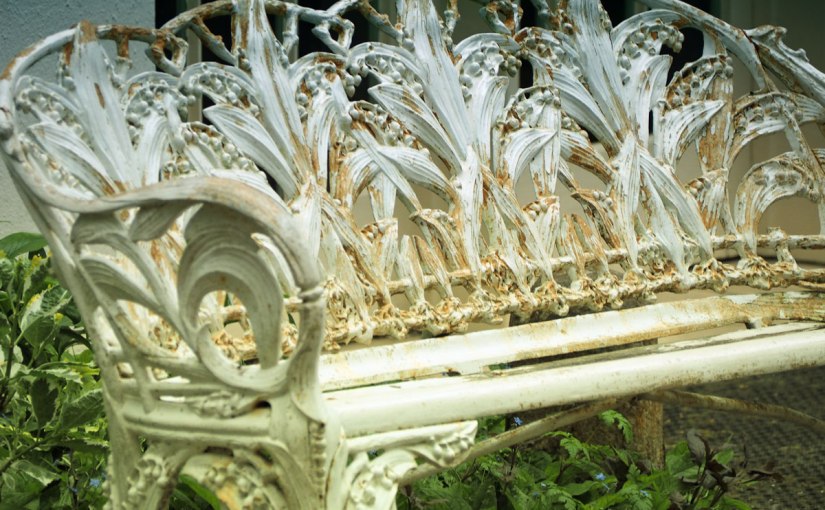
Way back in 2015 – yes that really is ten years ago – I decided to post photos of the numerous benches sitting in my folders. It seemed that I was not alone and suddenly it turned into the Bench Challenge where I set a particular criterion each month and people joined in posting their bench photos. It was a lot of fun and I met a lot of wonderful bloggers through it.
A bench among the Azaleas in Isabella’s Plantation, Richmond Park, Surrey.
This year I am returning to mark the occasion by posting a bench photo every Sunday. There will not be any particular theme set this year so it’s not really much of a challenge, but if there is anyone out there who still has a bucketful of bench photos and would like to join me, then please do so by adding a link in the comments or a link to my post in yours (a pingback) and I will happily pop along to admire.
Whilst in Surrey over the early Spring Bank Holiday, I suggested that my daughter and I had a day out visiting Hever Castle and Gardens in Kent. It was a hot day so we didn’t have enough energy to stroll around the lake, nor did we visit the Tudor Garden with the topiary chess set! Two good reasons to return.
Dating back to the 14th century, Hever Castle was once the childhood home of Anne Boleyn, second wife of Henry VIII and Mother of Elizabeth I. It is well worth a visit especially of you are interested in Tudor history.
But for this post I am only exploring the beautiful gardens which were laid out between 1904 and 1908 by Joseph Cheal and Son. Until William Waldorf Astor bought Hever Castle in 1903, only a modest garden existed around the castle walls. One of the most magnificent areas of the gardens is the Italian Garden, which was designed to display William Waldorf Astor’s collection of Italian sculptures.
The impressive Loggia at the lake end of the garden is flanked by pillared colonnades and descends by balustrade steps to the piazza below with its classical sculpture inspired by the Trevi Fountain in Rome.The Italian Garden. Covering four acres, the long sweeping lawns and tall clipped yew hedges form the central area of this magnificent garden, bordered by two twelve foot high walls made from local stone.Along the south side runs the Pergola Walk with its shaded grottoes planted with ferns and moisture loving plants.Pergola WalkItalianate sculptureEntrance to the Pergola Walk and the Italian Garden with the stunning golden gatesOn the north side is the Pompeiian Wall which contains small bays showcasing antiquities in stone and marble enveloped with shrubs and climbing plants.Italianate sculptures and antiquities
In one of the recessed baysPompeiian WallHidden in the centre of the Italian Garden behind a tall hedge lies the Sunken Garden, an oasis of peace and quiet.Sunken GardenAt the beginning of May the gardens were full of tulips, irises and wisteria. The planting is stunning and there is so much to see. Far more than I can possibly put in one post.And to end, a glimpse of the lake from the Pavilion courtyard.
Then there is the Rose Garden, the setting for over 5,000 roses which flourish from June until the end of September. Yet one more reason to return.
Way back in 2015 – yes that really is ten years ago – I decided to post photos of the numerous benches sitting in my folders. It seemed that I was not alone and suddenly it turned into the Bench Challenge where I set a particular criterion each month and people joined in posting their bench photos. It was a lot of fun and I met a lot of wonderful bloggers through it.
Greenway – Agatha Christie’s holiday home in south Devon. Among the woodland ransoms and bluebells
This year I am returning to mark the occasion by posting a bench photo every Sunday. There will not be any particular theme set this year so it’s not really much of a challenge, but if there is anyone out there who still has a bucketful of bench photos and would like to join me, then please do so by adding a link in the comments or a link to my post in yours (a pingback) and I will happily pop along to admire.