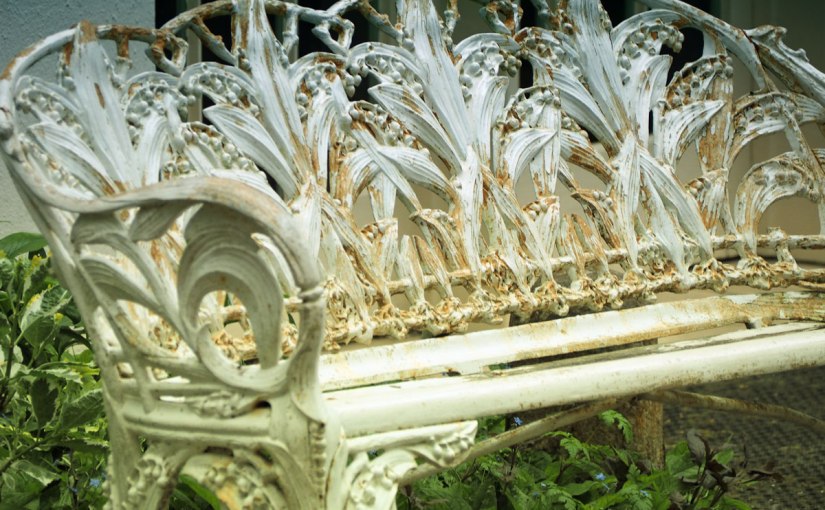
Way back in 2015 – yes that really is ten years ago – I decided to post photos of the numerous benches sitting in my folders. It seemed that I was not alone and suddenly it turned into the Bench Challenge where I set a particular criterion each month and people joined in posting their bench photos. It was a lot of fun and I met a lot of wonderful bloggers through it.
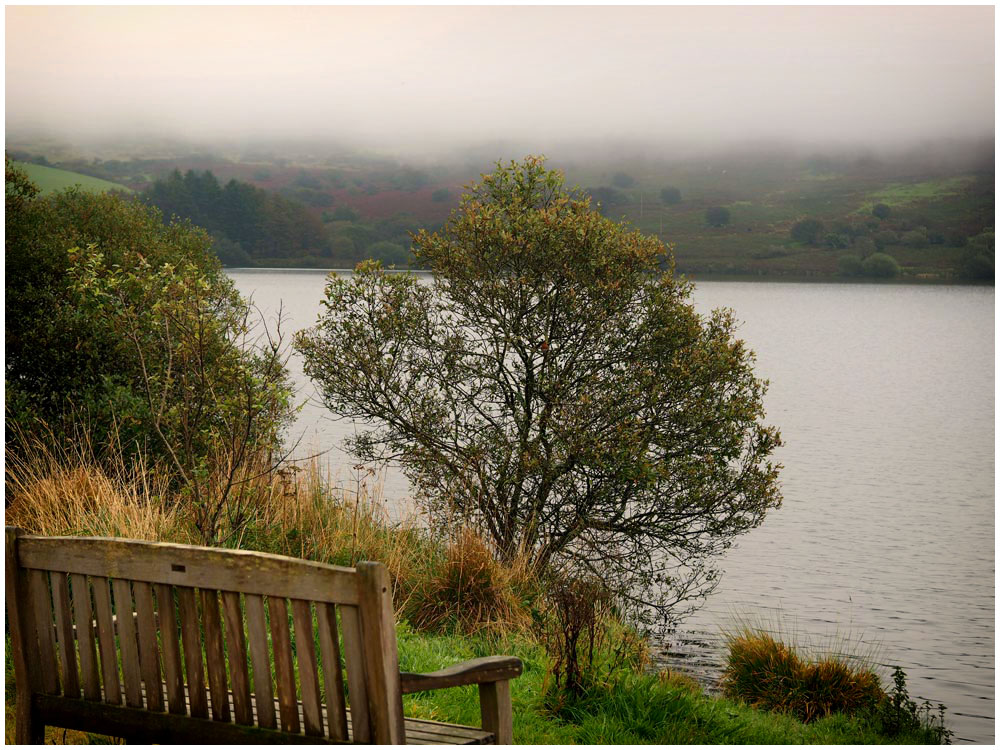
In the mist – somewhere in the Lake District Bodmin Moor (Siblyback Lake)
This year I am returning to mark the occasion by posting a bench photo every Sunday. There will not be any particular theme set this year so it’s not really much of a challenge, but if there is anyone out there who still has a bucketful of bench photos and would like to join me, then please do so by adding a link in the comments or a link to my post in yours (a pingback) and I will happily pop along to admire.
It was the largest stained glass project ever executed and has some of the finest Victorian stained glass in the country, produced by the leading company of the time: Clayton and Bell. The scheme has three big themes: the Trinity, Biblical stories and the history of the English church. Alongside these are three lesser themes: Cornwall, baptism and St Mary’s aisle.
There is a recommended route, so that the interrelationships between the windows in each part of the Scheme can be explored, but of course I hadn’t realised that. Now that I do it may be a good reason to return to the cathedral and be more observant.
The rose windows
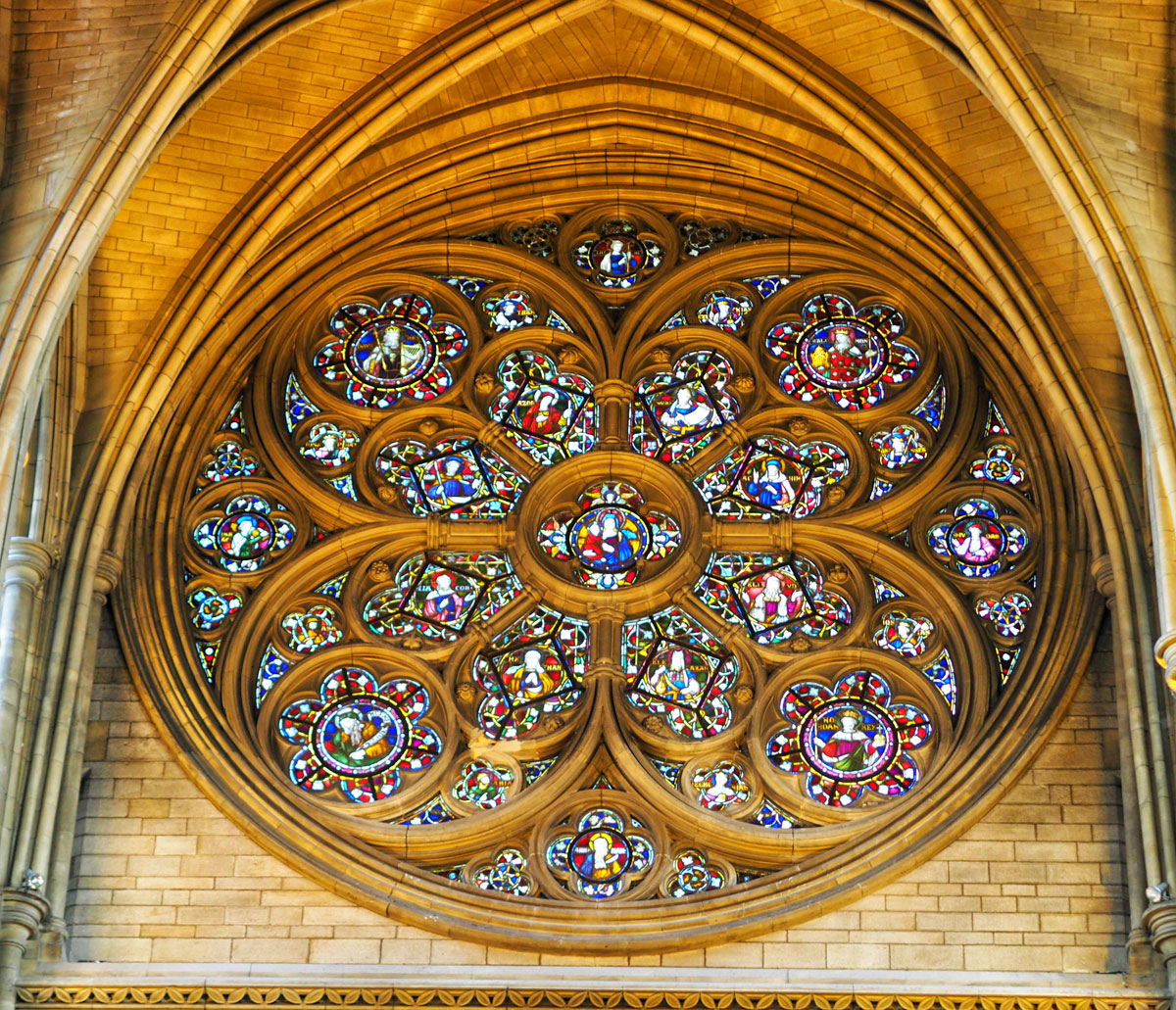
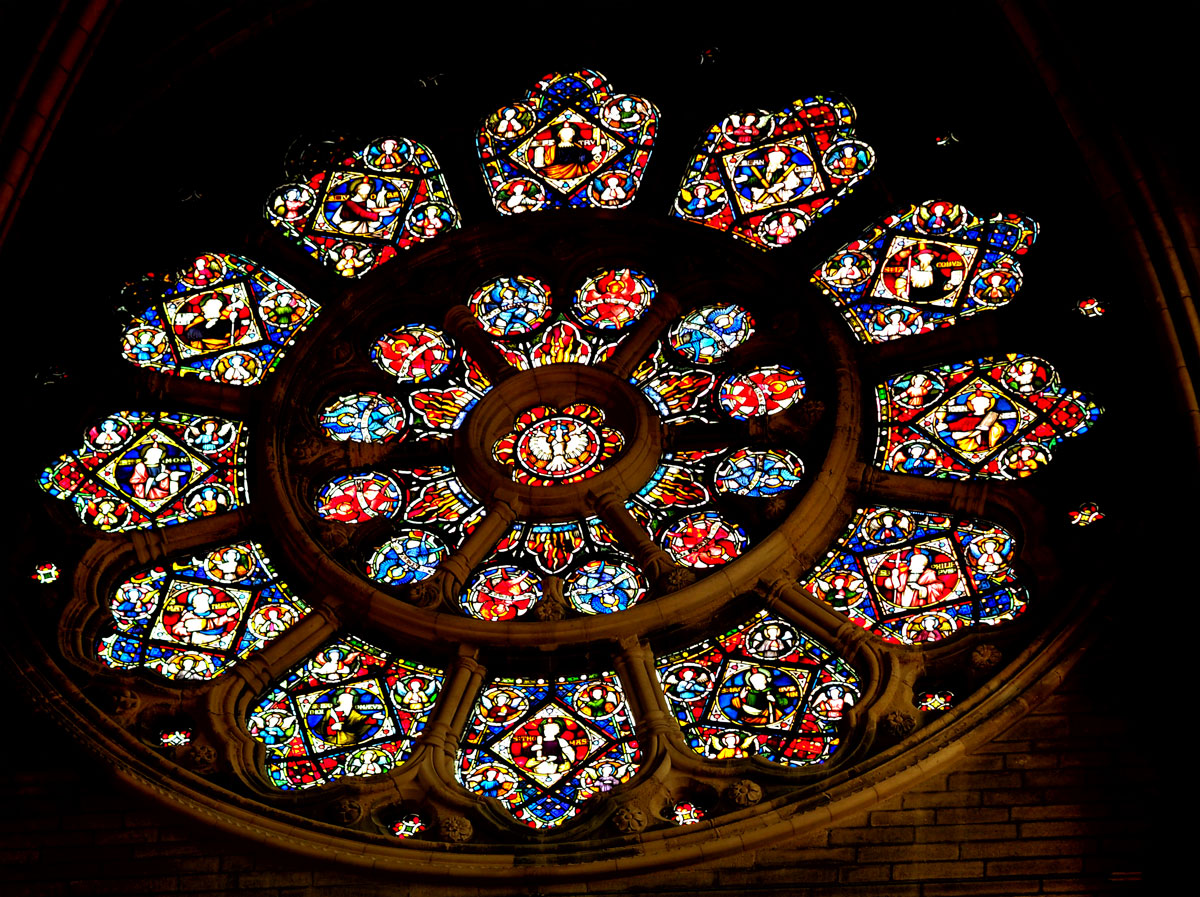
The greatest windows are the three great rose windows which reflect the Trinity;
God the Father/Creator appears in the great West window which is divided into seven sections for the seven days of creation
West window
Jesus, the Son of God, is at the heart of the North transept rose surrounded by the prophets and his antecedents: Jacob, Isaac, Judah and Abraham, leading through to Mary and Joseph.
North window
The Holy Spirit is at the centre of the South window with the twelve apostles around the edge.
South window
The biblical stories
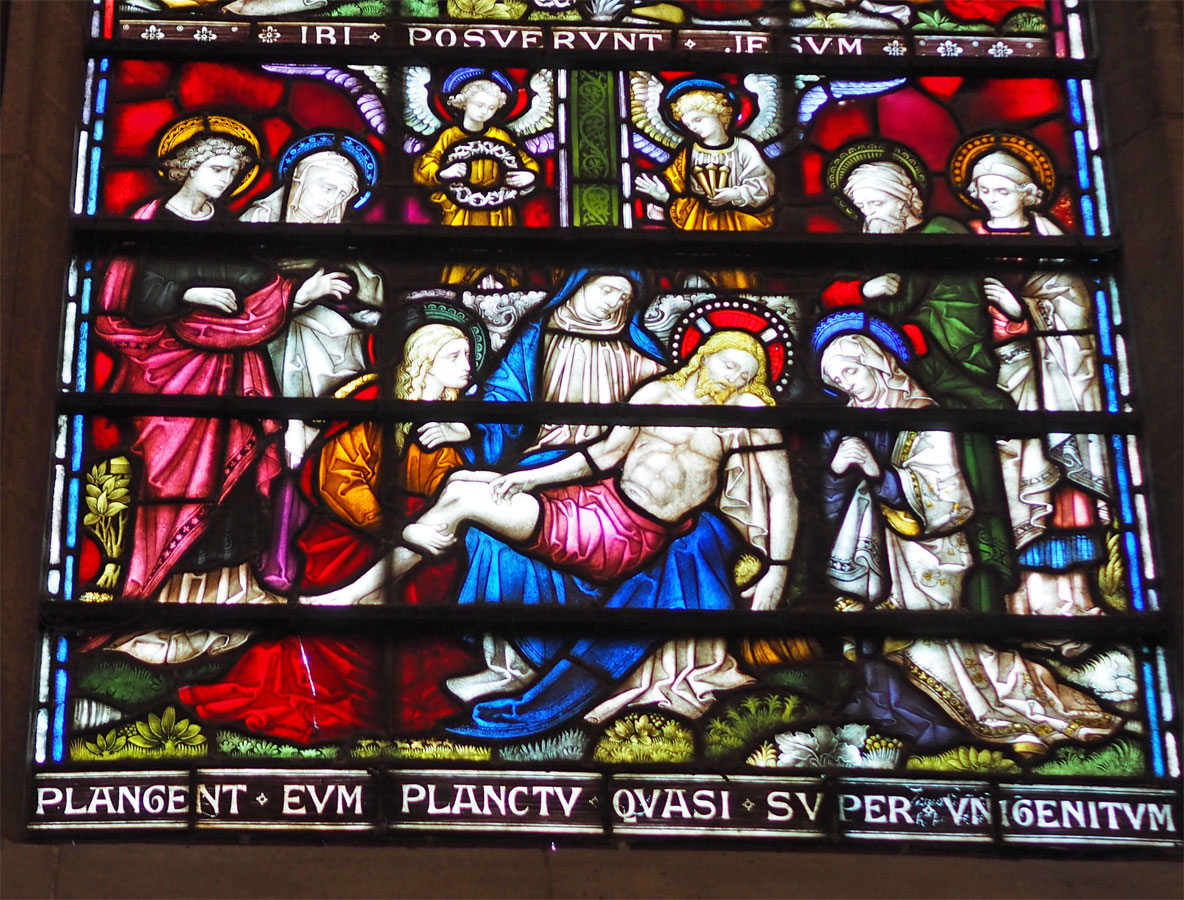
The biblical stories are told in and around the quire. The great east windows tell the story of Christ and his Passion.
The Deposition. The angels at the top hold the Crown of Thorns and the nails with which Jesus was fixed to the Cross
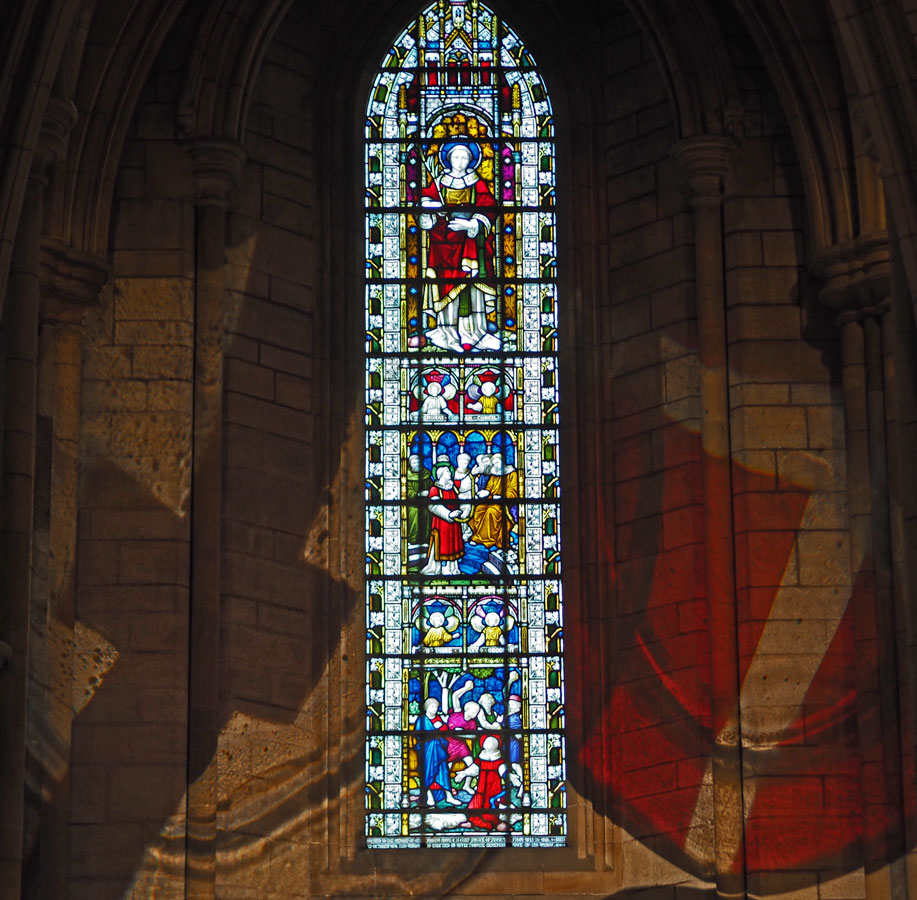
PLANGENT · EVM · PLANCTV · QVASI · SVPER · VNIGENITVM (They shall mourn for him, as one mourneth for his only son) (Zechariah 12:10).St Stephen. From top to bottom: St Stephen holding, in his left hand, a Gospel Book and, in his right, a martyr’s palm frond; He makes a speech before the Sanhedrin; Sub imbre saxeo obdormit (He goes to sleep under a shower of stone); The stoning of St Stephen
St Stephen holding, in his left hand, a Gospel Book and, in his right, a martyr’s palm frond
He makes a speech before the Sanhedrin
The stoning of St Stephen
The history of the church
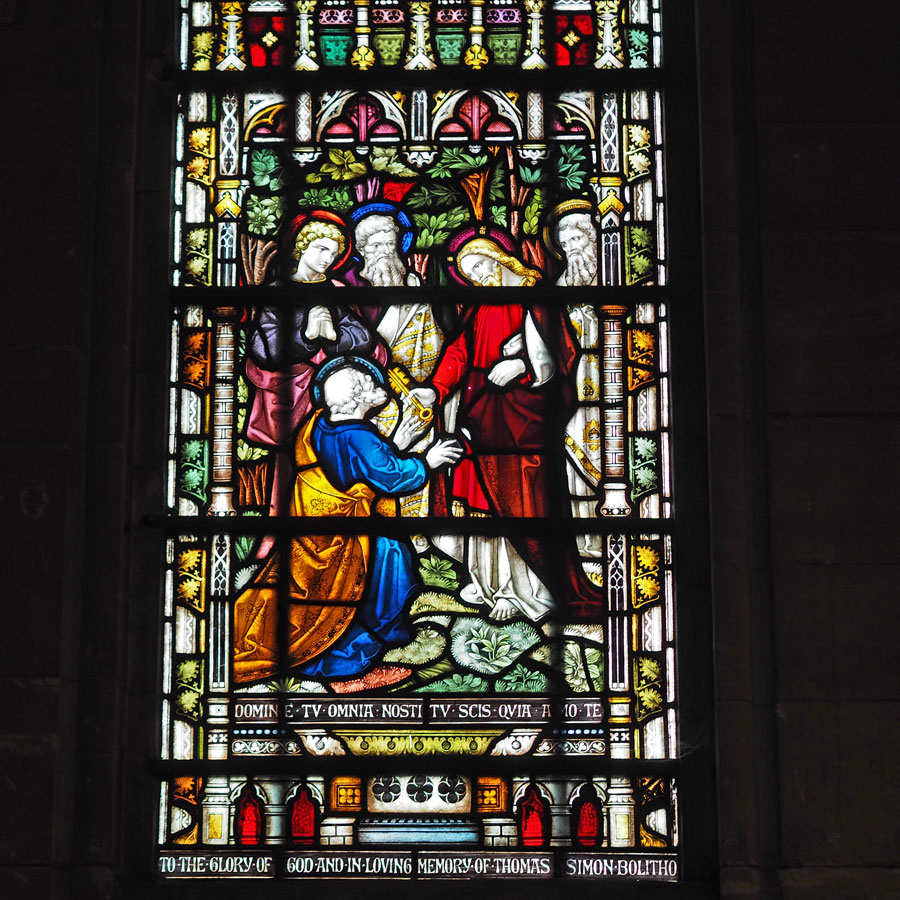
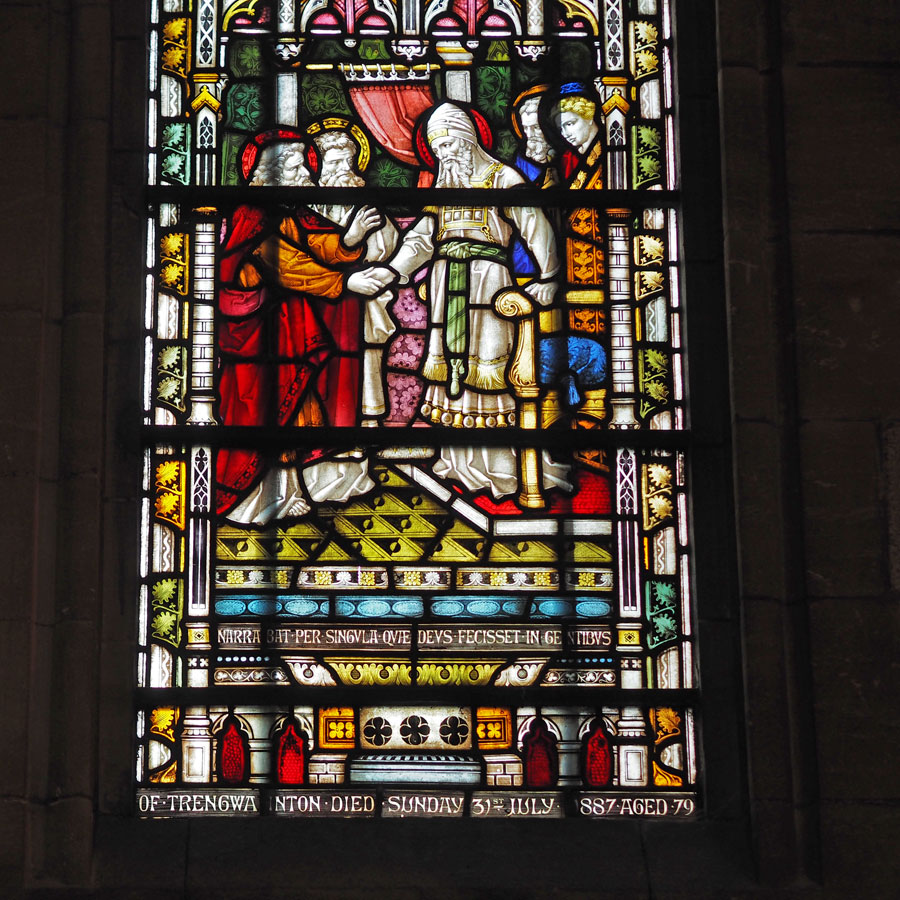
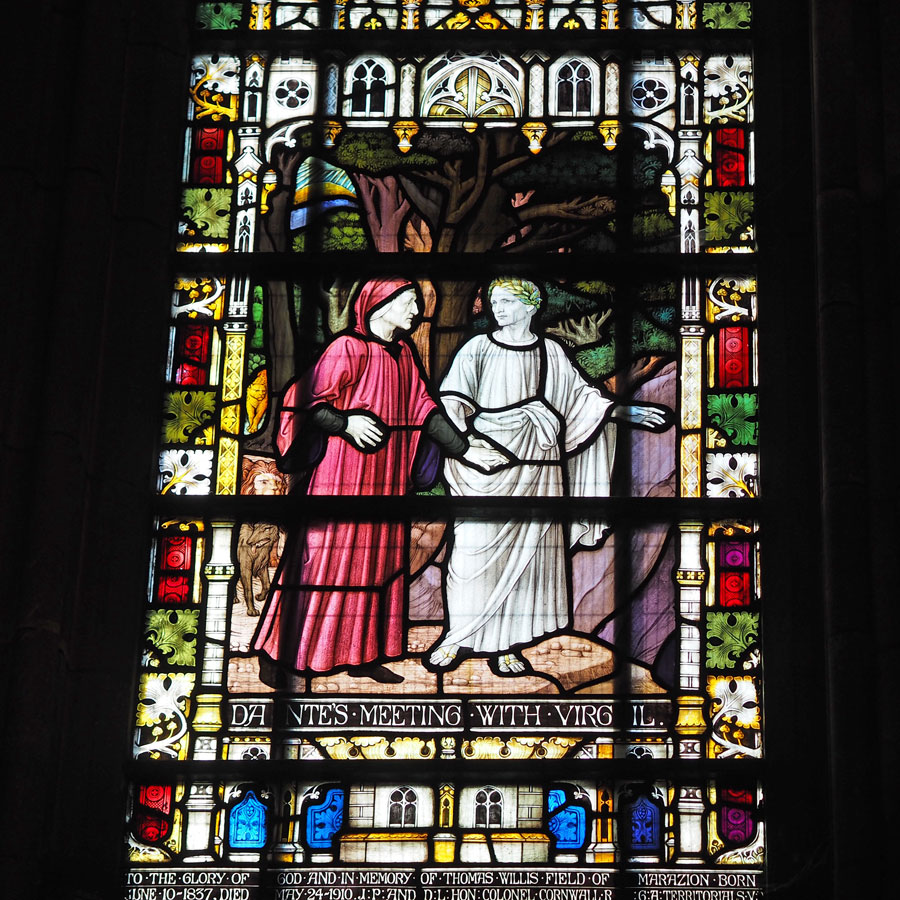
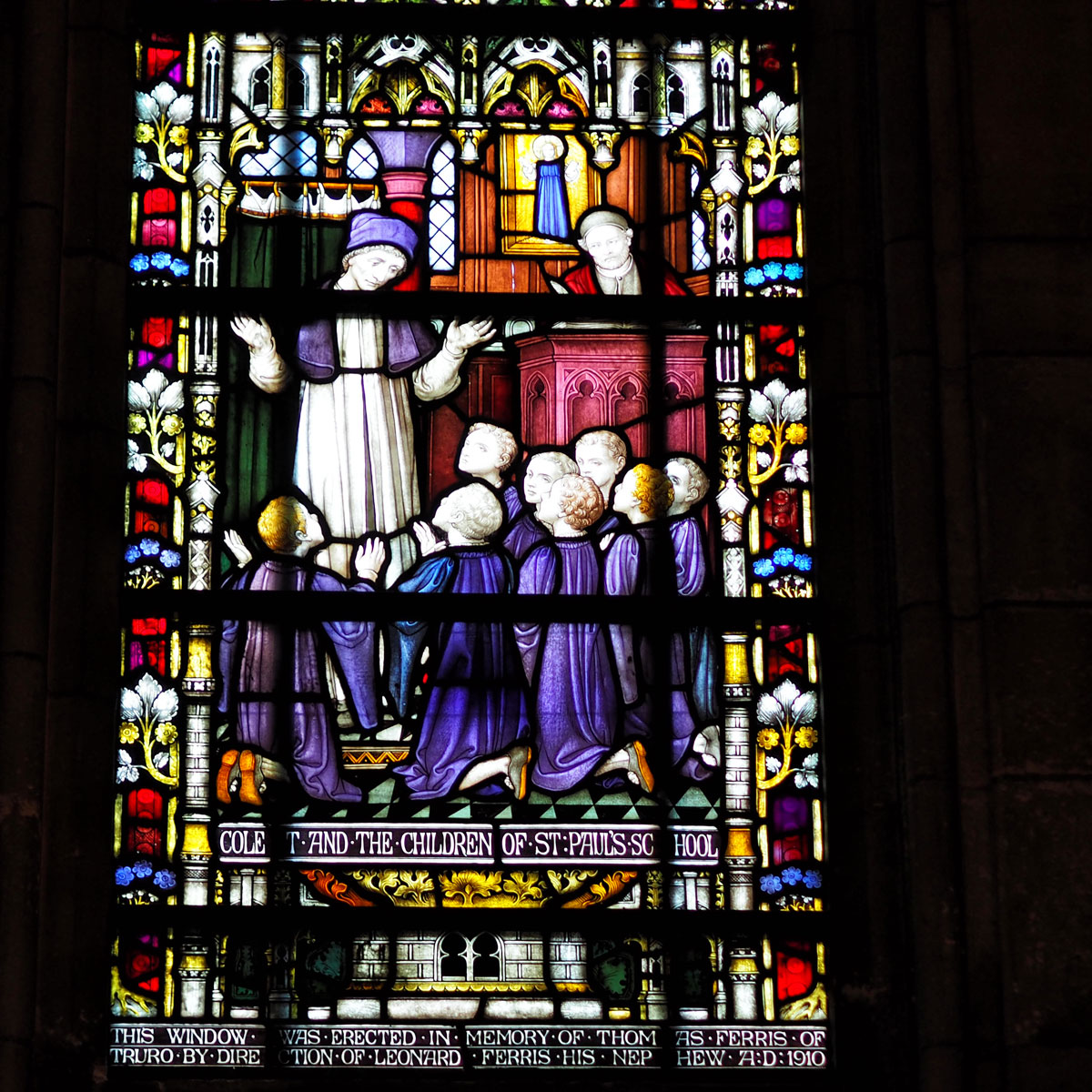
The choices reflect the late Victorian sensibilities and the enthusiasms of the two creators, like, for instance, the execution of King Charles I which I didn’t see. There is a flow to the sequence that does make sense. The theme starts in the South transept through to the retro-quire and quire. This section begins with St Peter receiving the keys from Christ and ends with St Benedict though my photos are rather more random.
Christ gives Peter the keys to the kingdom of Heaven. On the left is the youthful St John.St James the Lesser, Peter and John receive St Paul and St Barnabas at the Council of Jerusalem.The opening scene of the Divina Commedia in which Virgil, in a toga with a laurel wreath on his head, starts to guide Dante on his journey through hell and purgatory. Behind Dante stand a lion, panther and she-wolf.John Colet teaching the boys at St Paul’s Cathedral School in London.
In the foreground are eight boys kneeling and looking at Colet. The scene refers to the end of the preface to the Latin grammar that he wrote for the school: “And lift up your little white hands for me, which prayest for you to God … ” There is a picture of the Child Jesus in the background. In the rear at the High Master’s desk is the celebrated scholar William Lily, the first High Master of the school.
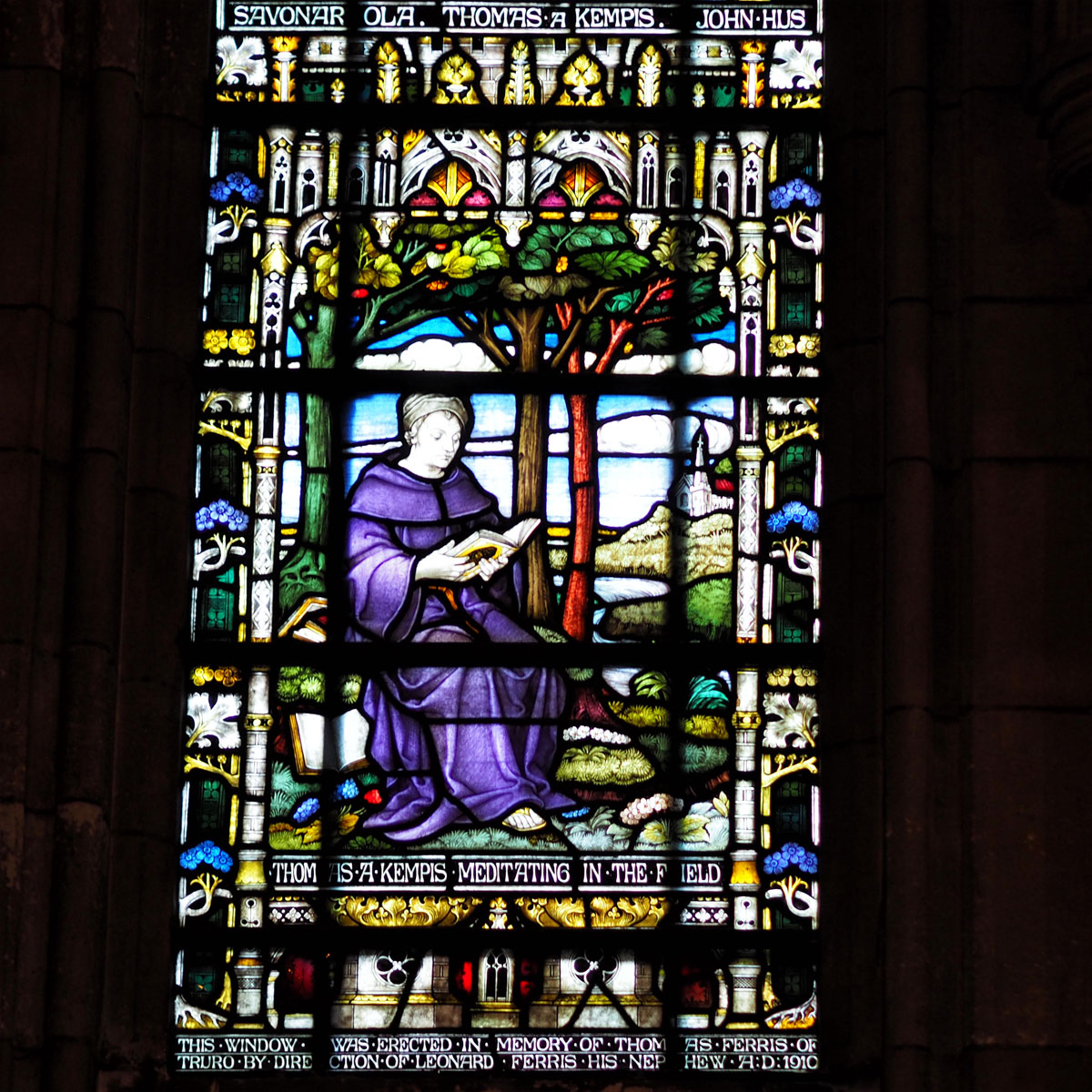
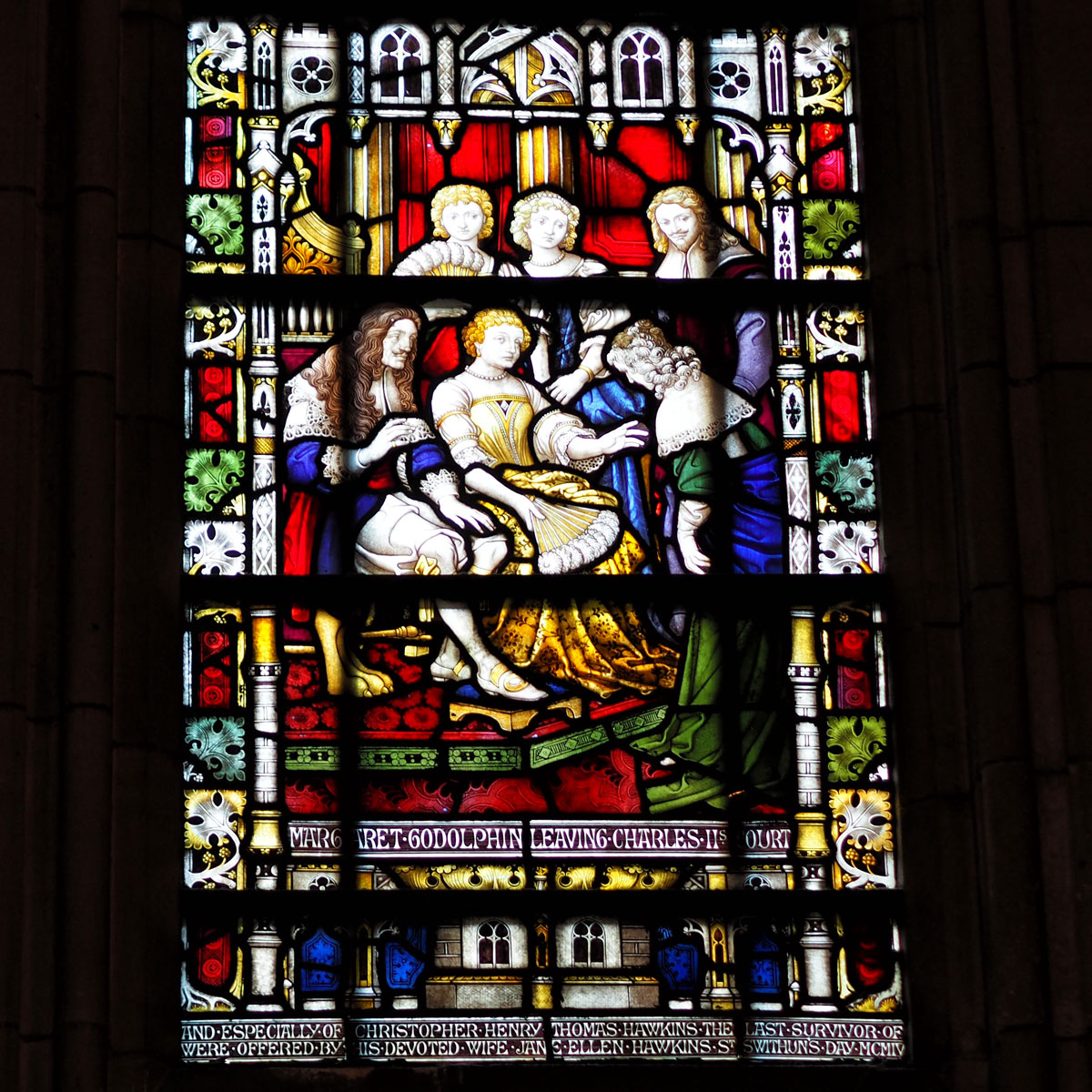
Thomas à Kempis meditating near the monastery of Sint Agnietenberg (Mount St Agnes, shown at the top right) near Zwolle in the Netherlands.Margaret Godolphin on the point of resigning her post at the court. King Charles II and Queen Catherine are seated on a throne on a podium, and Margaret stands below on the right with her head bowed.
Margaret Godolphin, née Blagge, of Godolphin House between Helston and Penzance was a Lady in Waiting to the Queen at the court of Charles II. She was a vigorous opponent of the lax moral tone of the court and resigned her position there in protest. She died in and is buried in Breage Church near Helston.
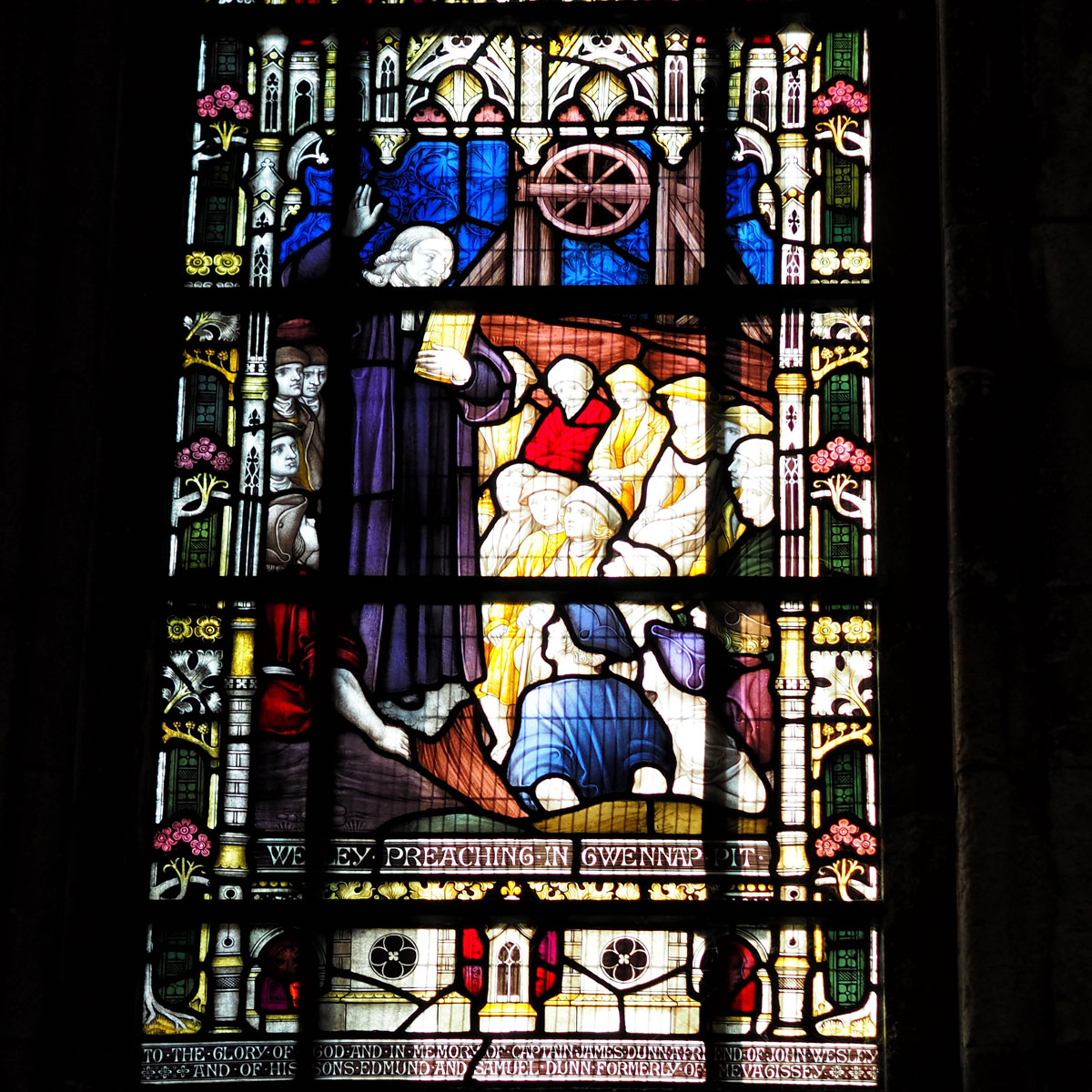
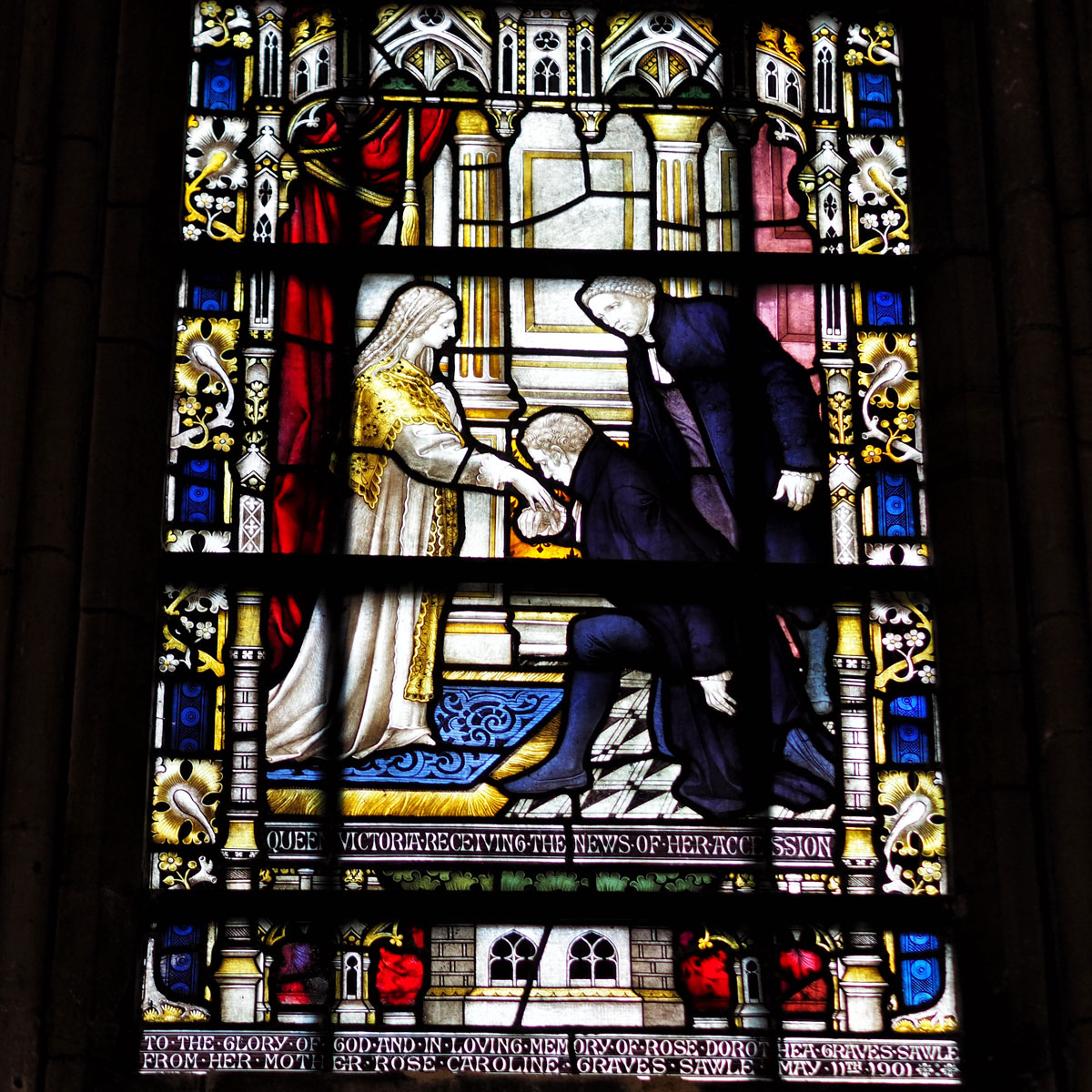
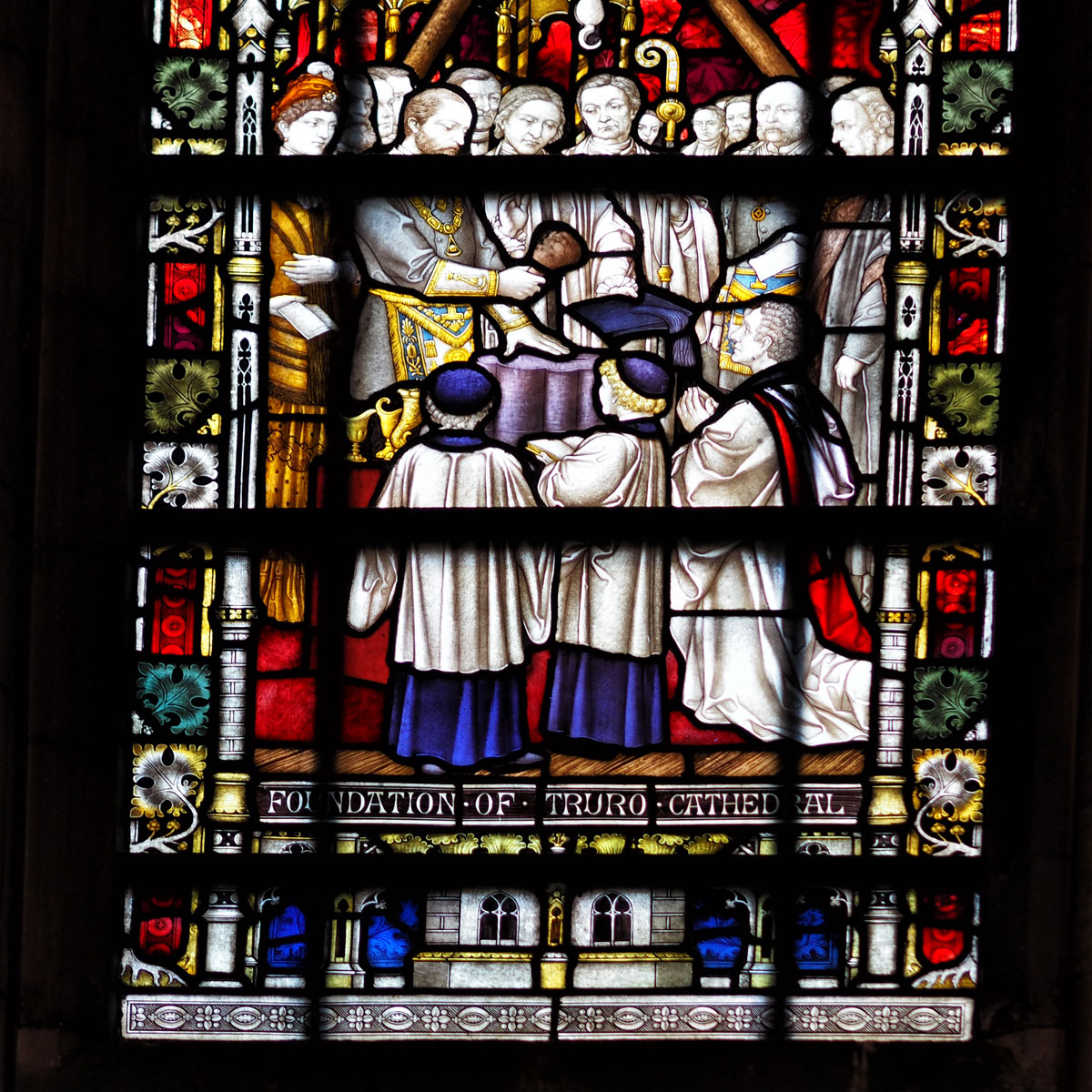
John Wesley preaching to the miners at the famous Gwennap pit near Redruth, the most renowned site for his field preaching in Cornwall. The figure of Wesley is surrounded by eighteen figures of miners and their families. A pit wheel and supports are in the background.Victoria receiving news of her accession on 20th June 1837. In the foreground the young Queen, bareheaded and clothed in a nightdress and shawl, is holding out her right hand to the kneeling figure of Marquess Conyngham, the Lord Chamberlain. Behind Conyngham stands the bowing figure of Dr William Howley, Archbishop of Canterbury from 1828 to 1848Albert Edward, Prince of Wales, lays the Foundation Stone of Truro Cathedral on 20th May 1880.
He is dressed in Masonic regalia and holds a maul. He is surrounded by a number of other figures associated with the occasion and the Cathedral, including the Princess of Wales, John Loughborough Pearson (Architect), Prince George and Prince Albert Victor. The background features scaffolding and other evidence of building work.
The other themes
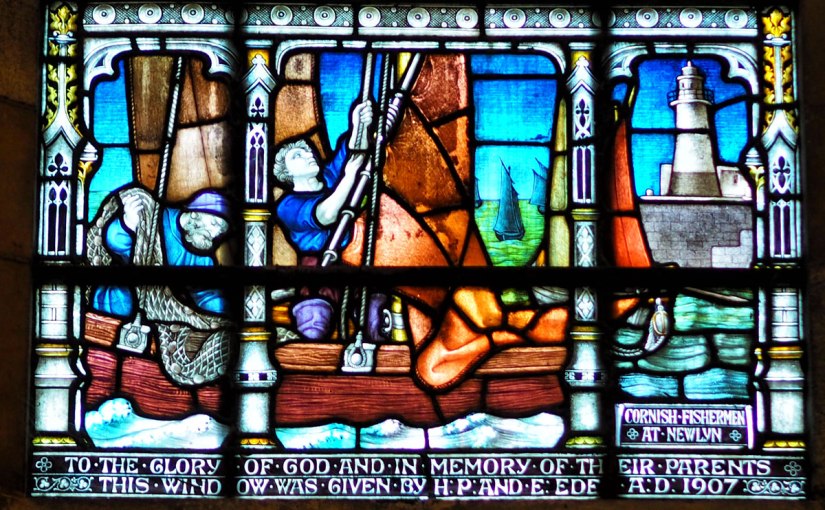
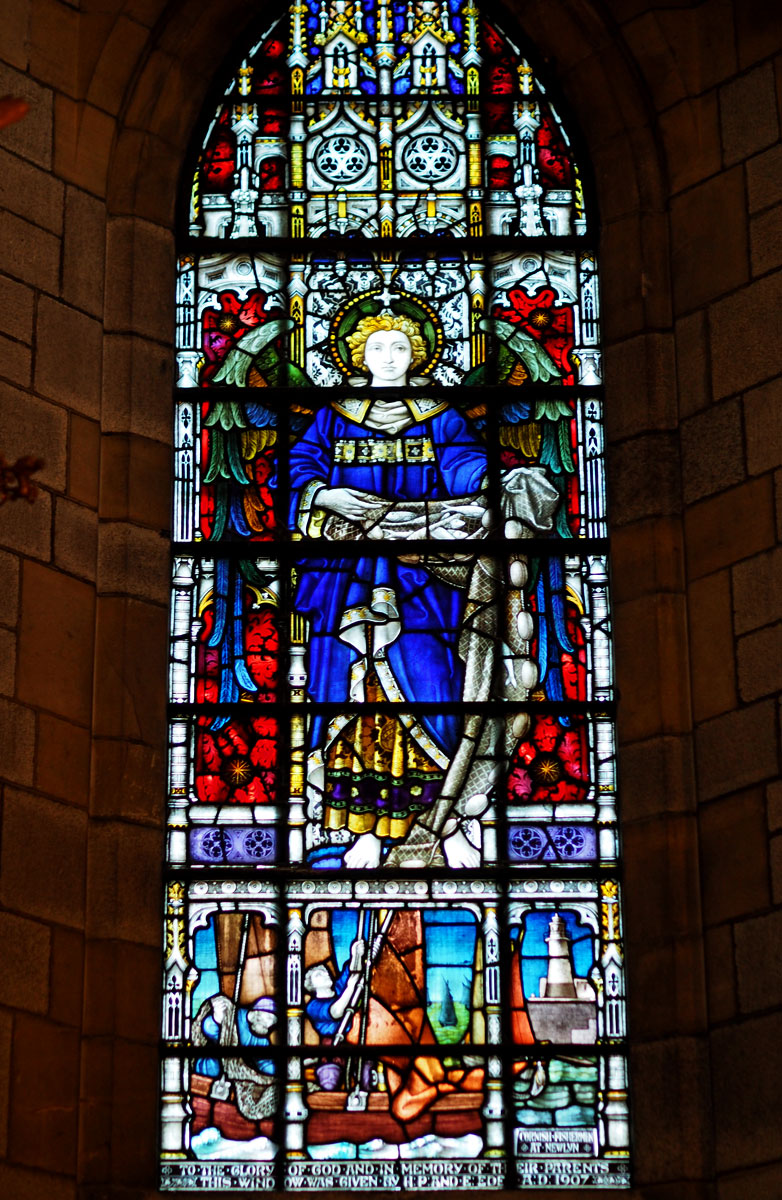
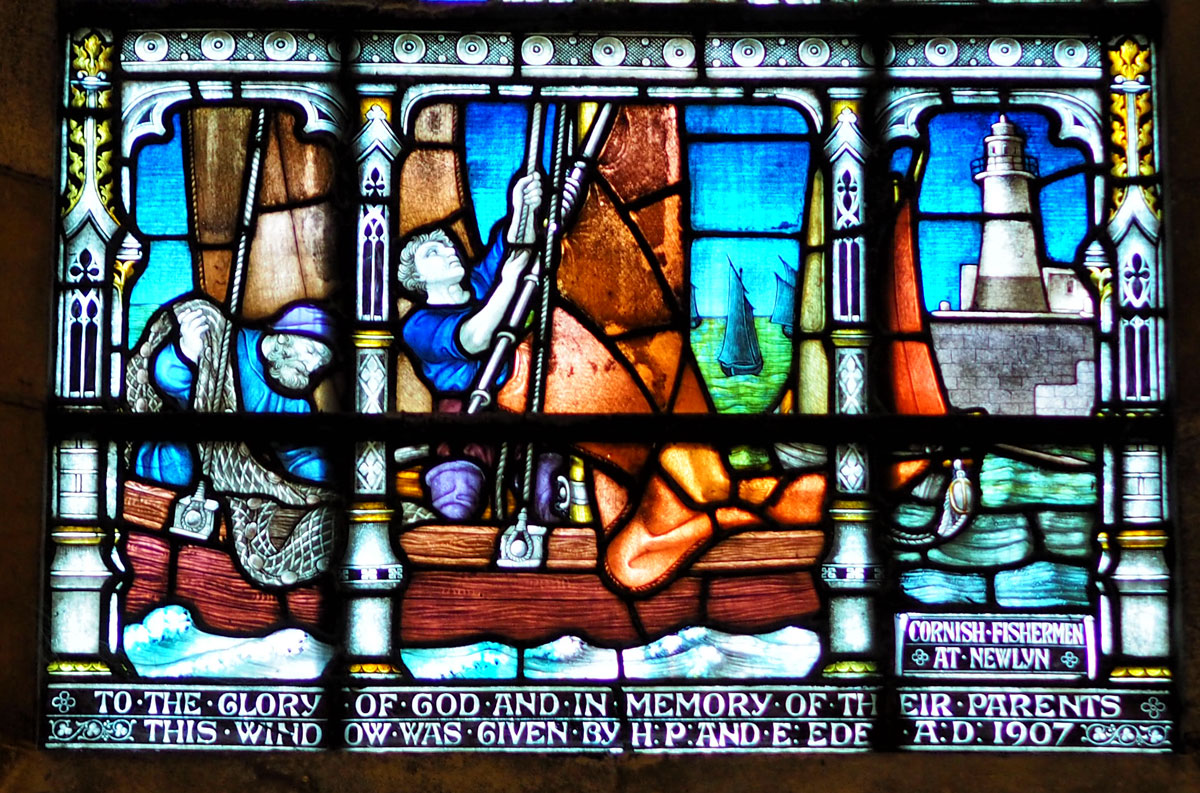
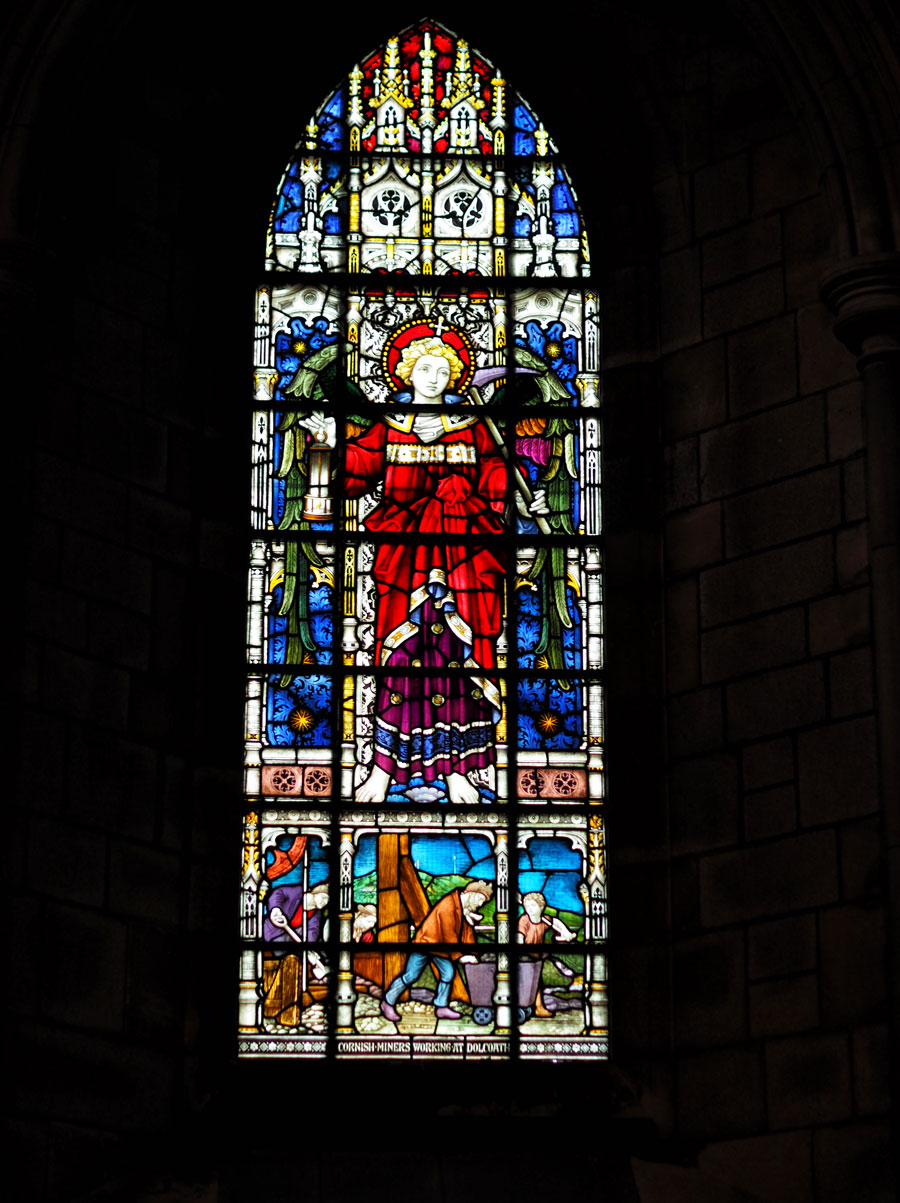
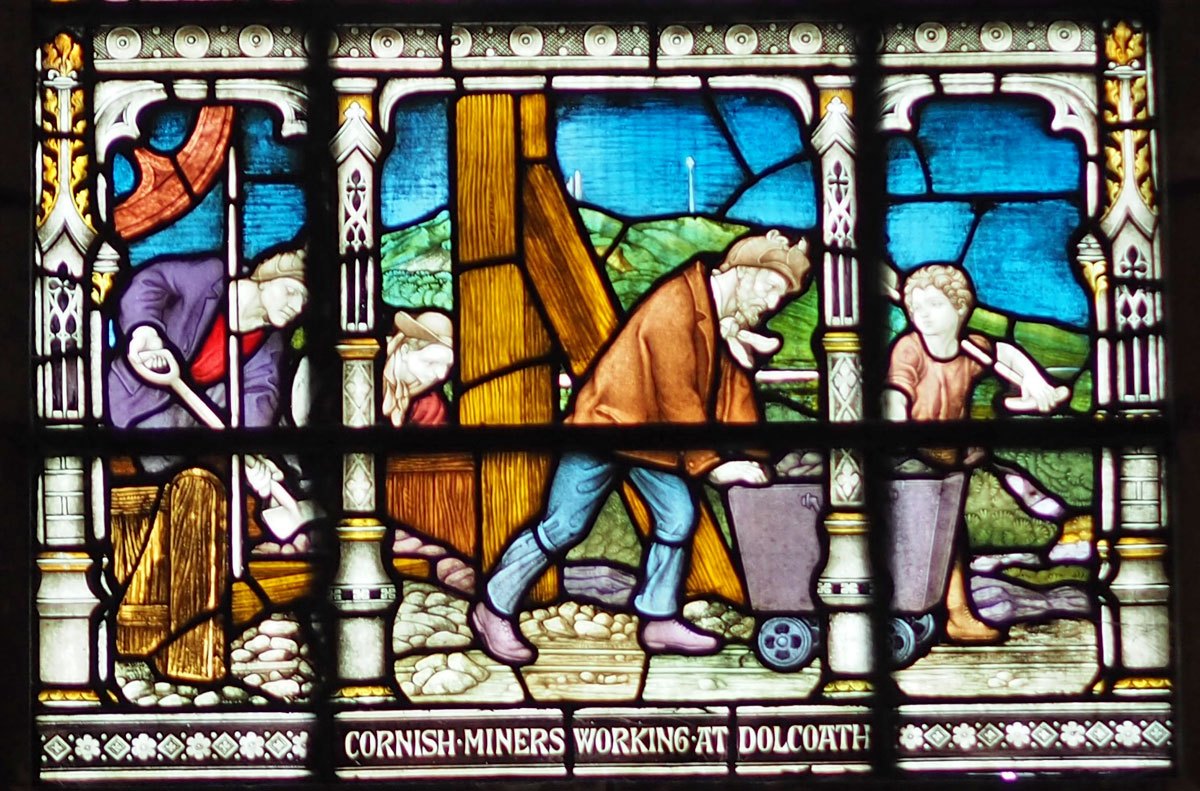
Cornwall’s industry is included in the west nave windows, which feature mining and fishing through images of miners, fishermen, Newlyn harbour and Dolcoath mine.
The guardian angel of fishermen dressed in flowing robes and depicted with long wings, bare feet, and a nimbus with a bejewelled rim. The angel holds a net full of fish with floats.In the foreground is a fishing boat, with an older sailor sorting the fishing net while his younger companion raises the sail. In the distance is a fleet of fishing boats, and to the right is the Newlyn lighthouse and jetty.The guardian angel of miners, dressed in flowing robes and depicted with long wings, bare feet, and a nimbus with a bejewelled rim. The angel holds a miner’s Davy safety lamp in its right hand, and its left hand holds a pickaxe resting against its left shoulder.To the left and centre are the pit head with part of the pit wheel and men working. The hill in the background is Carn Brea; the cross on top of it is a monument to Francis Basset, 1st Baron de Dunstanville and Basset, and to the left are the remains of Carn Brea Castle. The Basset family were the original owners of the mineral rights to Dolcoath mine.
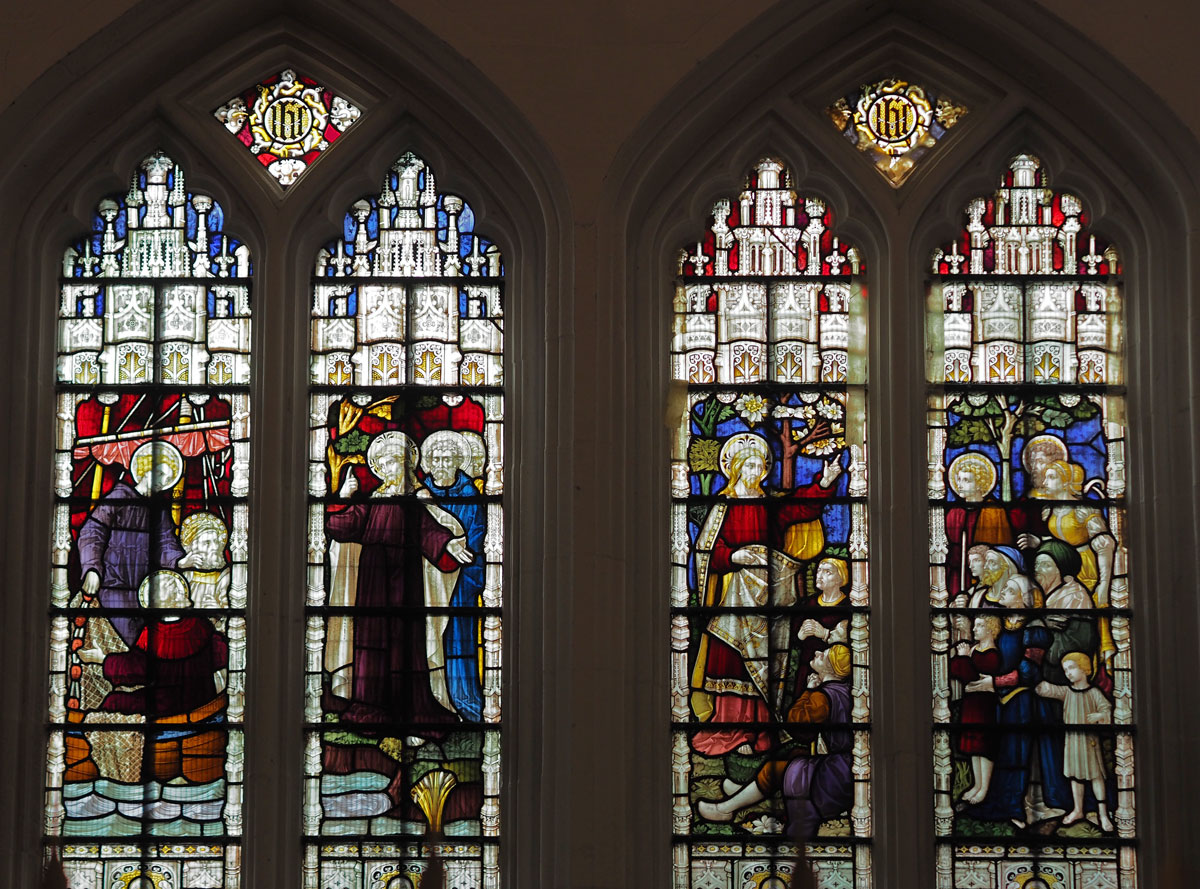
And finally, there are the windows in St Mary’s aisle, which has some mid-Victorian windows from the original St Mary’s church on traditional biblical subjects, as well as some medieval fragments.
On the left: Christ summons James and John, who are in a fishing boat with their father Zebedee. On the right: The Sermon on the Mount.This five-light window is the largest in the south wall of the aisle.
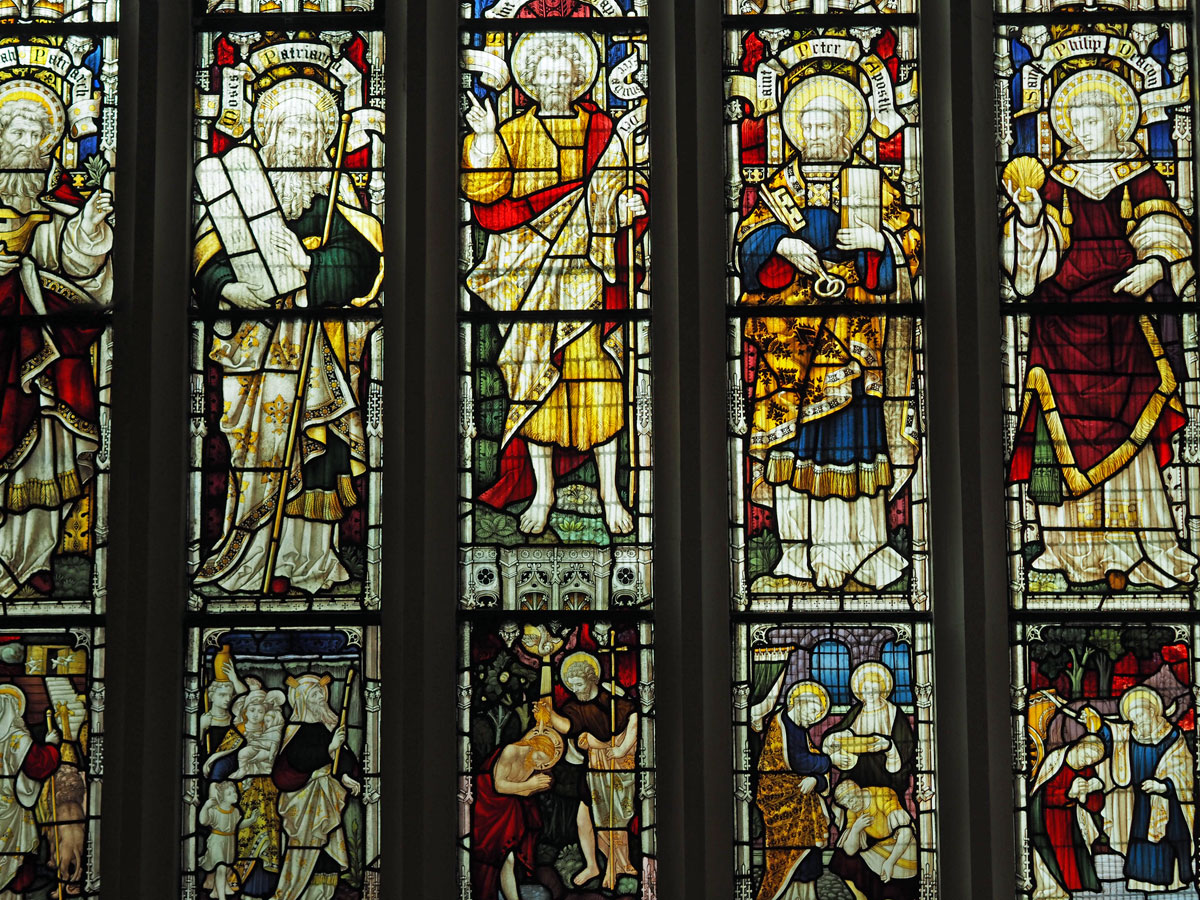
Each light shows a main figure above a related scene, and all are connected by the imagery and symbolism of water. This was, and still is, the baptistry area for the old parish church.
In the first light, Noah, holding a model of the Ark and a leaf to represent the one the dove brought back to the Ark, is placed above a scene with Noah, his wife and sons supervising the entry of the animals (including giraffe and lion) into the Ark. (I appear to have unfortunately cut this one in half).
In the second, Moses is shown carrying the two tablets of the Ten Commandments above a scene in which he leads the Israelites across the Red Sea.
St John the Baptist, holding in his left hand a staff to which is attached a banner on which is written Ecce agnus Dei (Behold the lamb of God) above the scene of the Baptism of Christ.
St Peter holding his keys and a clasped book above a scene of his baptism of Cornelius.
Finally, St Philip holding a scallop shell is shown above a scene of his baptism of the Ethiopian eunuch, whose chariot and horse are in the background.
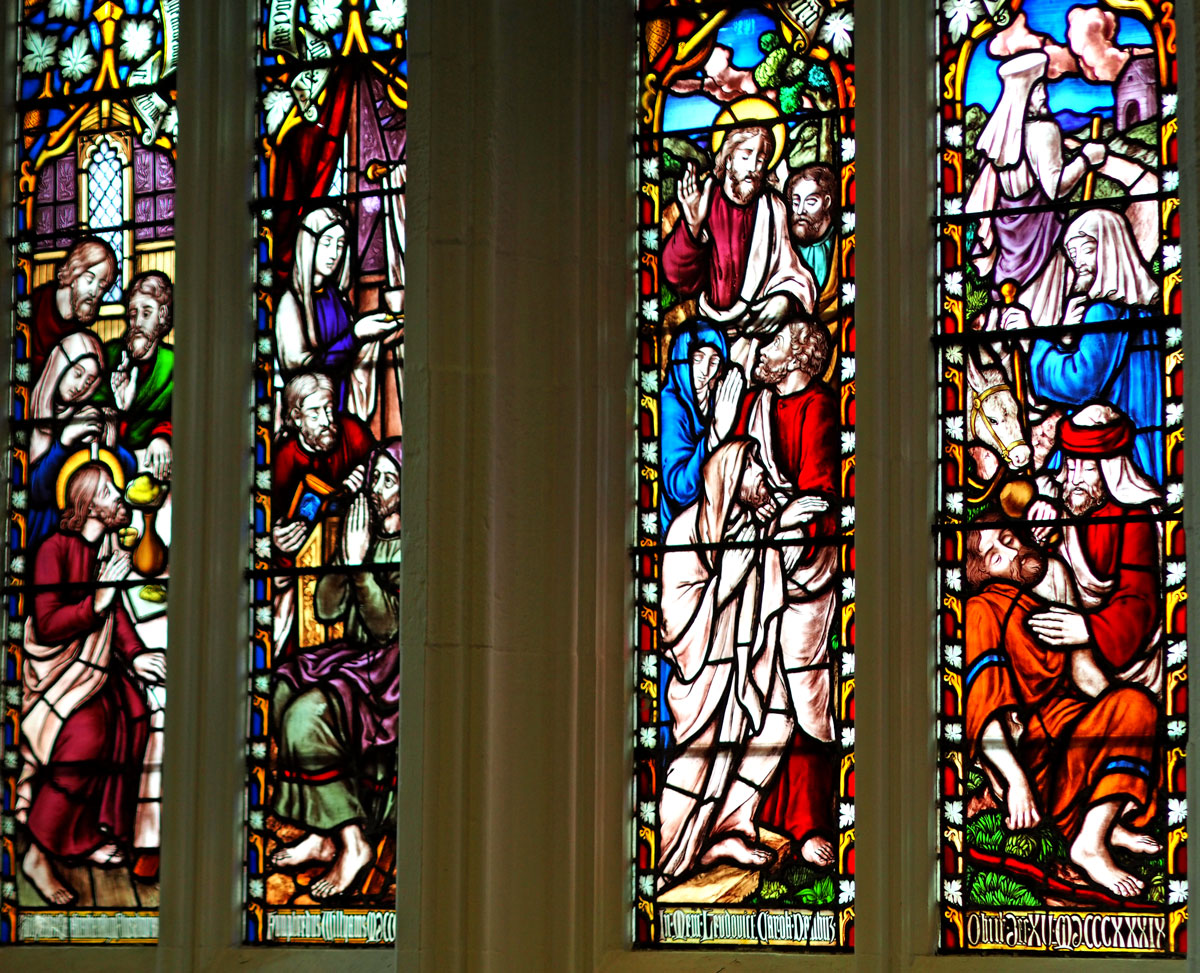
The six south wall windows are all by William Warrington. They are typical examples of his use of bold primary colours, strong leading, dramatic design, and heavy painted shading.
a. The supper at Bethany. Mary, the sister of Martha, anoints Christ. b. Visitation of the sick. c. The Raising of Lazarus. d. The Good Samaritan.
It’s been a long while since I was last in Truro (other than hospital visits) and I never did get around to writing about the cathedral. On my first visit I wasn’t very enthusiastic, but my second was better and I was more interested in looking around. At the time there was some kind of exhibition which was very attractive and which has reminded me that maybe I should make another trip to the city and cathedral.
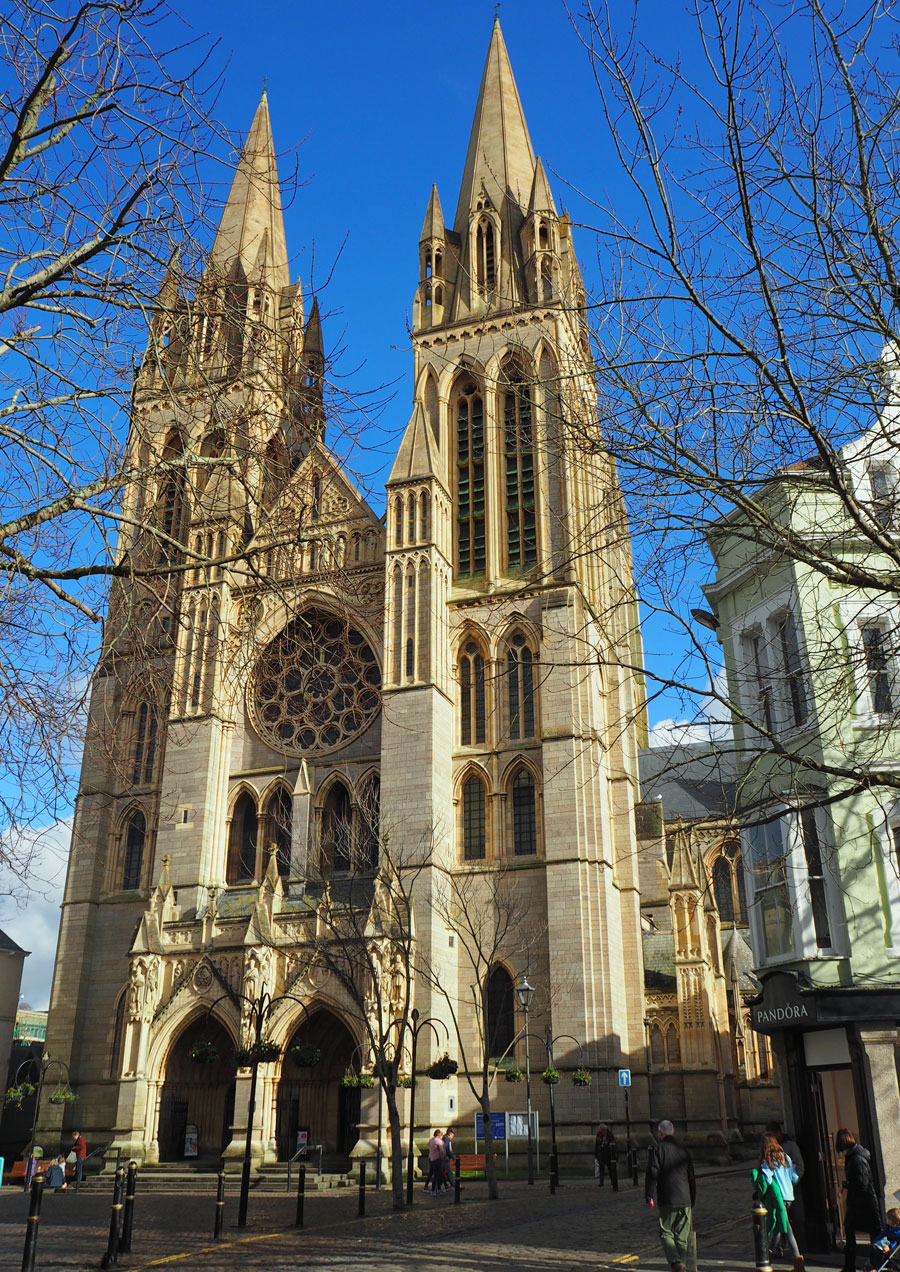
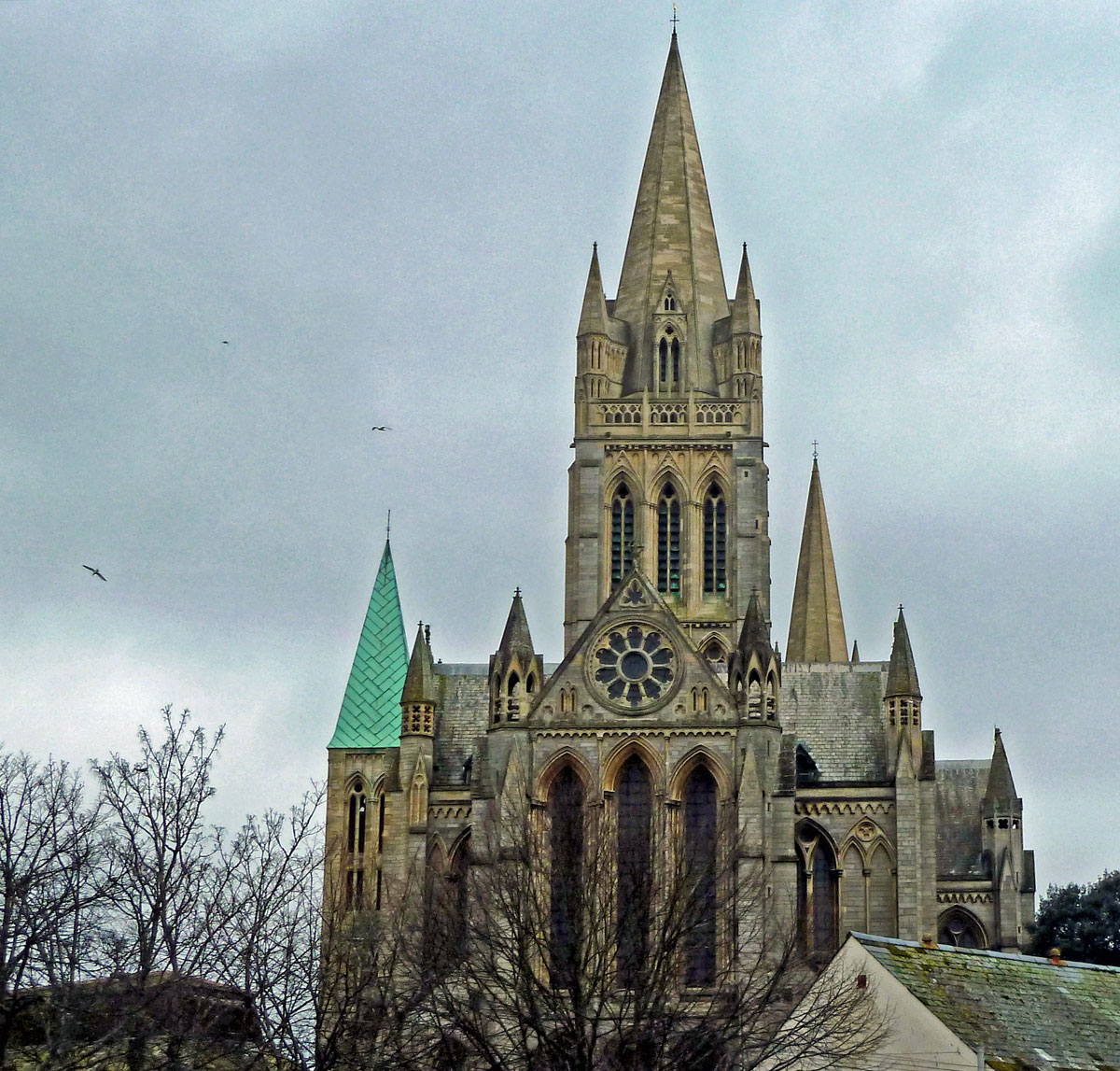
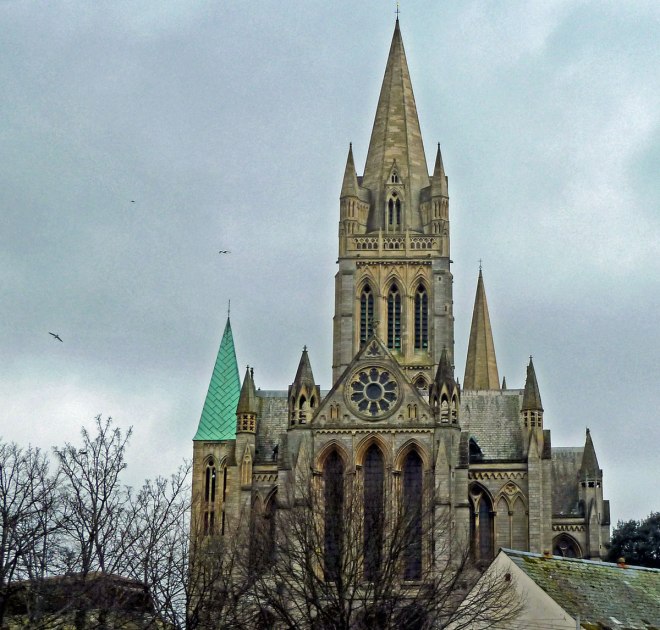
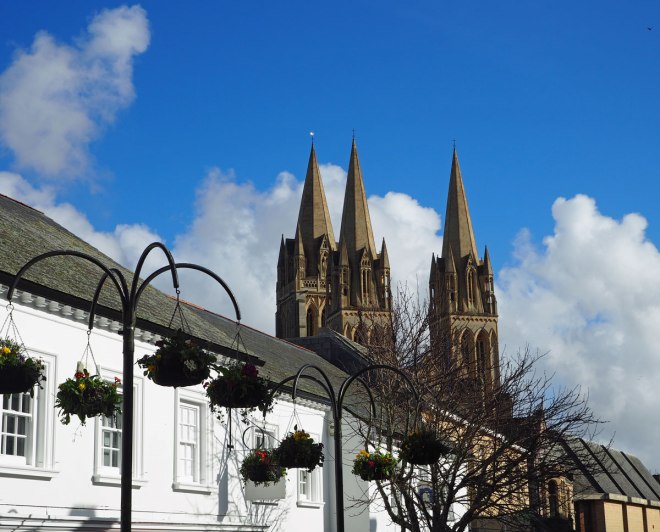
Truro Cathedral is seen as a triumph of Gothic Revival Architecture and its magnificent spires can be seen soaring above the city’s skyline.
Formerly the site of St Mary’s Church, the Cornish Diocese of Truro was formed in 1867 and St Mary’s became the cathedral church. In 1880 the Foundation Stones of the cathedral were laid by Edward, the Prince of Wales, Duke of Cornwall. Work started on the cathedral under John Loughborough Pearson. Truro would be the first Anglican cathedral to be built on a new site since Salisbury Cathedral in 1220.
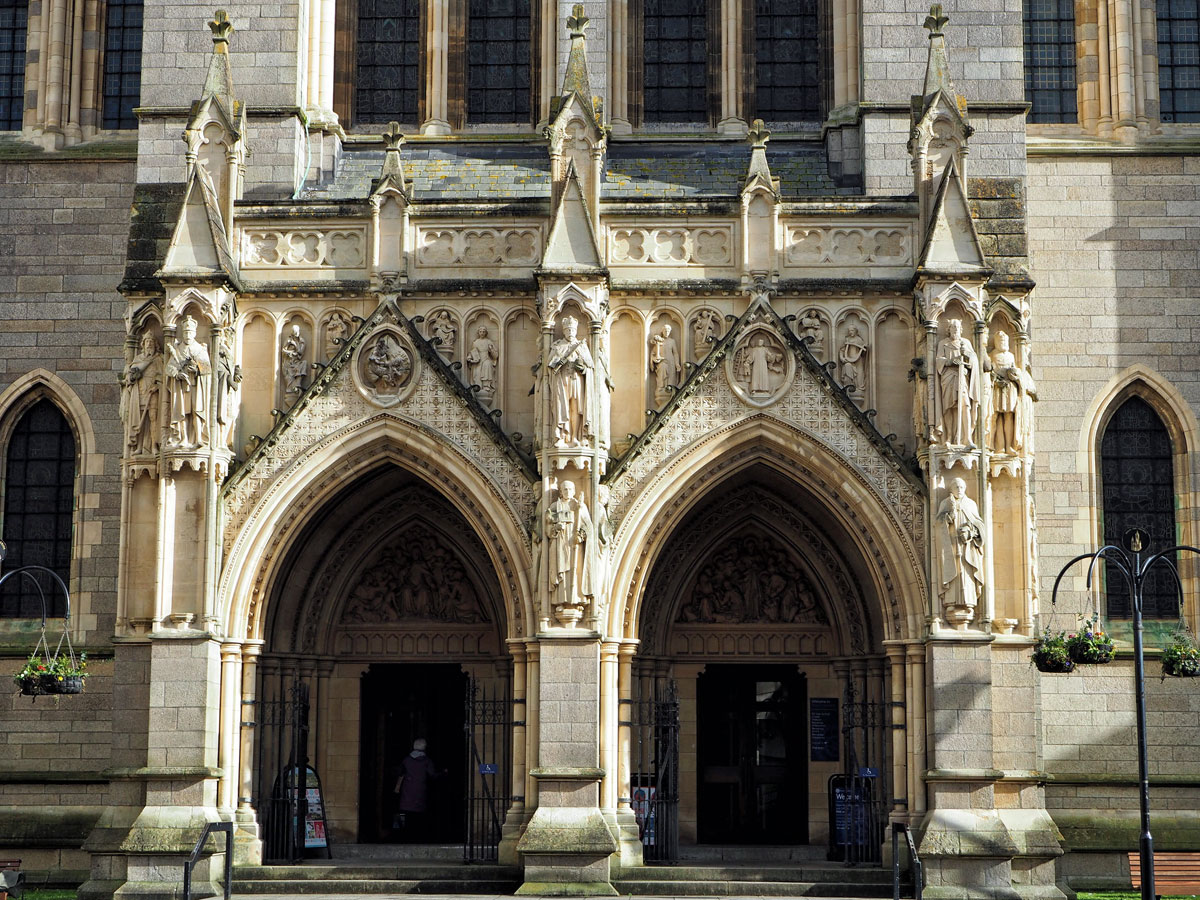
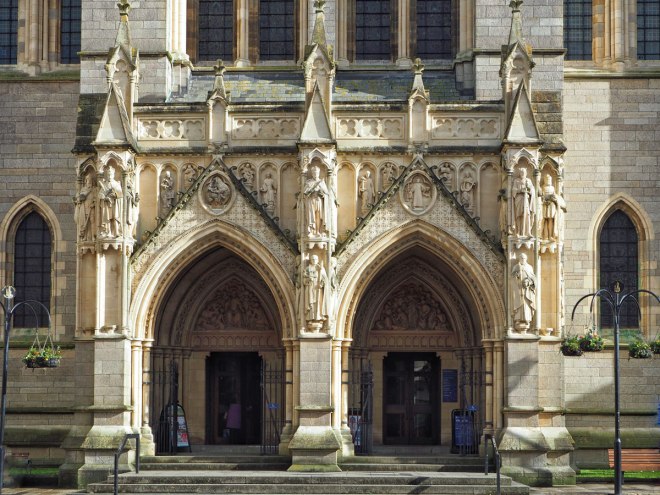
Entrance
The architecture of the cathedral is often likened to that of Lincoln cathedral and French cathedrals like that at Caen: a mixture of Early English (Lincoln and Salisbury) and French Gothic. While the three simple spires are reminiscent of a French cathedral, Truro is only one of four cathedrals in the UK with three spires.
The light inside was wonderful on this day.
The Nave
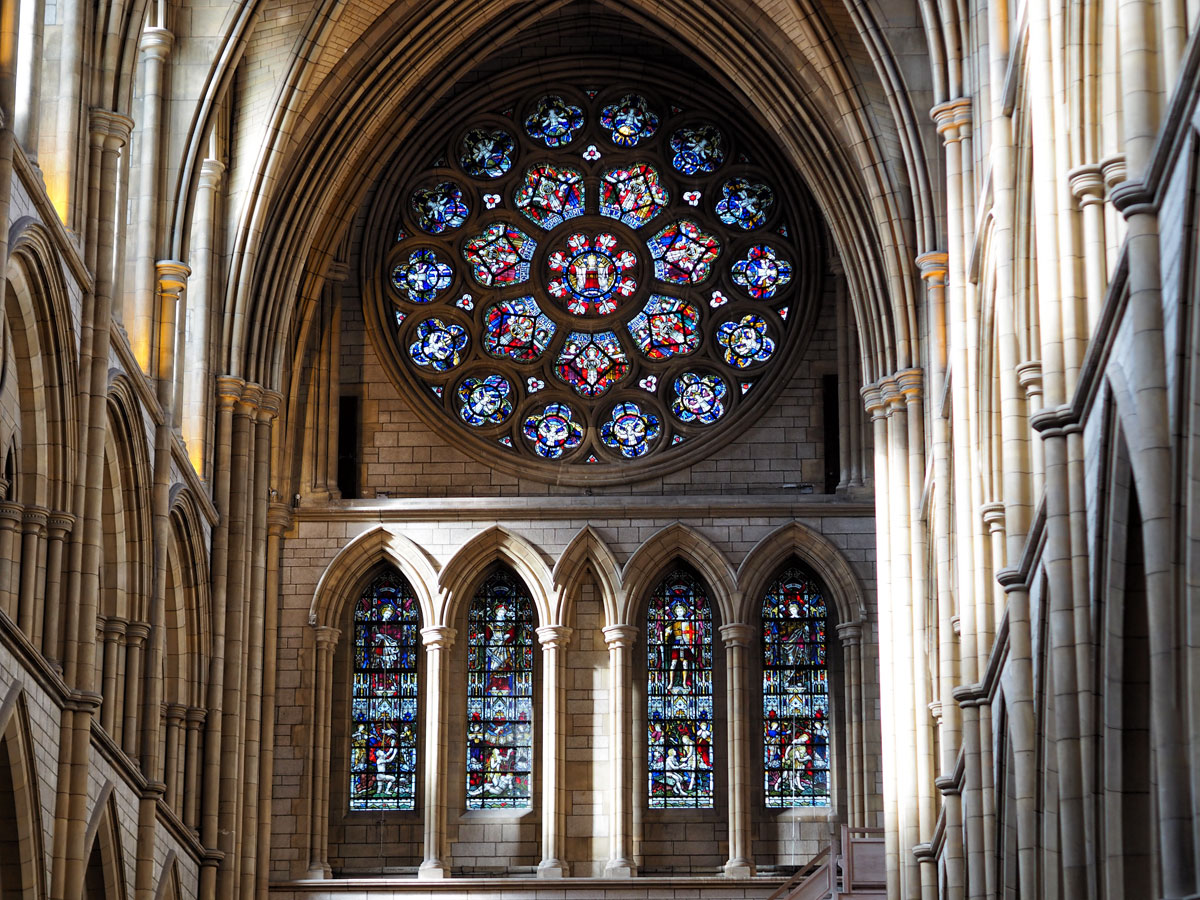
Truro cathedral has three beautiful circular rose windows, part of the large and inspiring collection of Victorian stained glass created by Clayton and Bell.
God the Father: Truro’s west rose is the first of the sequence of three rose windows on the theme of the Holy Trinity. It is divided into the irregular number of seven inner and fourteen outer sections: this is to accommodate seven angels holding shields signifying each of the six days of creation and the seventh Day of Rest in the inner ring.
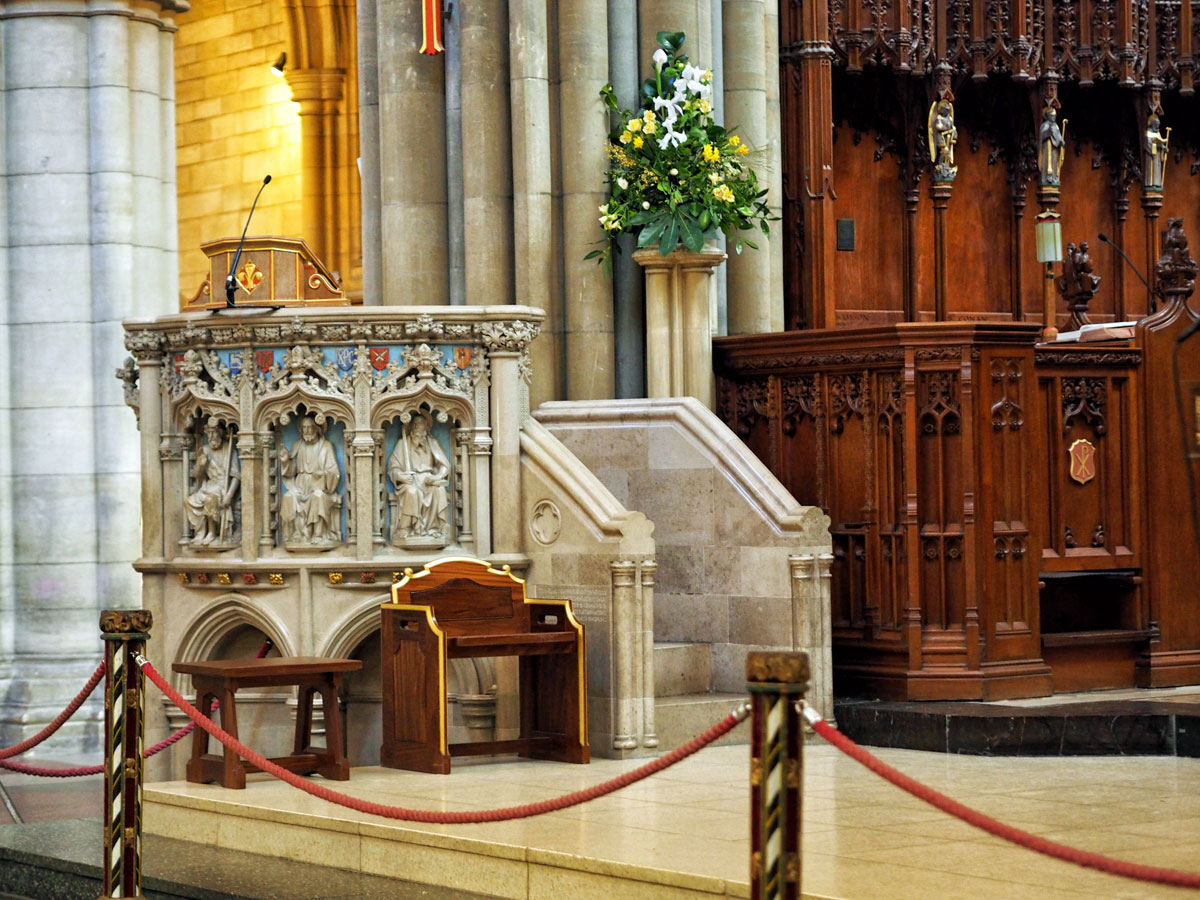
The west nave rose windowPulpit and Quire stalls
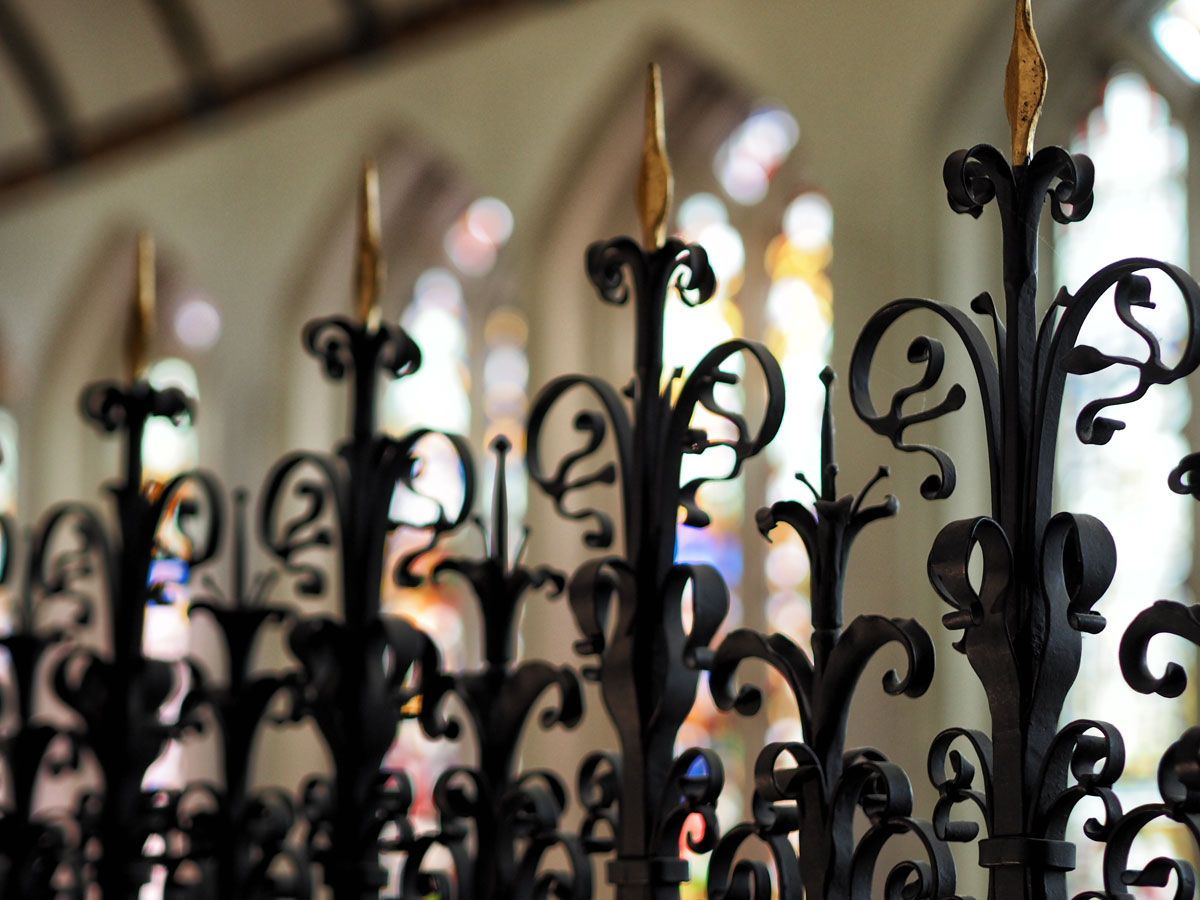
The statues of Bishops and saints are tinted, standing out amongst a sea of intricate wooden carvings. No misericords, unfortunately, nor are there any tombs in the floor of this Cathedral, far too young.
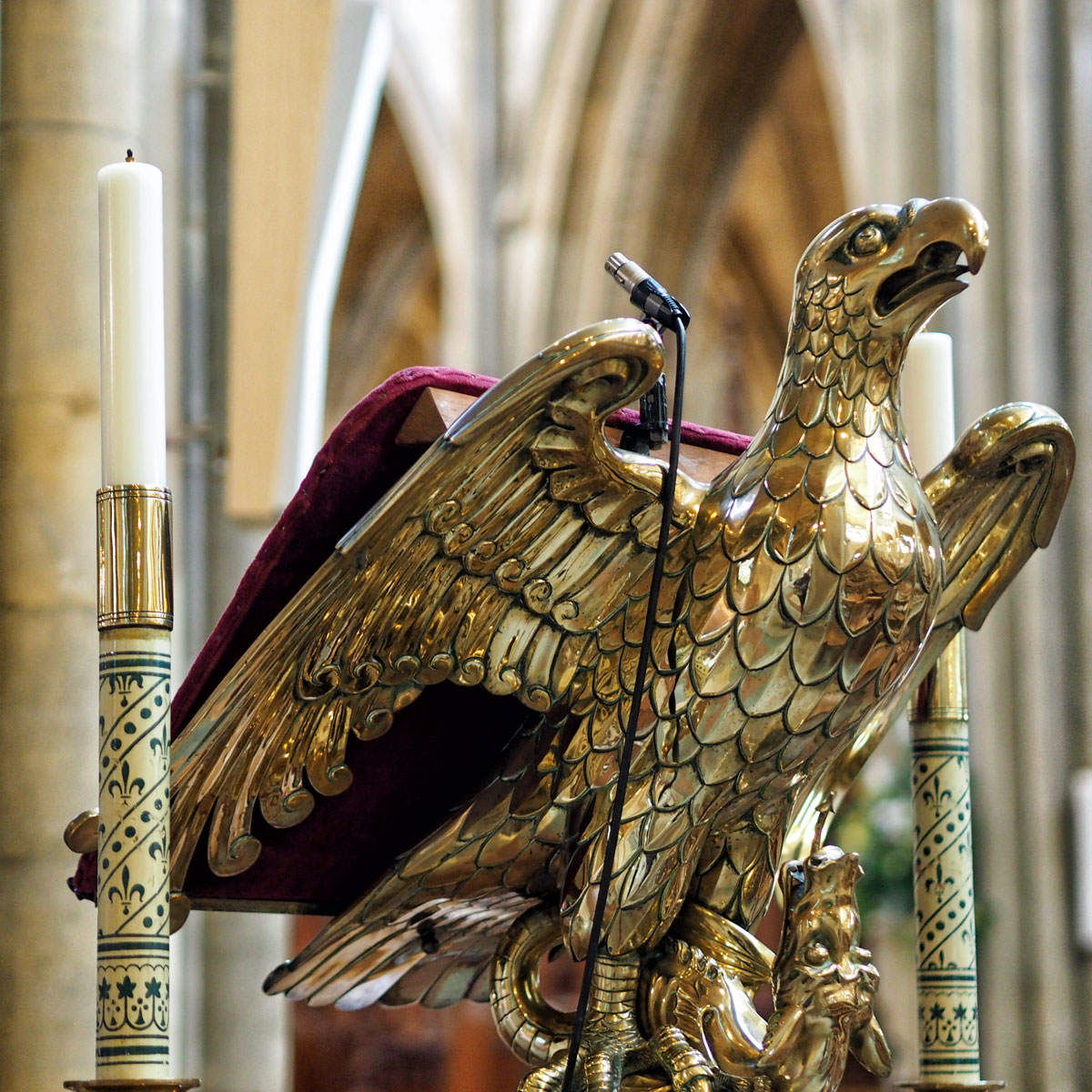
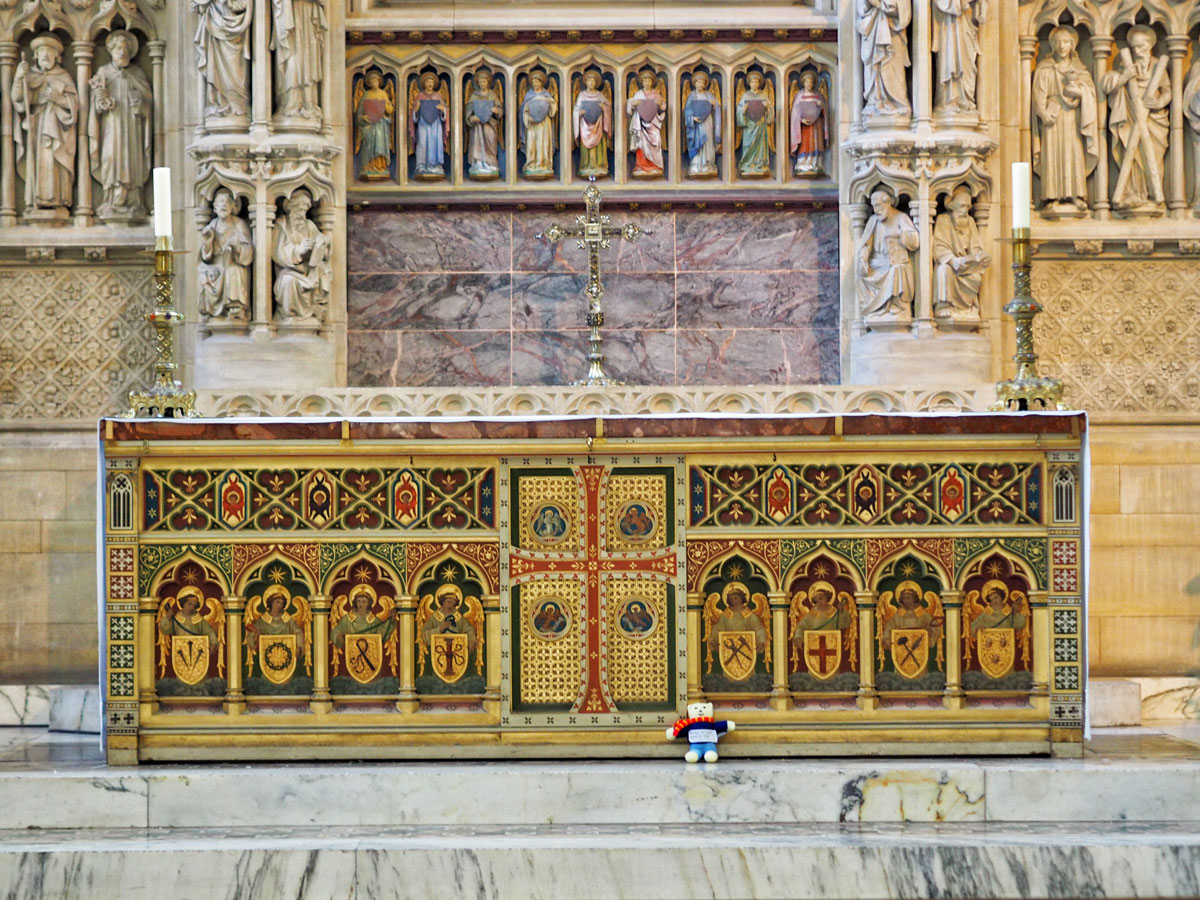
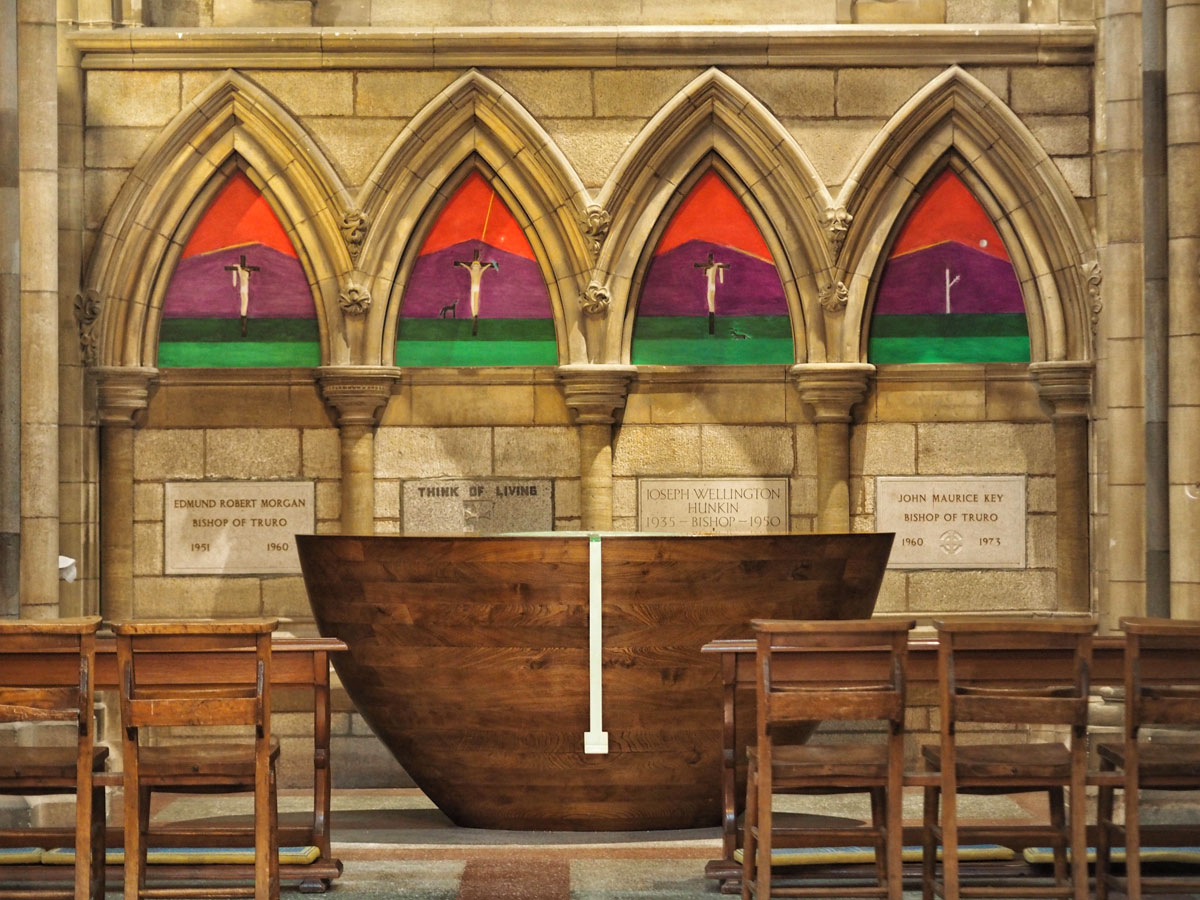
The wonderful brass eagle lectern supported by the four evangelists as it slays the dragon.This is the area that is central to worship at the cathedral. Behind the High Altar is the magnificent reredos.St Margaret’s Chapel. A contemporary area for prayer and contemplation located in the Retro-quire. Here you can see four paintings by Scottish artist, Craigie Aitchison.
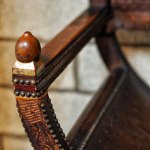
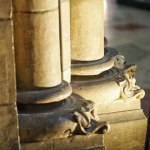
As usual, I wander around looking for quirky details, reflections, light, shadow, colours that appeal to me.
icon of the Virgin of Tenderness
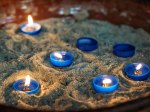
Candles to light
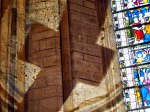
Shadow
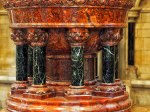
Marble font – red stone is Beccia marble from N. Africa, the green stone is Serpentine rock from the Lizard in Cornwall.
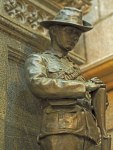
Figure from the Boer War Memorial
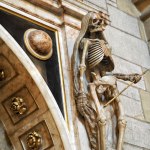
Figure on the Robartes Memorial representing Death
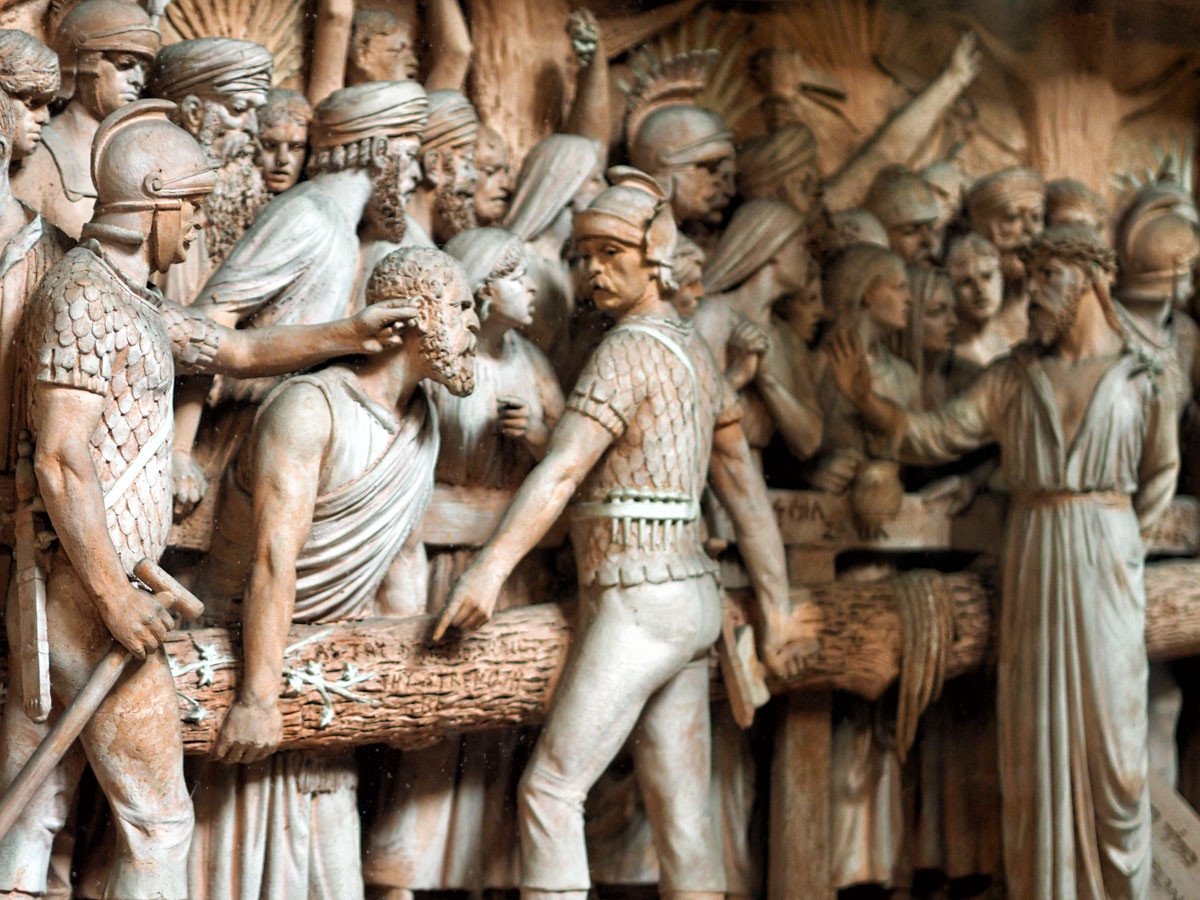
The Way of the Cross with Simon the Cyrenian being forced to carry the cross. On the right Jesus addresses the daughters of Jerusalem.
The Tinworth terracotta panel at Truro Cathedral is extraordinary. “Our Lord on His Way to Crucifixion” made by George Tinworth, master craftsman and chief designer at the Doulton company is one of only three surviving examples of his large-scale religious works and the only one still on public view.
This slideshow requires JavaScript.
The black ebony statue of Madonna and Child.
The Pieta carved by Breton monks in the 14th Century from Caen granite.
I’ll be back next week with a look at a few of the stained glass windows that caught my eye.
During this year I shall be posting photographs from places around the UK, many of which have not been published before. Where I have previously blogged about a location I will provide a link to the post, though you won’t be able to comment on it as I restrict comments to six months.
Z is for Zennor
The last letter in the alphabet just happens to be only six miles away from where I live. It is on West Penwith, a sparsely populated peninsula, ringed by high cliffs and rising to high, rocky moorland at its centre. It is surrounded on three sides by the pounding waves of the Atlantic Ocean.
The ancient landscape includes Zennor Head and Gurnard Head, granite moorland hills such as Carn Galver and Zennor Carn. Wonderful hiking country for those who are fit enough.
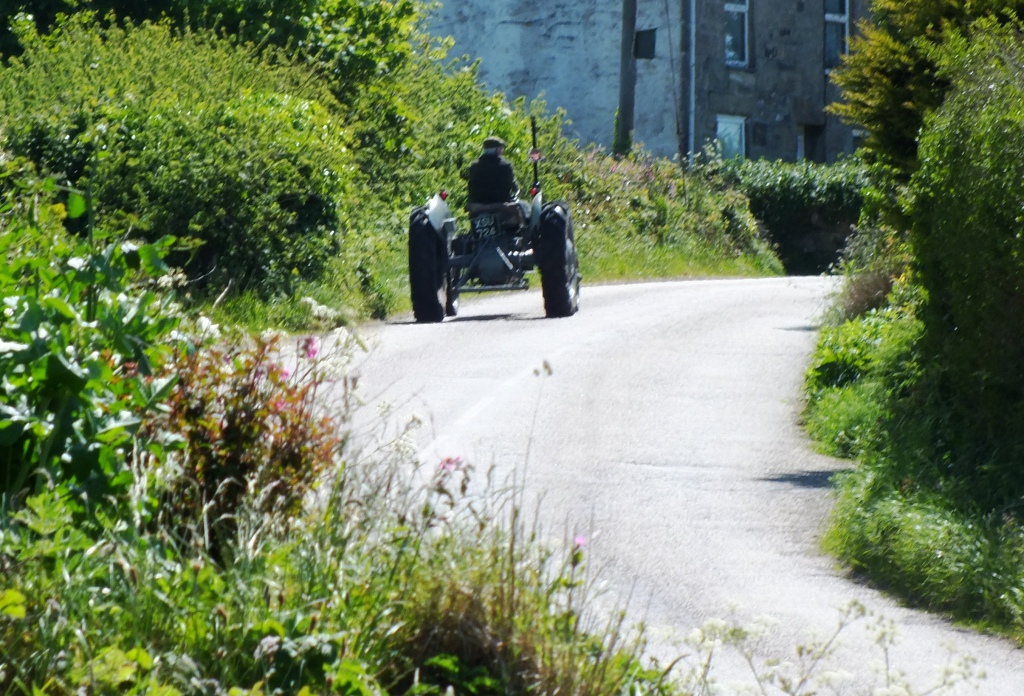
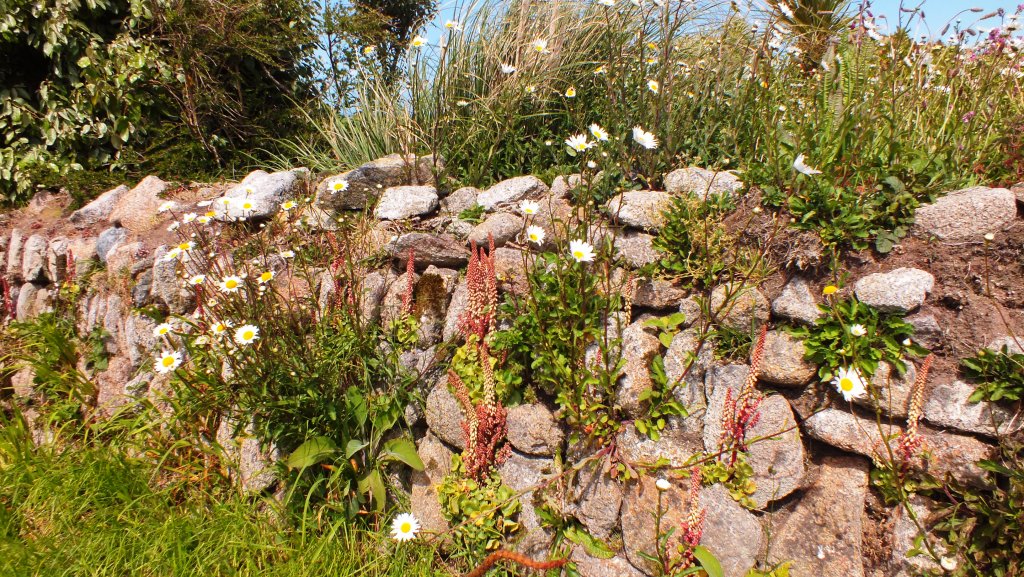
Access to most of the landscape is by narrow ancient lanes bounded by Cornish hedges.
Typical Cornish LanesA Cornish Hedge
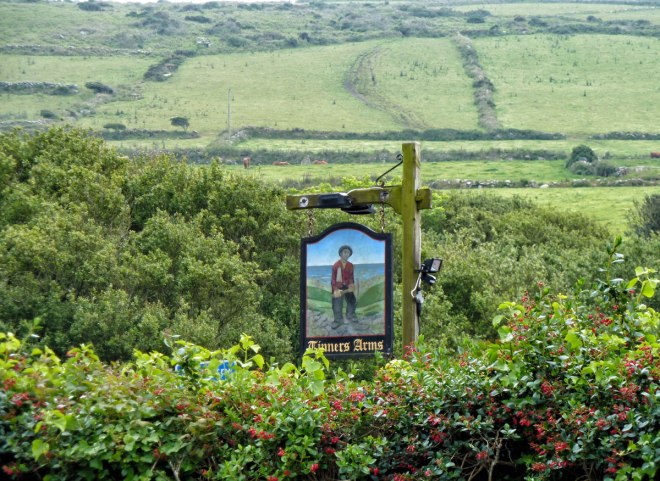
In Zennor you will find the wonderful Tinners Arms, built in 1271, for good food and drink and a popular place for people who walk the South West Coastal path from St Ives to find well needed refreshments. Up on the main road is a bus route either back to St Ives or on towards Land’s End.
The Tinners Arms, Zennor
Also in Zennor is St Senara’s church, home to the famous mermaid chair.
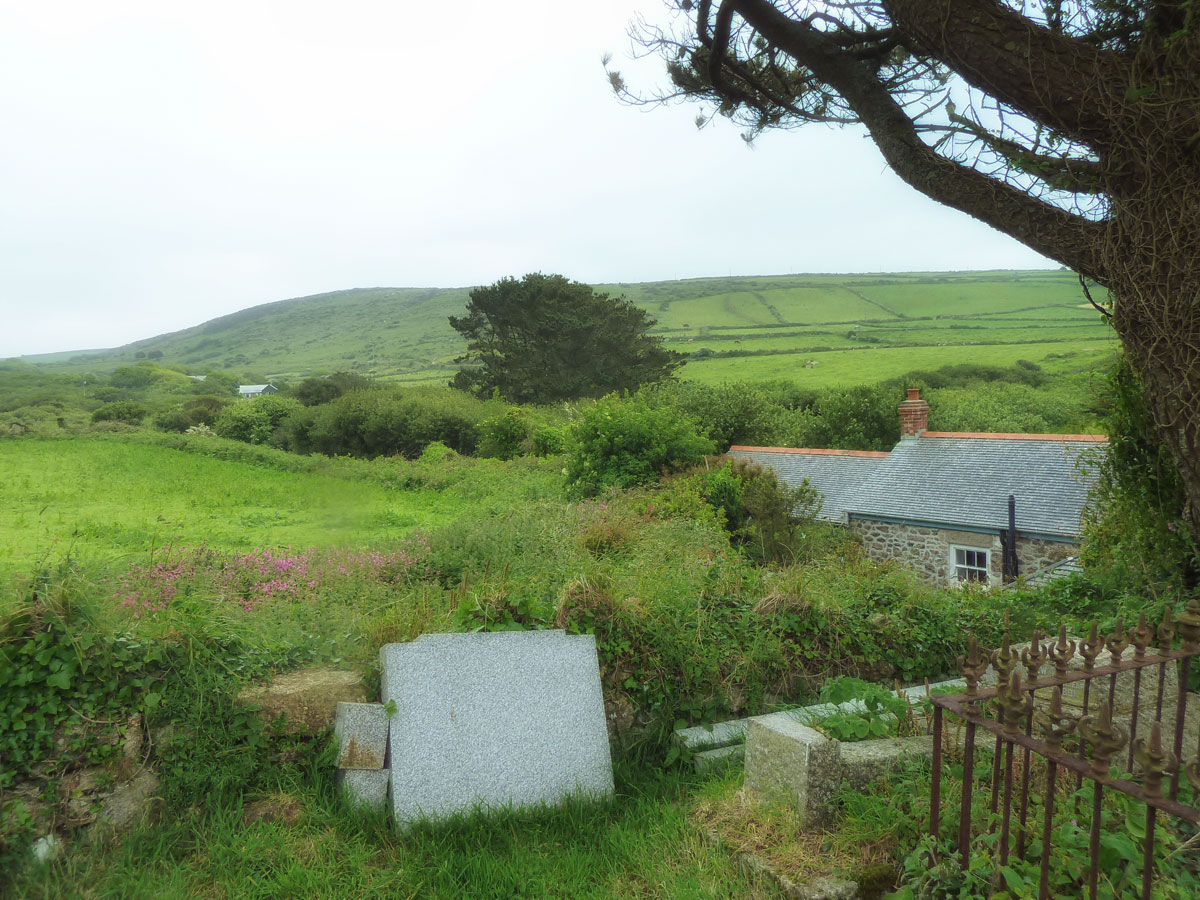
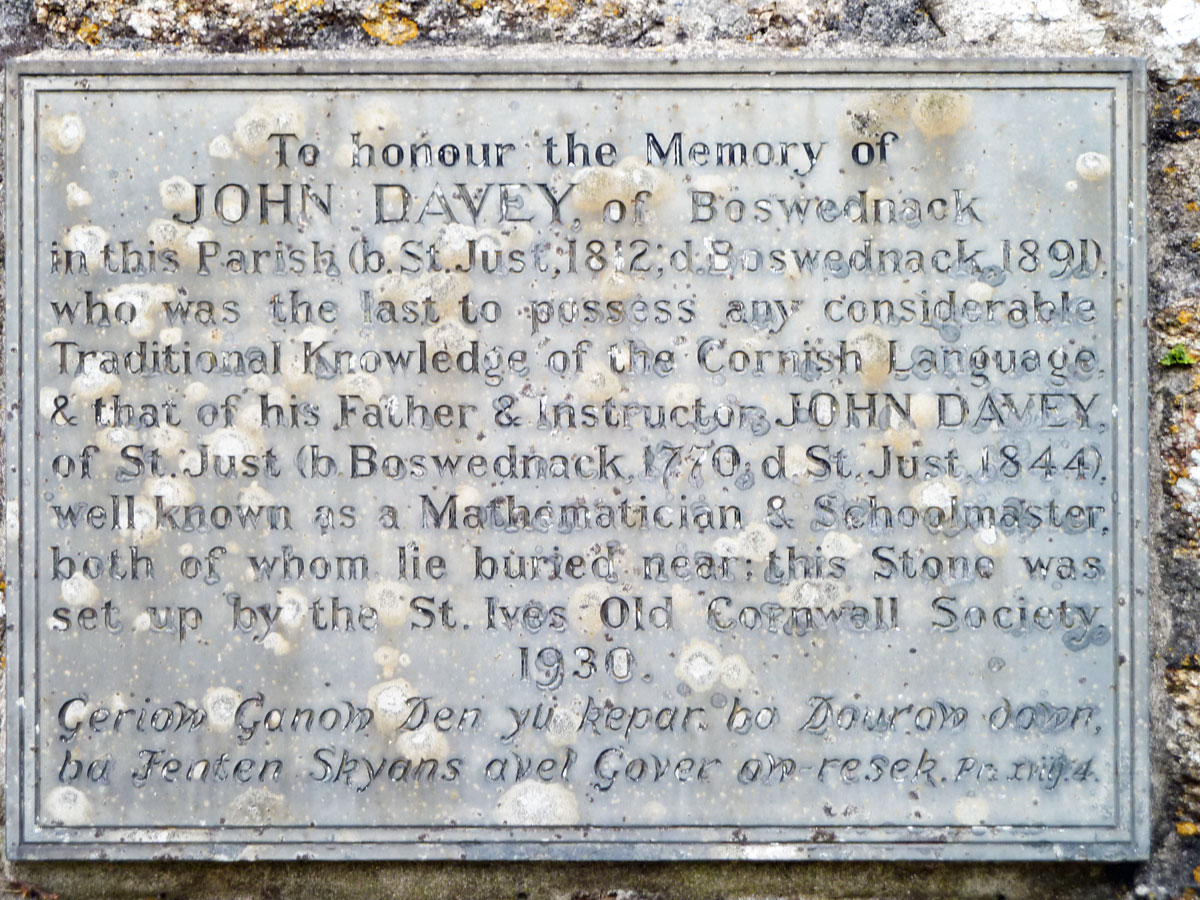
Views from Zennor churchyard
I hope that you have enjoyed my tour around the UK and hopefully I have introduced you to some places that are not necessarily on the tourist trail. There are a lot of wonderful towns, cities, villages and countryside to explore throughout England, Scotland and Wales. I’m sorry that I haven’t been able to include Northern Ireland too. We are not short of history, interesting architecture, great walks and incredible landscapes so I hope that this series has whetted your appetite to discover new places to enjoy.
During this year I shall be posting photographs from places around the UK, many of which have not been published before. Where I have previously blogged about a location I will provide a link to the post, though you won’t be able to comment on it as I restrict comments to six months.
T is for Truro
Truro is the only city in Cornwall and the centre is, by city standards, quite a small one. Bodmin is still the county town and St Austell is the largest. For locals, Truro is the place you come to shop, study or have a good night out (and, rather less appealingly, to go to hospital). However, the city employs more people than other towns, with the major employers being the Royal Cornwall Hospital, Truro College and Cornwall Council so it is very busy.
Some cobbled streets remain (Pydar Street)
Look out for the leats along the streets; locally known as kennels, these Victorian channels that once kept the streets clean and the horses watered. There are some attractive Georgian buildings and some cobbled streets, but the layout of the city is very confusing.
Truro cathedral (the Cathedral of the Blessed Virgin Mary) has one of the tallest spires of any church the UK. It is largely Victorian and Edwardian and was built after Truro had already gained city status in 1877.
Back in the past Truro was a market town and port and then became one of Cornwall’s five stannary towns, where copper and tin were brought to be assayed.
Coinage Hall: The current building was built as the Cornish Bank in 1848 on the site of the old Coinage Hall where twice yearly tin was brought here to be assayed and taxed.
In spite of its early history, few very pre-18th-century buildings remain today, and most of the town centre dates from Truro’s Georgian, Regency and Victorian heydays. Lemon Street in particular has some very fine Georgian houses.
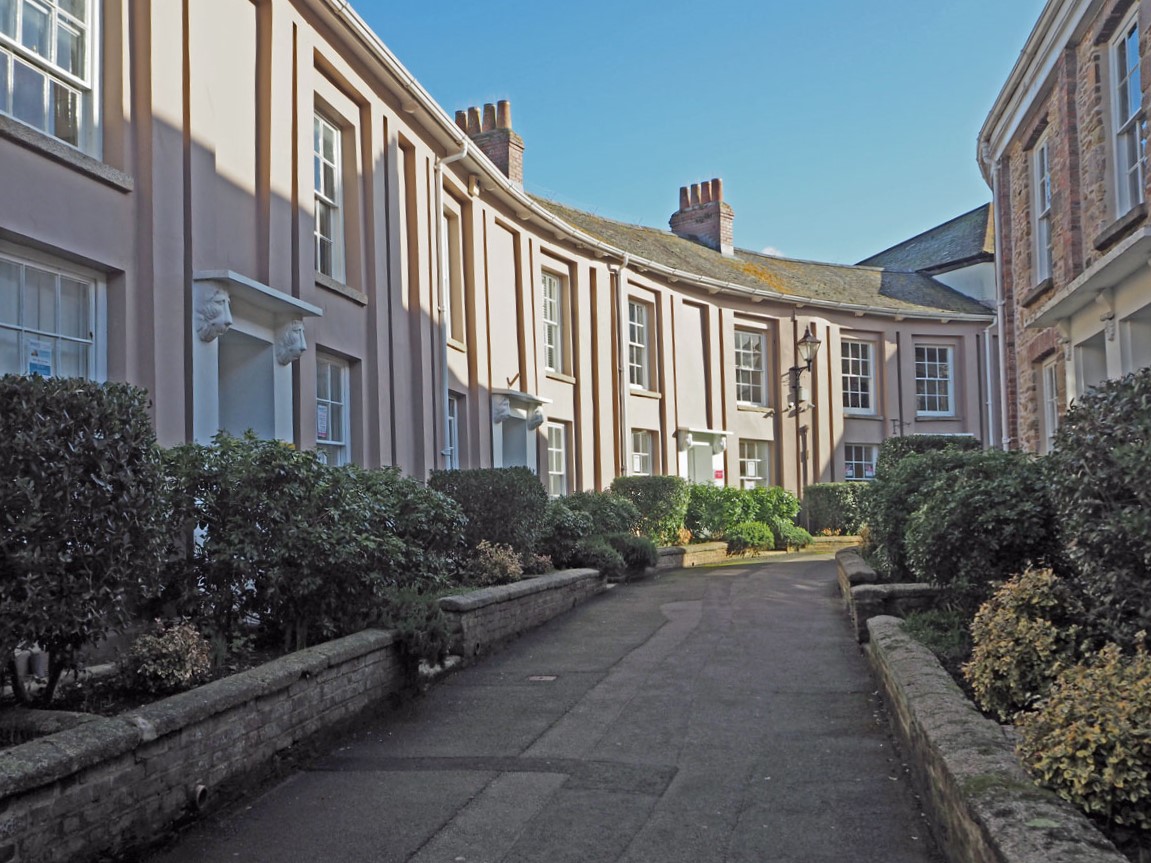
And one of the most puzzling streets I came across is Walsingham Place, a curious curved late Georgian terrace with lions. Apparently it began life as Caribee Island, a very boggy place; the name is thought to derive from the Caribbean, due to the large number of slave ships docking in Truro’s port. It wasn’t until the 1800s after Lemon Street was completed that Walsingham Place was constructed.
In 1851 it was reported that Walsingham Place was home to clerks, a wheelwright, butcher, wine and spirit merchant, ironmonger, fancy chair maker, English teacher, and the wife and family of an Inland Revenue officer called Mugford. Gradually the private residences changed to business premises, with the last domestic dweller thought to have moved out around ten years ago.
Walsingham Place with lions
And the lions? Well they were added in 1960 by architect John Crowther, but I have no idea why.
The Lions
For a more detailed walk around Truro please click here.







 Also in Zennor is St Senara’s church, home to the famous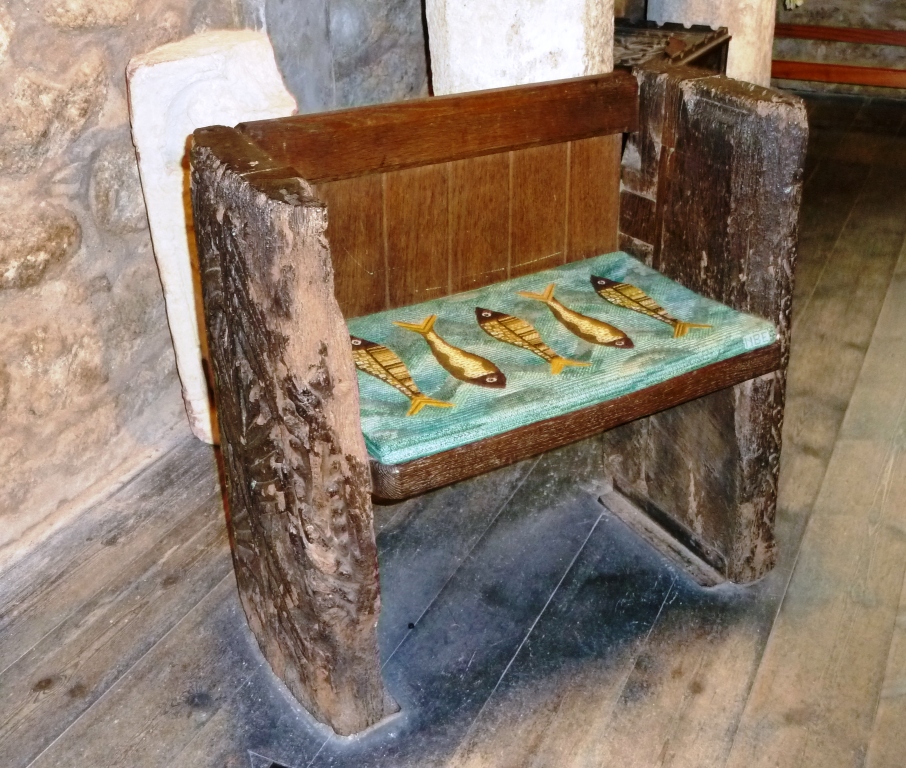

 Back in the past Truro was a market town and port and then became one of Cornwall’s five stannary towns, where copper and tin were brought to be assayed.


 TRAVEL WORDS