U for Ursuline Monastery

frizztext hosts a weekly A – Z Challenge

A_Z logo

Event Type: General Blogging

Start Date: Tuesdays, recurring weekly

Description: Every Tuesday I offer the “A to Z challenge”, walking step by step through the alphabet.

If you would like to join in then please click here

ursuline-monastery-1

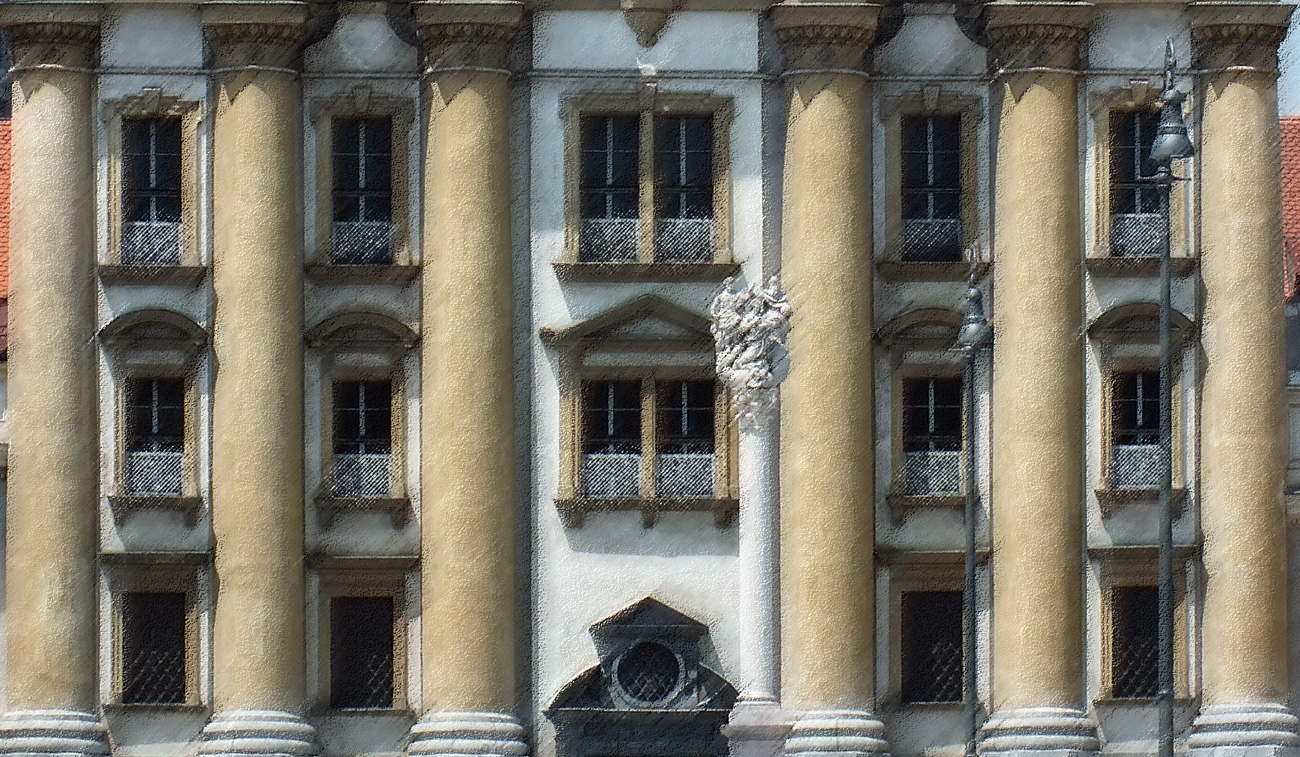
The Ursuline Monastery in Solvenia’s young capital, Ljubljana and the Holy Trinity Parish Church  was commissioned by Jakob Schell von Schellenburg, a wealthy local merchant and financier, and his wife Ana Katarina. During the construction of the Trg republike square, the Monastery underwent a thorough reconstruction and its garden was completely destroyed. 

Its undulating façade enhanced by semi-columns and a characteristic gable inspired by the famous Roman architect Francesco Borromini make it one of Ljubljana’s most beautiful and extraordinary example of Baroque architecture.

U---ursuline-monastery-2

In front is the Holy Trinity Column erected in 1693 as a thanks offering for the city having been spared from the plague.

U---Ursuline-Monastery-rough-pastelsand given the number of windows in this beautiful building I am linking this to Dawn’s Lingering Windows Challenge.

T for Týn Church / Týnský chrám

frizztext hosts a weekly A – Z Challenge

A_Z logo

Event Type: General Blogging

Start Date: Tuesdays, recurring weekly

Description: Every Tuesday I offer the “A to Z challenge”, walking step by step through the alphabet.

If you would like to join in then please click here

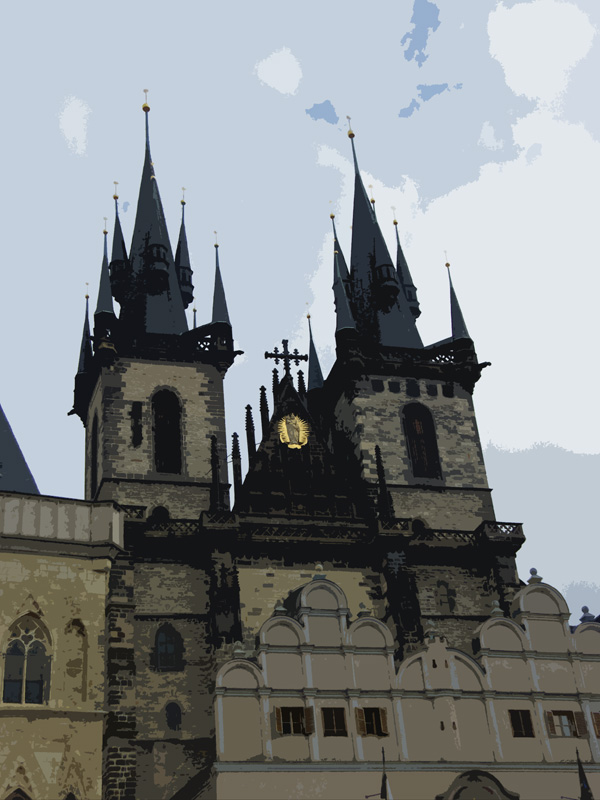
Back in Prague (the city of 101 spires apparently) this week for one of the most recognisable buildings in the Old Town, a Gothic church called ‘The Church of Our Lady in front of Týn

The current church is a late Gothic style and construction began in the 14th century. The roof, the 80m high church towers and the smaller spires were completed in the 15th century. It dominates one side of the Old Town Square. (Wikipedia)

T---tyn's-church

The front is decorated with a golden image of the Virgin Mary, made in the 1620s from the melted down Hussite chalice that previously adorned the church. This was during the tumultuous period when Roman Catholics were slaughtering the Hussites who had controlled the church for two centuries.

T - tyn's church (2)

And take a close look at the two spires on the church. They are not symmetrical. They represent the masculine and feminine sides of the world. This is characteristic of Gothic architecture of the period.

The church is difficult to picture in its entirety as it is hidden behind the  four-storey Týn School, and although impressively Gothic on the outside it is heavily Baroque on the inside. It is open to the public, though closed on Mondays, and often used for mass, so check before you  visit.

T---tyn's-church-3

Entrance to the church can be difficult to find as you have to negotiate through the narrow lanes behind the square. This amazing portal dates from 1390 and depicts scenes of Christ’s Passion.

Legend has it that Walt Disney based his Sleeping Beauty Castle on this church. What do you think?

S for Sintra Palácio Nacional da Pena

frizztext hosts a weekly A – Z Challenge

A_Z logo

Event Type: General Blogging

Start Date: Tuesdays, recurring weekly

Description: Every Tuesday I offer the “A to Z challenge”, walking step by step through the alphabet.

If you would like to join in then please click here

The  town of Sintra, Unesco-listed thanks to its extraordinary castles, palaces and country houses, is popular with Lisbon day-trippers. There is a lot of flamboyant architecture to see.

(please click on an image to enlarge)

S - sintra pena palace

The Park and Palace of Pena above the old town of Sintra  are the finest examples of 19th century Portuguese Romanticism and the integration of natural and built heritage. It is another example (along with Rossio Station in Lisbon and Count Guimaraes Palace in Cascais) of neo-Manueline style, a revival architecture of the 19th/20th centuries.

sintra-pena-palace-gateway

This is as far as you go if you haven’t bought the full ticket. The coat of arms above the gateway is of Don Fernando II of Portugal and Saxe-Coburg-Gotha. He died in 1885 leaving the property to the Countess of Edla.

sintra-alcove

An alcove you pass on the way up to the second terrace, charmingly filled with a stone urn and lush tropical plants.

sintra-fish-man

Allegorical gateway of the Creation. Half-man half-fish figure.

S-=-Sintra-Pena-Palace-(2)

On your way up to the entrance you go past a lovely border of tropical planting, which all looks in much better shape than the actual Palace buildings, which I thought were rather tired and scruffy looking. I wanted to get a paintbrush out there and then!

It is a steep walk up to the Palace and you may prefer to  take the 434 circular bus route from the railway station (regular trains to and from Lisbon make it an easy day out) to the historic centre of the Old Town, the castle and Pena Palace. If you walk from the station then you can enter the lovely Parque de Liberdade.

S - Sintra parque

I went there on a very humid day in May, and found it a little disappointing. The exterior of the Palace and the Palacio Nacional de Sintra were in need of some TLC and I found the historic centre to be very crowded and it was very hot and sticky. Climbing up hill in those conditions do not suit me, but I would like to go back as there are many other sites to visit that are very interesting.

Have you visited Sintra? Did you go to the Pena Palace and Gardens? What are your thoughts?

Just Back From… London

It’s a funny old world. I lived a little more than an hour away from London for 7 years, but in all that time I’d never spent a day there other than for attending meetings for work. So a train in, a tube to the location and back again, sometimes with a glance at some interesting architecture, thinking I really should bring a camera with me next time. Never spent any time in recent years exploring the city. I didn’t like London you see. I found it dirty, noisy and too busy so all I wanted to do was get in and get out as quickly as possible.

I have ‘done’ the tourist things years ago – Buck Palace, the Mall, Trafalgar Square, Big Ben, Camden Lock, Greenwich Market, but never been interested in what else it has to offer, until now, when I decided that I should at least visit the splendid museums that lie within the centre and are free. I like free. And Kew Royal Botanical Gardens. I like gardens.

So last week I accompanied the OH who was going there for business purposes and found myself in a reasonable hotel a spit away from Earl’s Court. With three days at my disposal. And a tube strike for two of those days. I dislike the tube at the best of times but at least it gets you to where you need to go, usually. Now buses, not only are they complicated, but also they are slow. On account of all that traffic you see.

Tuesday

On my first day I spent an hour and a half going round in circles as I attempted to get across to Chancery Lane tube station to go on a London walk.  Eventually it dawned on me that there was no way I was getting anywhere close to the centre as Circle, Central and Piccadilly lines were not running. Had I realised that at the start of the journey I could have made my way differently, but by the time I’d sussed out an alternative route it was too late. Frustrated now, by all the hopping on and off tubes going nowhere, I opted for some fresh air in Kew Gardens, but even that was a challenge as it involved a tube to Turnham Green, a walk to a bus stop, a bus to Kew Gardens Station and a walk to the gardens. Phew! I was quite exhausted before I even got there!

Kew is big. Really big. And although I walked for four hours I only covered half of it.  I got to see the Palm House, which was closed on a previous visit, but not the Temperate House, which is closed for restoration. I was enchanted by the peonies, the Woodland Garden and the Rockery. I loved the Princess of Wales Conservatory with the pelargoniums, the succulents and cacti, the jade vine and the chameleon. I was irritated by the number of school children on a day trip (usually Primary age) running around, screeching at full volume, getting in the way of a shot. They were everywhere!

I hear leaves drinking rain;
I hear rich leaves on top
Giving the poor beneath
Drop after drop;
‘Tis a sweet noise to hear
These green leaves drinking near.

~ from ‘The Rain’ by W H Davies

Getting away from them I discovered the lovely Davies Alpine House, the Waterlily House and further away, the Secluded Garden where I sheltered from a heavy April shower beneath the canopy of a Prunus tree.  Only to find another small glasshouse just around the corner! Oh, well.

Just when I thought I couldn’t walk any more my eyes glimpsed a shock of colour across the park, and I headed for the Azalea Garden, getting attacked by a crazy squirrel en route. I spotted him in the grass and thought about getting a photo of him, but he just kept heading straight towards me. Next minute he is clinging to my thigh and staring up at me, no way could I get a photo, I was too busy trying to encourage him to get down without being bitten!  After a couple of moments like this I did manage to take his picture and then quickly hurry away before he decided to have another go. Anyway, the azaleas were well worth being attacked for.

bluebells

Admitting defeat just before I found the bluebells and knowing that I still had to make my way back to the hotel as we had a dinner date at 7 pm I reluctantly left Kew Royal Botanical Gardens, footsore, but happy, and both camera batteries exhausted, like me. Continue reading Just Back From… London

O for OBECNÍ DŮM

frizztext hosts a weekly A – Z Challenge

A_Z logo

Event Type: General Blogging

Start Date: Tuesdays, recurring weekly

Description: Every Tuesday I offer the “A to Z challenge”, walking step by step through the alphabet.

If you would like to join in then please click here

OBECNÍ DŮM / The Municipal House / Prague, Czech Republic

is Prague’s most prominent Art Nouveau building. It is a civic building and concert hall and located on Náměstí Republiky 5 next to the Powder Gate. It is a beautiful building from all aspects. The outside has intricate stonework, gold trimmings, frescos and stained glass windows.

The Smetana concert hall  is an architectural masterpiece, a mix of carved white stone and gold, illuminated by hundreds of lights, and with frescos by Karel Spillar adorning the walls. It is home to the Czech National Symphony Orchestra.

Postcard
Postcard
O (3)
Staircase
Lift / Elevator
Lift / Elevator

A couple of restaurants and an American bar can also be found inside the building though many of the rooms are closed to the public and open only for guided tours. Unfortunately we didn’t manage to time it right, so only had a glimpse of what lies inside.