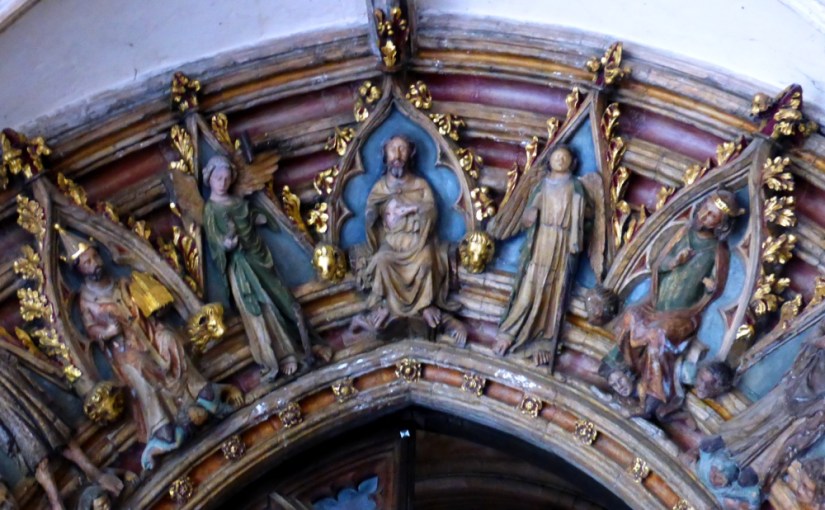
At the south east corner of the nave, next to the south transept, is the more spectacular of two doors leading from the priory cloisters into the cathedral church. This is called the Prior’s Door. The door dates to about 1300 and has a finely carved arch decorated with thin piers at its sides and decorated recesses in the arch. These recesses contain statues of Christ at the top, John the Baptist and possibly Aaron to the left, and David and Moses bearing a scroll detailing the Ten Commandments to the right. To the right of the doorway are three sedilia, or seats, recessed into the wall of the cloister. The wear and polishing of the stone from feet and bottoms is very noticeable!
Category: England
Norwich Cathedral Part III: Bosses
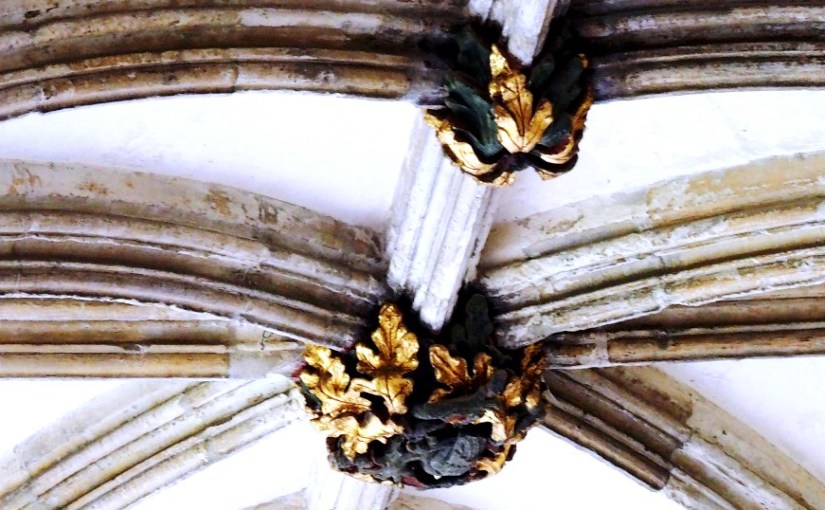
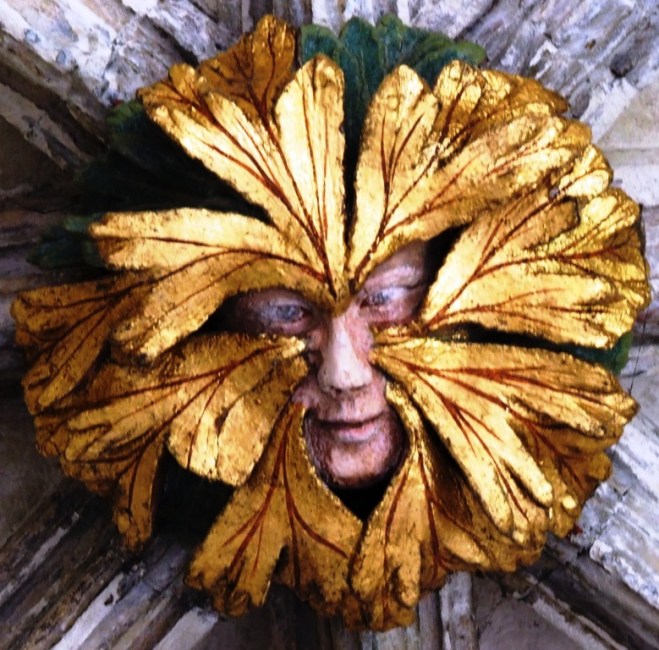
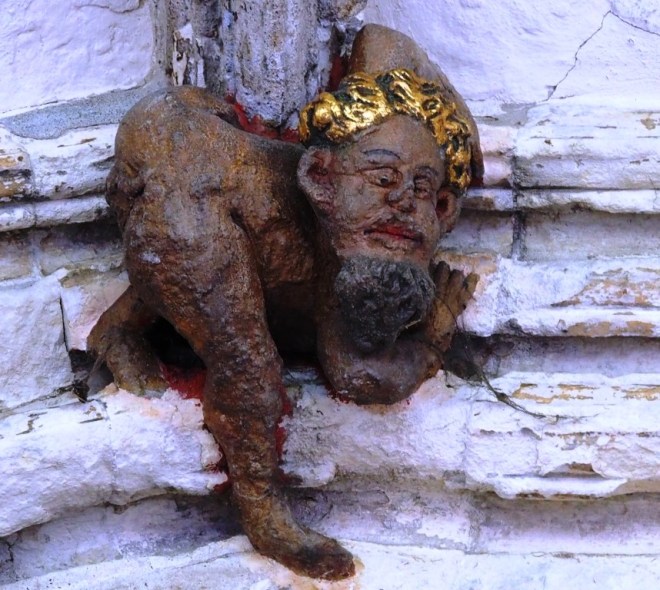
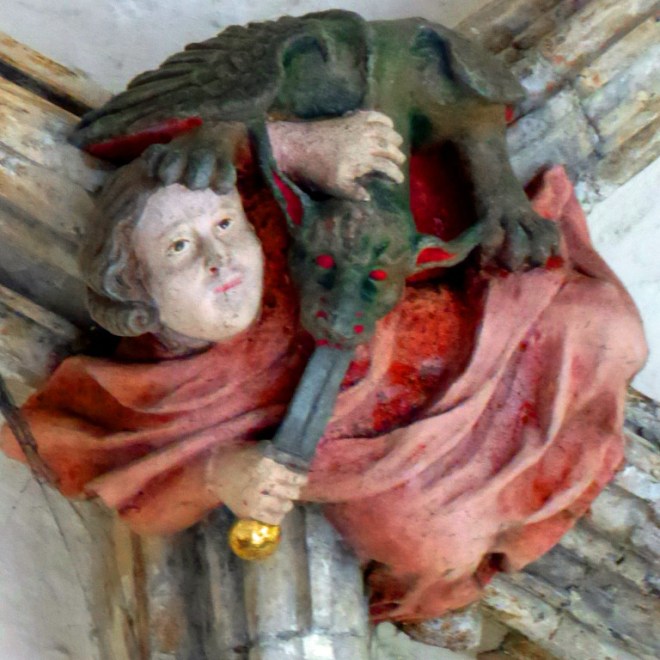
Norwich Cathedral has more bosses than any other cathedral worldwide: some 1106, including those of Lyhart’s nave roof; those of the presbytery vault, added in 1480 by Bishop Goldwell; those of the transept vaults, added in 1509 by Bishop Nykke after a further fire; and those in the cloister. The bosses represent the largest collection of decorative roof bosses in Christendom, and depict scene from both the old and new testaments. Carved into the stone vaulting and then painted, each boss would have taken almost two weeks to complete. They represent a Christian view of the history of the world including carvings of Noah and the flood, the Nativity, the Crucifixion, the end of the world and the tales of judgement day.
There are some good examples of medieval art.
There are also bosses depicting mythical beasts and figures like the Green Man. It is thought that roof bosses such as these provided one of the earliest forms of theological education, at a time when illiteracy was high.


The east walk was built first in 1297, and aside from a Passion sequence and the Evangelists at the north end has mostly foliage bosses. Continue reading Norwich Cathedral Part III: Bosses
Norwich Cathedral Part II: Interior
I said in my previous post that the exterior of this cathedral wasn’t that impressive. Mainly because it is so difficult to see the complete building. However, inside is another story. It is incredibly beautiful with wonderful windows, arches, bosses and oozing with history. With so many nooks and crannies it would take far longer than my couple of hours to explore. But here are some of my highlights:
The entrance to the cathedral is through the Hostry, the new visitor and education centre, built on the foundations of the medieval Hostry where guests would have been welcomed into the Benedictine monastery.
The brightly burnished copper font was formerly used in a Norwich chocolate factory.
The Jesus Chapel is decorated with the kind of wall painting that may once have covered most of the building. Continue reading Norwich Cathedral Part II: Interior
Norwich Cathedral Part I: The Close
The most complete Norman Cathedral in England and one of the finest examples of Romanesque architecture in Europe, Norwich Cathedral is one of England’s finest Cathedrals and dedicated to the Holy and Undivided Trinity.
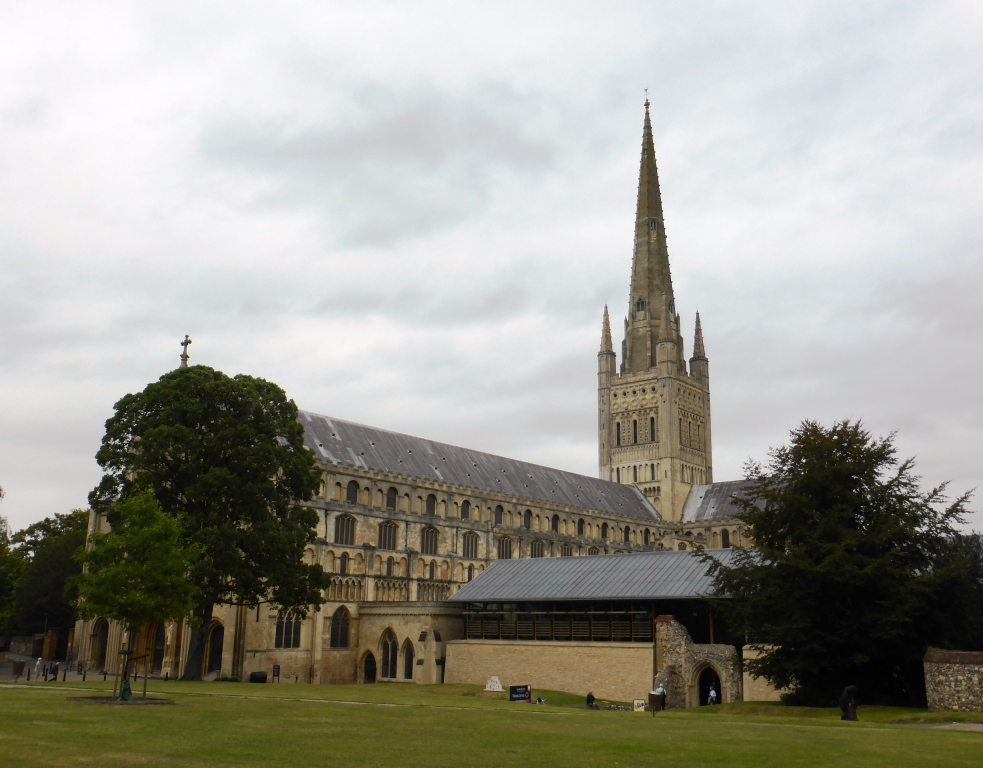
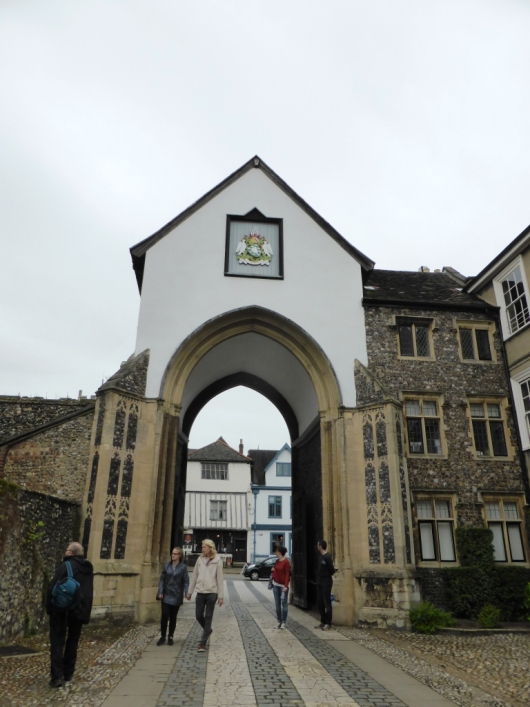
I showed you the two dramatic entrance gates in to the cathedral grounds from Tombland. Now it is time to walk through and have a look at the cathedral precinct which occupies the former monastery. It is very difficult to get the entire building in frame and the addition of a rather ugly visitors’ entrance is not helpful and certainly (IMO) not sympathetic to the 900 year old Norman cathedral.

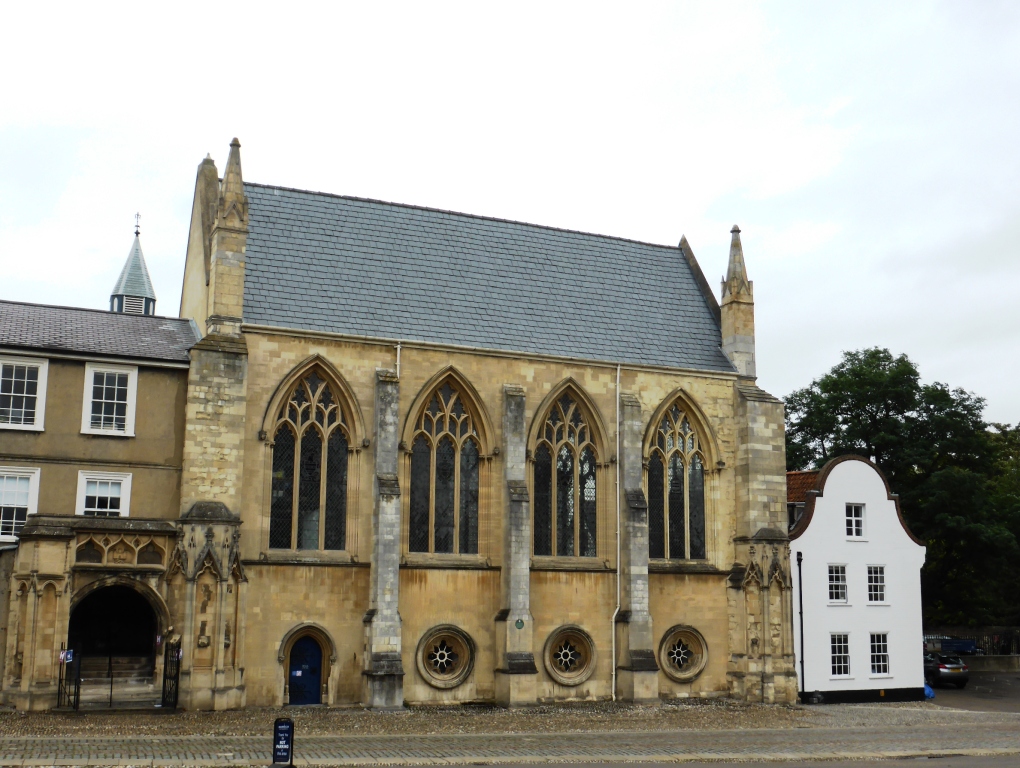
The Cathedral Close, an area surrounding the Cathedral, contains more than 80 listed buildings. The Upper end of ‘The Close’ as it is known, is a large green space stretching along the west front of the Cathedral. The Norwich School (independent) occupies one end and we were lucky enough to be able to enter the Grade 1 listed school chapel as it was open for the Historic Open weekend. Built in 1316-1320 it was originally a chantry chapel where monks said prayers four times a day to save the soul of Bishop Salmon who was a very rich Norwich bishop. The architectural style is transitional between Gothic Decorated and Perpendicular.

I was particularly taken with the lovely blue doors Continue reading Norwich Cathedral Part I: The Close
Black and White Sunday: Heckington Windmill
The eight sail windmill was built in 1830 with five sails, but after a gale in 1890 destroyed both the cap and sails it was rebuilt by John Pocklington using machinery from Skirbeck mill in Boston, Lincolnshire.
Now the only eight sail windmill in Western Europe it is fully working and producing flour again.