Old shoes, scuffed and oddly shaped by old feet,
Heels run down, soles flapping.
Miles of dusty pavements
Ingrained in the cracked leather.
For sale?
Surely not.
Electrical items from a bygone era
Pose safety implications for sure.
A VHS larger than any I have seen before.
So much tat.
Chipped and ugly painted vases
Lie amongst broken crockery
And balding teddy bears,
Once loved
Now forgotten.
LPs without covers
More than likely scratched
Causing that irritating repetition
When the needle jumps
And stutters
Again
And again.
And again.
Curiously there is an entire car engine
Rusty and tired
Like the car it once belonged in.
And a motherboard!
I recognise the jumpers,
The switches,
The spaces for the RAM,
And Video cards.
Almost an antique.
Almost definitely useless.
Close by is combat gear
And camouflage clothing,
Rusty saws and axes,
Swords and other miscellaneous evil-looking instruments
Of torture.
Or maybe not.
My imagination is getting the better of me,
they are probably gardening tools.
An elephant’s foot table.
Now that must be illegal to sell.
Or buy.
I grimace.
Indian puppet dolls
Are much more cheerful,
But I don’t stop.
Tables full of coins and clothing, glassware and china.
Bundles of straw which leave me wondering
What one would do with them
In a city.
Like this.
Time for me
to move on.
Yvoire – a floral medieval village in France on Lac Léman (lake Geneva)
I have no idea how I came to hear about Yvoire, maybe a search for gardens in the area when I was planning my trip to Geneva back in 2009. I always want to check out the gardens in a place I visit so do a search and then make notes of the ones I can fit in, including times and days open etc. When I discovered ‘Le Jardin des Cinq Sens’ (The Garden of Five Senses) was just a ferry ride from Geneva and the fact it is in a place called the ‘floral’ town then I had to make it happen.
The Gate of Rovorée (or Gate of Thonon) built into the ramparts of Yvoire.
I am not going to talk about the garden here, that deserves a post of its own, though if you click on the link you will get a sense of how it affected me. I will write a fuller post on the garden blog.
Yvoire is not all about this garden: the medieval centre is romantic and famous for its flowers, cobbled streets, town walls and a wonderful historic chateau (private) going back to 1306 and a time when Lake Geneva castles played an important role in protecting the strategic trade routes through the Alps and along the lake. Probably best to time your visit outside of peak holiday time as it can become very crowded.
Yvoire Castle as viewed from Le Jardin des Cinq Sens
As I leave the port along with many other disembarking passengers I debate whether to eat first or explore. When I notice that everyone was else was headed for the restaurants the decision was made. Explore.
Once I get behind the camera I am lost in the zone. My eyes flit from flower to flower. The heat brings out the scents, the bees are busy humming and the gentle trickle of water from the drinking fountains are all I hear. Most people are busy eating in the numerous eateries in the village so I am able to wander in peace. Murmurs of conversations blending into the background. I saunter along the lanes and alleys lost in the history and beauty of this place.
Yvoire Castle as viewed from the ferry port
Everywhere you look are flowers: hanging baskets, window boxes on every balcony, containers crammed into tiny nooks and crannies, flowers along the narrow lanes and steps leading to the marina, flowers on steps. Begonias, petunias, pelargoniums. A riot of colour. And then there are the colourful shutters: pale blues and greens, turquoise.
The streets and alleys within the medieval walls are lined with restaurants, bars, tea shops, ice-cream makers, creperies, boutiques and artisan workshops. The unusual onion dome of St Pancras was constructed in 1857, replacing the old campanile. It was eventually covered in stainless steel in 1989 and the top is covered with gold leaf coming from one of the last gold miller in France located in Excenevex, near Yvoire. The church itself dates from 1250.
The castle, although privately owned and not open to the public, dominates the village and is a must for photographers. The only question is where to take the photo(s) from. I try to find some unusual angles
Stepping outside the two gates I discovered more floral displays as well as sculptures, hotels and car parks and bus stops. By now it was time to visit that garden, before everyone else descended upon it.
Display outside the ramparts
The Gate of Geneva (or Gate of Nernier) built in the ramparts of the medieval village of Yvoire.
Sculpture
I did finally have some lunch, a little late, but delicious all the same. And what better place than the Brasserie Les Cygnes(swans) in the ferry port where I tucked into Tarte à la tomate et au chèvre, salade mixte and a bier blond citron. Followed by a desert called ‘Baby Estelle’ consisting of pistachio ice-cream, fruit of forest sorbet and sauce and whipped cream. Well I had done a lot of walking. I enjoyed sitting on the upstairs terrace overlooking the port and the lake and reflecting on my day out whilst waiting for the boat back to Geneva.
“It was hot. Unusually so for Switzerland in late September. The lake was covered in a hazy fog as the boat (Henri Dunant) left Geneva at 09:15 and sailed from one quay to another along the Swiss shore before zigzagging across the lake to the French side.
After coffee and a croissant in the restaurant I took myself up onto the deck so I could absorb the scenery. As we approached each town, buildings appeared and disappeared through the mist: church towers and romantic turrets, quays adorned with flowers and queues of people patiently waiting in the soft sunshine, shuttered windows and petite balconies overlooked the lake.
Sleepy boats tied to wooden jettys belonging to millionaire’s houses on the shoreline. Autumnal tints in the trees. A white swan at Coppet. Straight lines of vineyards on the hillside.
The sun broke through as we left Nyon. A yacht lazily passed by, not much wind in its sails. As we approached Nernier on the French shore, the mist revealed a quiet harbour. Covered boats, closed parasols, empty chairs on the terrace of the café, odd pollarded trees.
Departing we got our first glimpse of Yvoire. My destination. The marina and the chateau and the shiny silver-topped church steeple.
I had read about this medieval town famous for its flowers and ‘Le Jardin des Cinq Sens’ (The Garden of Five Senses) and knew that during my brief visit to Geneva I had to try to get there. As the boat left the dock I was eager to depart and start photographing the floral town.”
It is rare that I choose to travel by water. I am not a good sailor, but a lake is generally calm and it is not usually a problem plus on this occasion I was drawn a place that I couldn’t easily reach any other way. On the journey back to Geneva I managed to catch one of the jewels in the Belle Epoque fleet – the Savoie – an elegant paddle steamboat which deserves its own post.
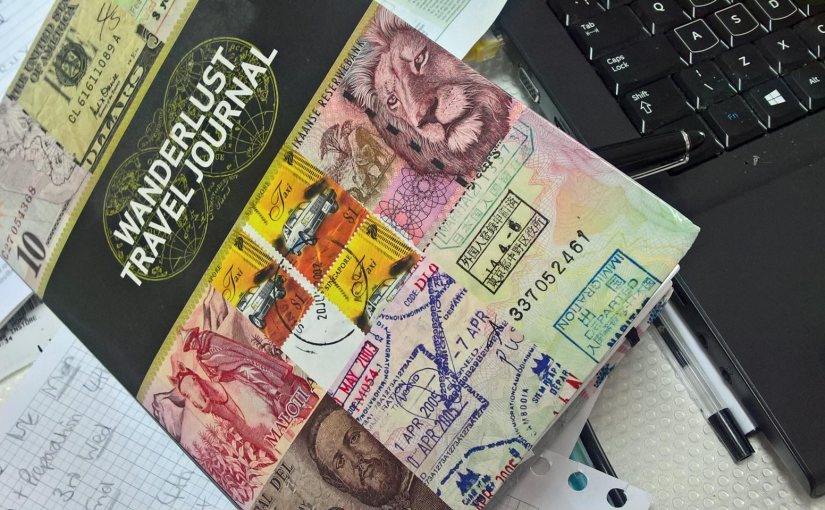
Cathy’s travel stories on ~wander.essence~ has made me hunt out an old travel journal that I used to take with me on overseas trips to look for snippets that could be turned into poems or prose for the travel writing invitations on her site. This is the first of my ‘Impressions’ series and I hope she and you enjoy it.
Carouge, Geneva’s Italianate district, was created by a bunch of architects from Turin in the 18th century as an independent town.
“I catch the tram from Plainpalais to the terminus in Carouge with the intention of walking back to the River Arve following the tram lines to photograph the Italianate architecture.
I am charmed by the shuttered townhouses and thrilled with the hidden courtyards, secret gardens, a small world, typically “carougeois”. I idly wonder if there is a map showing them all, as I poke my nose into a few of them. I eat a wonderful vegetarian wrap in one. The wrap was a little messy to eat, but the combination of crisp lettuce, mozzarella, marinated aubergines and tomatoes was delectable. Only CHF6.50 so a bargain here in Geneva. The courtyard where I am sitting to write this is a delightful restful place. The sound of running water from the drinking fountain can be heard, joyful birdsong and the faint hum of a tram going by, the occasional sound of ringing church bells in the distance. The drinking water is crystal clear and cold. Poured from a sublime brass spout shaped like a jaguar’s head. Why a jaguar? I might be confused.
I draw a little sketch of my courtyard.
Carouge is such a pretty ‘village’. Many of the older buildings have wonderful wooden shutters, some faded and peeling, but just so right, some have wrought-iron balconies often with a bike leaning against them or washing hanging from lines strung between the shutters.
I cannot stop taking photos of the wonderfully ornate fountains that can be found along the street and in the squares. I am fascinated by what I first think are black swans, but later learn are Basilisks, a legendary reptile reputed to be a serpent king who can cause death with a single glance. Although I think the ones below probably ARE swans.
On Wednesdays and Saturdays Carouge gets a further boost with the arrival of the market on the lovely Place du Marché. Although I am unable to buy anything as I am staying in a hotel, I can enjoy looking around the stalls where fruit and veg, cheese, honey, fresh bread, flowers, wine and locally made treats are for sale.
As I drift past fountains and flowers the basilisks with their water spouting out I turn my camera to shops and shop signs, a theatre, more shutters – predominately green – street signs and sculptures, cafés, a church, more fountains.
People come here for the many restaurants and shops. It is true that the area’s numerous independent shops and artisanal workshops turn any shopping spree into an adventure, but I am too curious to be satisfied with that. I want to know what makes Carouge different to the rest of Geneva.
As I reach the River Arve I look along the river before catching a bus back to the city, but Carouge is hidden from view. A secret enclave of Geneva. I like it.”
First there is Hadrian’s Wall.
Milecastles, hill forts and temples and bucket loads of history
from its turbulent English and Scottish conflicts.
Then there are the green fells and bubbling rivers,
stained tea brown from all the tannin.
And the heather-clad Pennines landscape,
Where sheep abound
And rare alpine plants can be found.
Mile upon mile of roller-coaster roads with their blind summits and hidden dips,
Twisting hairpin bends and narrow single lane bridges arching over wee burns.
And long forgotten viaducts striding over a river many vertiginous feet below.
Makes travel here very, very slow.
Invigorating walks lead past cottages built from honey-coloured stone
With pots full of bright red geraniums
and purple petunias cascading down the golden walls.
Where inviting tea-rooms, set amidst old railway tracks,
entice you inside with coffee and cakes to tempt you.
Rich chocolate brownies,
Victoria Sponge,
luxury carrot cake,
and scones with cream and jam.
Then the ultimate temptation –
coffee and walnut cake
And the promise of another walk.
Finding traditional pubs,
One dating back to the 12th century,
Another used as a meeting place in the Jacobite Rebellion,
where once men gathered in shadowy corners to discuss their secrets.
Now the smiling bar-staff greet you with their warm northern accents,
or possibly Polish.
They settle you in the same dark corners
with handwritten menus to inspect
and the daily specials chalked on the blackboard.
Villages and small towns with houses crammed together,
supporting one another down hidden snickets and narrow cobbled lanes,
where secret gardens lie.
Churches within ancient churchyards are open at all times,
Welcoming strangers to view their beautiful stained glass windows, bell towers, carved pulpits and unusual altars,
Or simply to admire the craftsmanship of the homemade pew cushions.
Lovingly stitched by a dwindling congregation.
Finally there’s the coast and the string of castles.
Wide, sandy beaches, river mouths and harbours.
There are tide timetables to consult, so you don’t get cut off.
Micro breweries and Craster kippers to taste,
seals and summer seabird colonies to visit,
There’s no time to waste
There’s a walk to a castle last occupied during the Wars of the Roses,
When the throne of England was hotly contested.
A church cut off from its village by the river changing its course
By a violent storm over two centuries ago.
History is around every corner and in every bloody step
of this ancient border country.
Herons and cormorants and twenty-five white swans
are seen on the River Coquet at Warkworth.
Swifts and finches fly in and out of the barns,
stopping to briefly rest on top of a stone wall beside you,
but not long enough for a photo.
They have things to do.
The call of an owl, the sighting of a hawk,
Dozens of rabbits scurrying around a churchyard at dusk.
A pair of Red Grouse strutting nonchalantly along the lanes
as if they know it’s not the shooting season.
And you sit with your engine idling until they are gone.
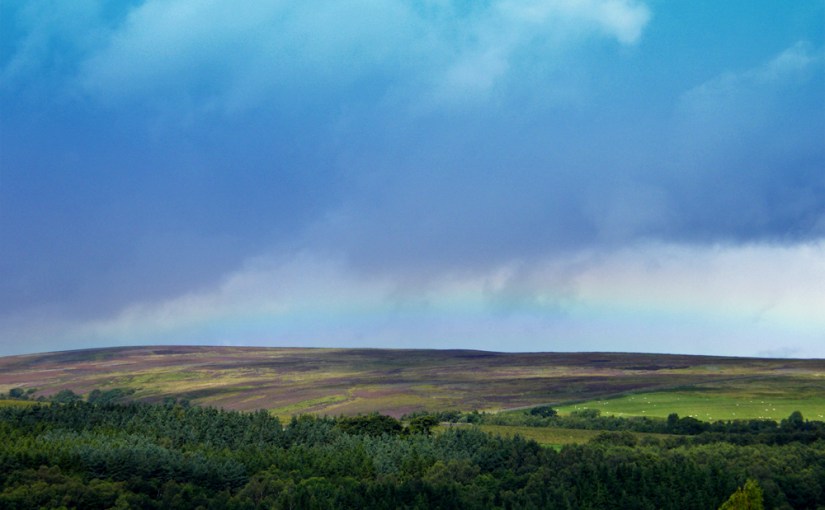
And the sky – the big open sky – cumulus clouds, a rainbow over the fells, the zillion stars and the Milky Way.
You want to gaze at it all the time,
Your eyes are drawn upwards,
It draws your breath away.
Driving home in the dusk after a very long day,
you round a final bend and slam on the brakes.
A young deer glides across the road.
It stops, hesitates, turns towards you,
eyes shining in the headlights,
then disappears back into the gloom of the woodland
from where it came. Serendipity.
When I first wrote about my holiday in the north Pennines and Northumberland it was in words and pictures, but many comments were made about the way the prose was almost poetic. With Cathy’s new blog stimulating creative juices about the way we travel and the different ways we can record it, I was driven to see if I could write an actual poem based on the words I used then. Mostly the same, with some additions and alternatives and of course, no photos. Am I insane to think I can write poetry? I hope you will honestly tell me in the comments below.