
One of my favourite places to take a local walk is in the burial ground of St Leonard’s in Ludlow. The grounds are now a naturalised area for people to enjoy nature and wildlife, an attractive environment that residents and visitors alike can enjoy. There are many trees including Yew trees which were grown to make bows, but as the berries are poisonous to animals (and humans), the trees had to be grown in places like churchyards where animals were excluded.
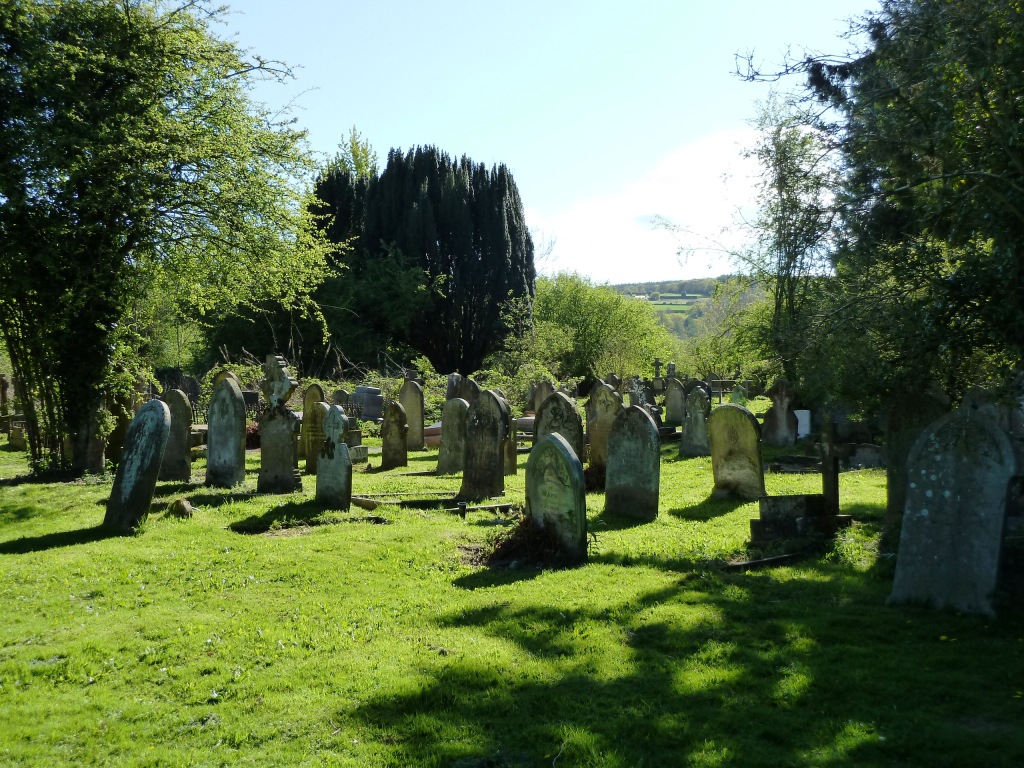
There are also some ageing Lawson’s Cypresses and self-sown Sycamores and Horse-Chestnuts. A large number of birds, butterflies and a colony of rabbits live in the grounds and there are many benches on which to sit and rest and enjoy the birdsong and the countryside views, as well as a few picnic tables and benches situated in a grass clearing.


I love to wander around the monuments and select interesting carvings, words, shapes to photograph. Often hidden by clumps of stinging nettles and moss or lichens each time I visit I see something different.


Perhaps some of you may find it creepy to enjoy a walk amongst graves, but I always find burial grounds so peaceful and relaxing and interesting. I like to imagine the lives of people who have gone before me.

St Leonard’s was first opened in August 1824 when it was clear that the old medieval cemetery was completely full. Space finally ran out during WWI and today the site contains 1400 gravestones, which have been recorded and now provides an important historical document. The site includes five listed war graves, all of which are now accessible to view. These are recorded by the Commonwealth War Graves Commission.

The monuments have remained in place despite repeated threats to clear the land over the years and the recording process not only recovered the texts of the inscriptions, but also demonstrated the order in which the graves were laid out showing how local social hierarchy and the ability to pay determined where the graves were placed.


The site has a long history. In 1349 the area was part of six medieval burgage plots held by Laurence de Ludlow, lord of nearby Stokesay Castle. Laurence founded a convent of Carmelite friars which continued on the site until its suppression by Henry VIII in 1538. The buildings were sold and demolished.
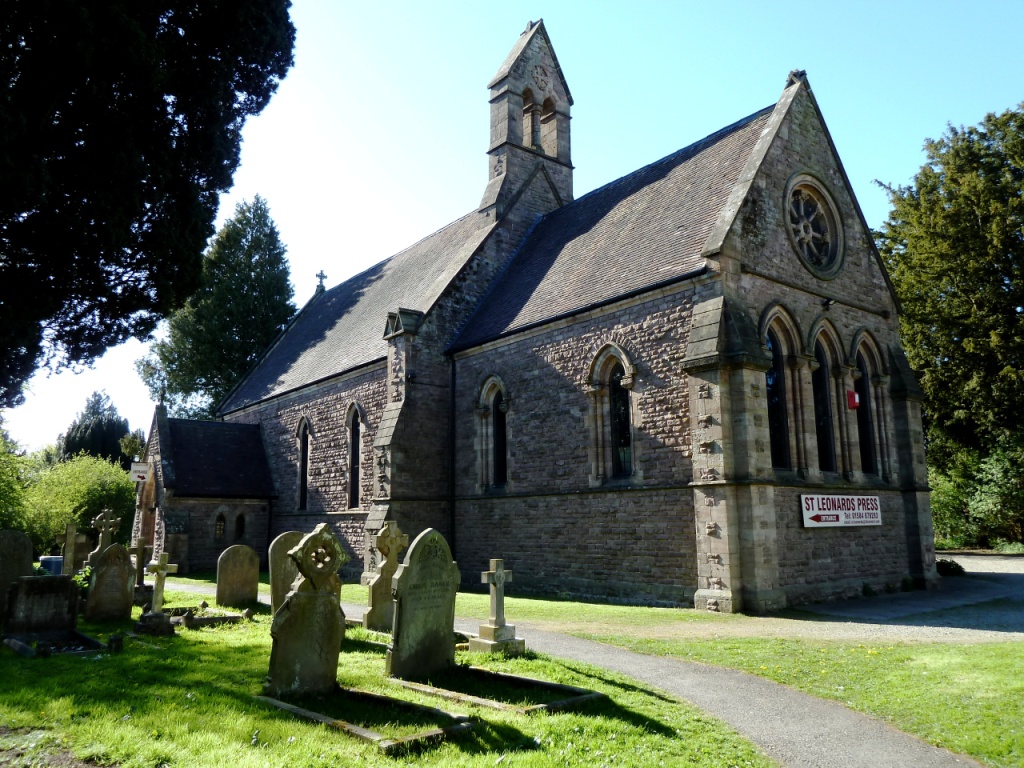
The Victorian building, (above) was formerly the chapel of rest and designed by George Gilbert Scott, an English Gothic revival architect, and opened in February 1871.
If you enjoy a walk, long or short, then have a look at Jo’s site where you are welcome to join in.

 TRAVEL WORDS
Some lovely shots, Jude. Nothing like an old cemetery or church graveyard to provide some interesting things to read about, and designs to admire.
Regards as always, Pete. x
I have many photos of this churchyard, but a lot were taken in poor light. On a sunny day, as this was, it is even more of a delight. And I find something different every visit.
I thought the last photo was an invader from here – the big Bodalla church is gothic revival. Clever colour coordination of lichen and bird; mourningly suitable grey and white flower; lovely sculptural details. And botanical information too, goes without saying! Do you know the symbolism of the hat on the cross? (Is it a hat?)
Oooh, nothing gets past you Meg, you have wonderfully sharp eyes 🙂 I did deliberately place the robin next to the lichen, uncanny how well they matched; the white flower is a blackberry; the hat on the cross is actually a banner wrapped around the cross, not sure what the symbolism is, but I see what you mean. And I even added a horse chestnut flower to the mix especially for you.
I meant to say thanks for the horse chestnut, but there were too many goodies, and I’m a fickle lover.
It does look really peaceful and with lots to stimulate curiosity and the imagination.
I like to go there as it is so quiet! The grockles head for the market and the shops and the castle, very few end up here.
There are usually a few interesting stories to be unearthed in an old cemetery. I love reading the headstones and imagining those people.
Unfortunately many of these headstones are unreadable.
I love wandering round old graveyards too – not creepy at all, though I find looking at some of the memorials very sad. So many children and young people, often from the same family. Lovely pictures as usual.
Churchyards tell their own social history stories don’t they? The one at Haworth (Bronte country) has a lot of graves of very young children as a result of measles, smallpox and other epidemics, apparently 40% died before the age of six in the mid 19th Century. And one on St Mary’s, Scilly Isles has graves of shipwreck victims.
Agreed. A tomb I visit regularly (I’m a tour guide on women’s history walks) is for the 12 year old daughter of a wealthy 19C merchant who lived to a good age himself but lost 5 children before they were 20. So infant mortality was no respecter of class. We live, most of us, in much safer times – very thankful!
Lovely captures of the detail on the gravestones. And of course the Robin 🙂
Couldn’t leave out the robin 🙂
🙂
Well done, Jude. I think historic cemeteries are some of the most interesting artifacts the human population has given us. I can’t imagine why there would be attempts to clear this land which is sacred to many families and carries such historic importance! Hub and I have walked cemeteries often – civilian and military. We don’t have ones that go back as far as your walk, but the varying monuments, cultural clues and family histories are all quite revealing. I love this post and am saving it to savor again!
Thanks so much for your comment Sammy, I mentioned the social history aspect of graveyards in my reply to Anabel. I must admit I don’t find modern ones very interesting, but perhaps I should pay more attention to them.
They aren’t as compelling aesthetically but I do understand the newer ones carry just as much emotion as older ones for the families. Of course we have NONE as old as yours !!
Not only is the walk peaceful but interesting too. Those tombstones do have a story to tell.
Yes, there is always something different to catch the eye.
Oh yes! I too noticed the proximity of bird and lichen with matching vibrant colors. Mother Nature (you?) has a well-coordinated eye in the wilds!
And there I thought I was being so subtle that no-one would notice the colour combination 🙂
It was too vibrant to miss 😀. Gray we would have overlooked (unless you called it gray when it was blue). *wink*
[looks up at the ceiling wondering what on earth she is on about…] 🙄
LOL
I hope they never get to clear this land…like you, I enjoy walking around graveyards. One I want to get back to is Nunhead – very overgrown, back to nature in parts. But as the paths are uneven, I need to go with a friend now….one day, I’ll sort it!
I was sorry to miss the one near the hotel in London last year, but I was too tired to go out again after a day in the city. I loved the Waverley cemetery in south Sydney for the elaborate statuary.
Don’t talk to me about being tired!!
😦