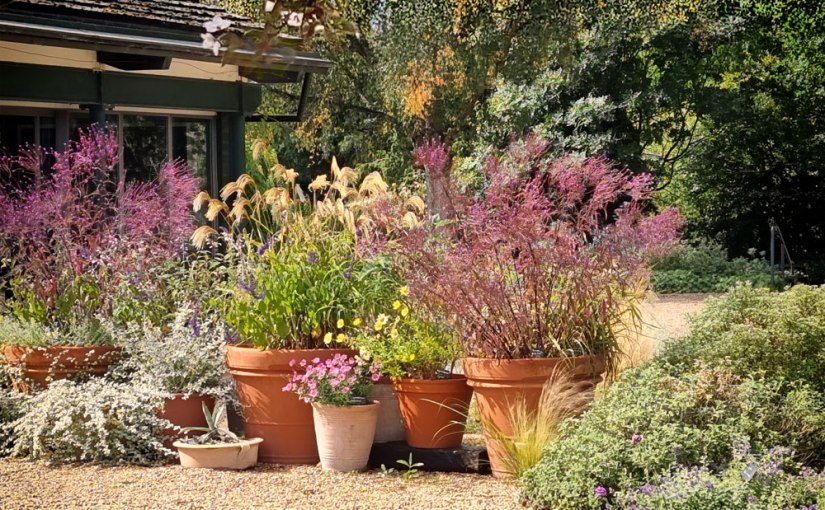

Beth Chatto transformed an overgrown wasteland deemed unfit for fruit farming, into a series of informal gardens. As the conditions within the garden vary widely, five distinct areas have been created providing useful examples of working with nature to find the right plant for the right place.

The world-famous drought-resistant Gravel Garden, created in 1992, began as an experiment to replace sun-scorched grass with a living garden of drought-tolerant plants.


The Gravel Garden, once a car park, was originally planted by Beth and her team as an experiment to test a range of drought-tolerant plants. The garden is famous for the fact that it is never watered, despite being situated in one of the driest parts of the country and having naturally occurring, free-draining soil.


 TRAVEL WORDS
WOW, what a beautiful garden. But we wonder too how to keep the gravel weed-free.
The Fab Four of Cley
🙂 🙂 🙂 🙂
This is a great continuity of Beths vision. Here in Arizona we work hard at xeriscaping. its not joke. It is hard stuff. And patience is everything. Gorgeous. And I am sure there are those who love to weed the gardens. I can only say that because I am one of them .
The grasses are lovely and really give shape and height.
This garden has been a huge influence on me, and her book about it too. I think gardening for drought is going to be even more important in the future, especially in this area, so Beth had a lot to teach us. (You were unlucky with the downpour – up until this month we’ve had very little rain.)
It was like that all week. Sunshine and then heavy showers. Same since we returned home.
Our garden was grateful for it! The ground has been desperately dry for a long time, but now it’s possible to dig again and I can move some plants around… 🙂
A garden that once was a car park and so beautiful without being watered – that’s quite amazing. Beth Chatto’s Gravel Garden is definitely an inspiration. Love your photos.