postcard from america

Ferry Landing Coronado, San Diego

“It was a sunny and warm Sunday morning so we took the short ferry crossing from Broadway Landing to the island of Coronado in order to partake in brunch at the Il Fornaio Restaurant. Which was excellent. So much so that we booked dinner there later in the week. After our brunch we looked around the waterfront shopping centre with its shops and art galleries at Ferry Landing and then had a stroll along the sandy beach watching wading birds along the seashore.”

(in late February 2010)

On Journey

It was hot. Unusually so for Switzerland in late September. The lake was covered in  a hazy fog as the boat (Henri Dunant) left Geneva at 09:15 and sailed from one quay to another along the Swiss shore before zigzagging across the lake to the French side.

After coffee and a croissant in the restaurant I took myself up onto the deck so I could absorb the scenery. As we approached each town, buildings appeared and disappeared through the mist: church towers and romantic turrets, quays adorned with flowers and queues of people patiently waiting in the soft sunshine, shuttered windows and petite balconies overlooked the lake.

Sleepy boats tied to wooden jettys belonging to millionaire’s houses on the shoreline. Autumnal tints in the trees. A white swan at Coppet. Straight lines of vineyards on the hillside.

The sun broke through as we left Nyon. A yacht lazily passed by, not much wind in its sails. As we approached Nernier on the French shore, the mist revealed a quiet harbour. Covered boats, closed parasols, empty chairs on the terrace of the café, odd pollarded trees.

Departing we got our first glimpse of Yvoire. My destination. The marina and the chateau and the shiny silver-topped church steeple.

I had read about this medieval town famous for its flowers and ‘Le Jardin des Cinq Sens’ (The Garden of Five Senses) and knew that during my brief visit to Geneva I had to try to get there. As the boat left the dock I was eager to depart and start photographing the floral town.

It is rare that I choose to travel by water. I am not a good sailor, but a lake is generally calm and it is not usually a problem plus on this occasion I was drawn a place that I couldn’t easily reach any other way. On the journey back to Geneva I managed to catch one of the jewels in the Belle Epoque fleet – the Savoie – an elegant paddle steamboat which deserves its own post.

~wander.essence~  On Journey

home thoughts from abroad

Home thoughts from abroad is a new series on Travel Words featuring a single photograph(s) that reminds me of a country visited and showing something that uniquely identifies it as being ‘abroad’.

La Pagode

Wandering around the 7th arrondissement of Paris I stumbled across this unusual building partially hidden by bamboos and wisteria.  The director of the department store Bon Marché had it constructed  as a gift for his wife in 1896. La Pagode became a cinema in 1931 and has played a big part in presenting cutting edge French cinema to the public. Jean Cocteau held the premiere of Testament d’Orphée here in 1959 and La Pagode Cinema played an important part in promoting the films of Ingmar Bergman and Sergei Eisenstein in France. Now it shows Art-house, foreign, cult and independent new releases. It is not uncommon for the cinema to hold retrospectives for directors such as Woody Allen and Alfred Hitchcock.

There is a tea house where you can grab a cuppa and chew over the fat in the rather small, but very pretty Japanese garden where you can get a glimpse of La Pagode and the beautiful details of colourful painted flowers,  carved dragons, flowers and birds in jade or ivory and large stained glass windows with geometric panes. It sounds as if it could be quite kitsch, but in reality it is an impressive building. I did not go inside, but apparently it is equally surprising.

I only hope that someone carries out some repairs on this extraordinary building, so that it is not lost.

Located on 57 bis, Rue de Babylon

Impressions

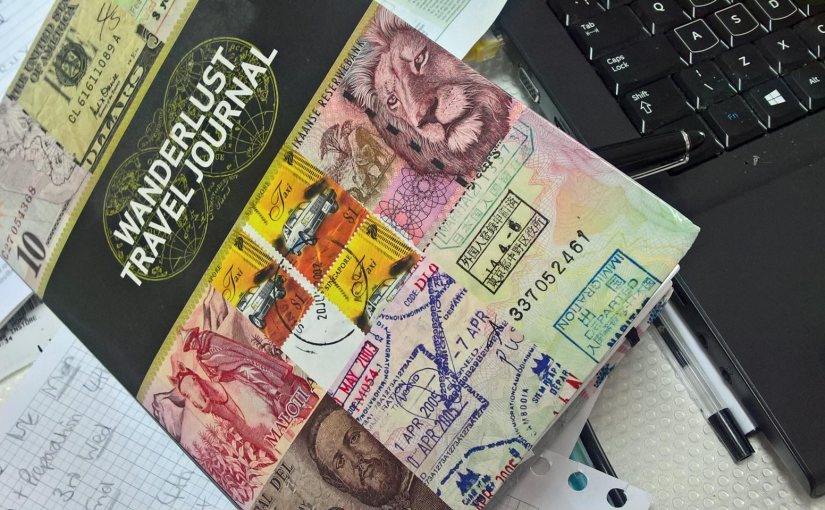
Cathy’s travel stories on ~wander.essence~ has made me hunt out an old travel journal that I used to take with me on overseas trips to look for snippets that could be turned into poems or prose for the travel writing invitations on her site. This is the first of my ‘Impressions’ series and I hope she and you enjoy it.

Carouge, Geneva’s Italianate district, was created by a bunch of architects from Turin in the 18th century as an independent town.

“I catch the tram from Plainpalais to the terminus in Carouge with the intention of walking back to the River Arve following the tram lines to photograph the Italianate architecture.

I am charmed by the shuttered townhouses and thrilled with the hidden courtyards, secret gardens, a small world, typically “carougeois”.  I idly wonder if there is a map showing them all, as I poke my nose into a few of them. I eat a wonderful vegetarian wrap in one. The wrap was a little messy to eat, but the combination of crisp lettuce, mozzarella, marinated aubergines and tomatoes was delectable. Only CHF6.50 so a bargain here in Geneva. The courtyard where I am sitting to write this is a delightful restful place. The sound of running water from the drinking fountain can be heard, joyful birdsong and the faint hum of a tram going by, the occasional sound of ringing church bells in the distance. The drinking water is crystal clear and cold. Poured from a sublime brass spout shaped like a jaguar’s head. Why a jaguar? I might be confused.

I draw a little sketch of my courtyard.

Carouge is such a pretty ‘village’. Many of the older buildings have wonderful wooden shutters, some faded and peeling, but just so right, some have wrought-iron balconies often with a bike leaning against them or washing hanging from lines strung between the shutters.

I cannot stop taking photos of the wonderfully ornate fountains that can be found along the street and in the squares. I am fascinated by what I first think are black swans, but later learn are Basilisks, a legendary reptile reputed to be a serpent king who can cause death with a single glance. Although I think the ones below probably ARE swans.

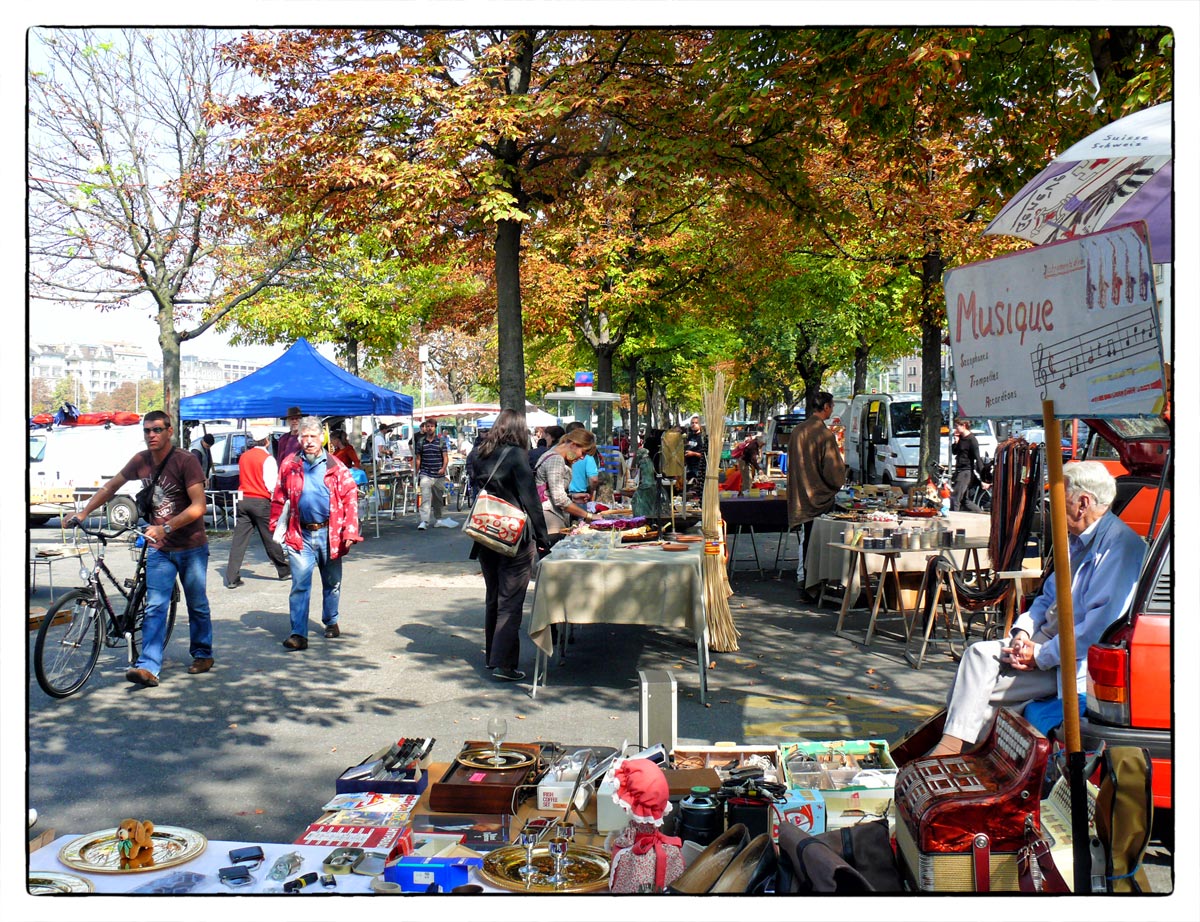
On Wednesdays and Saturdays Carouge gets a further boost with the arrival of the market on the lovely Place du Marché. Although I am unable to buy anything as I am staying in a hotel, I can enjoy looking around the stalls where fruit and veg, cheese, honey, fresh bread, flowers, wine and locally made treats are for sale.

As I drift past fountains and flowers the basilisks with their water spouting out I turn my camera to shops and shop signs, a theatre, more shutters – predominately green – street signs and sculptures, cafés, a church, more fountains.

People come here for the many restaurants and shops. It is true that the area’s numerous independent shops and artisanal workshops turn any shopping spree into an adventure, but I am too curious to be satisfied with that. I want to know what makes Carouge different to the rest of Geneva. 

As I reach the River Arve I look along the river before catching a bus back to the city, but Carouge is hidden from view. A secret enclave of Geneva. I like it.”

~wander.essence~ prose