Alert Bay III: Origin of the ‘Namgis

Long ago when the world was young, after the great flood, a giant halibut (so big you could stand on it) lived at Xwalkw (the mouth of the Nimpkish River). One day he swam ashore and transformed himself into a human. He built a house and made huge beams to be placed on top of the vertical poles, but he was unable to lift them into place. As he worried about his problem he heard a noise and turned around to see a Thunderbird alight on a huge rock.

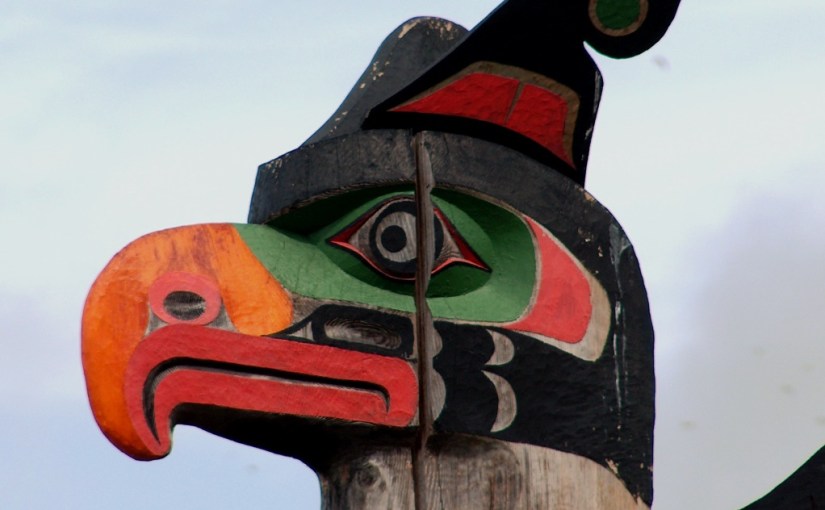
This supernatural bird offered assistance and grasping a beam in its talons, flew into the sky and put the beam in position. Then he descended and removed the Thunderbird mask and costume and ordered them into the sky saying “You shall never flap your great wings to cause thunder, nor flash your great eyes to cause lightning, only when death comes upon a prince or princess of my descendants.”

He then announced that he would be the brother of the first man and began to build a house for himself. This is why the ‘Namgis have the right to display the Thunderbird and the Halibut as their crests.

Alert Bay II: Totem and Memorial Posts

One of the attractions of visiting Alert Bay on Cormorant Island is to go out on the water to look for pods of Orcinus orca (killer whales) that are regular visitors in the waters around Alert Bay from June to October. The other is that Alert Bay is a rare and remarkable aboriginal cultural destination, steeped in history, natural beauty and living tradition. The ‘Namgis peoples, a First Nations band within the larger Kwakwaka’wakw nation of northern Vancouver Island live here on a slice of territorial lands traditionally known as ‘Yalis. It is a very interesting island to visit and well worth the long trip up the mainland to reach it.

A visit to the impressive U’mista Cultural Centre is a ‘must-do’ as well as seeing the world’s largest totem pole and a roadside First Nations’ graveyard filled with totem and memorial poles.

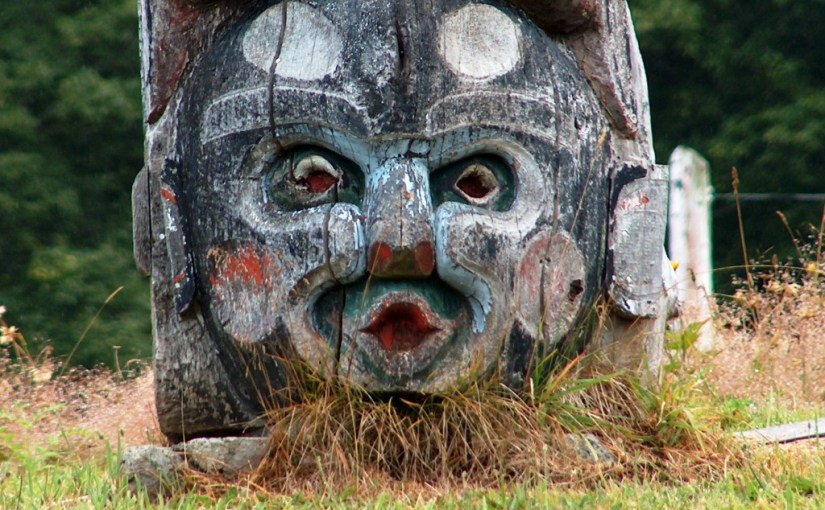
The burial ground in Alert Bay contains memorial totem poles marking the graves of members of the Kwakwaka’wakw. Figures on the poles depict family crests. The one at the top signifies the most important family symbol. The figures represented on the totem poles are those from mythology who became, or were encountered by, ancestors of the group who later took them as their crests. The Kwakwaka’wakw families claim the Thunderbird as a crest. He descended from the sky and became human. The raising of a totem pole was usually accompanied by a potlatch.

Figures featured on the poles include the eagle, raven, frog, killer whale (orca), grizzly bear, thunderbird, beaver, dogfish, salmon, wolf and Dzunukwa, a fearsome giantess of the dark forest. She is always painted in black with half-closed eyes and pursed lips.

Alert Bay I: Arrival

After a fun afternoon exploring Telegraph Cove we headed back to the 19 and on towards Port McNeil where we got the 40 minute ferry ride across to Alert Bay. It is an important fishing community and has been the traditional home to the ‘Namgis First Nation for thousands of years. It was named by Captain G H Richards of the Royal Navy in 1860 after HMS Alert, a screw corvette serving on the Pacific station at the time. We stayed in a small cabin right on the water’s edge with stunning sunset views back towards the mainland, and a deck where we could watch the fishing boats and whale watching boats coming in and spot herons and cormorants.

We had booked a whale trip for the Monday, but meanwhile had the whole island to explore. The weather wasn’t all that great – lots of fog and mist – but there was still a lot to see and do. Even spending a couple of hours photographing the beach for flotsam and jetsam was huge fun. We had great baked oysters with spinach and parmesan for dinner on Saturday although finding somewhere to dine on the Sunday was rather more challenging. The boat trip was brilliant even though it was so foggy that we could barely make out the pod of orcas we were following plus they were so quick leaping out of the water that most of our photos showed absolutely nothing at worst and the tip of a fin at best! But listening to them communicating with each other was the best.

Telegraph Cove

On our first visit to Vancouver Island, way back in 2005, we moved northwards after spending a week in the Comox Valley area to spend a few days in Alert Bay, a small settlement on the Cormorant Island which lies off the northeast corner of the Island in the Inside Passage, a 40 minute ferry ride from Port McNeil. (See the map on the Victoria 1 post). Our main reason for going there was to go on a boat trip to look for killer whales (Orcas – the lovely black and white ones).

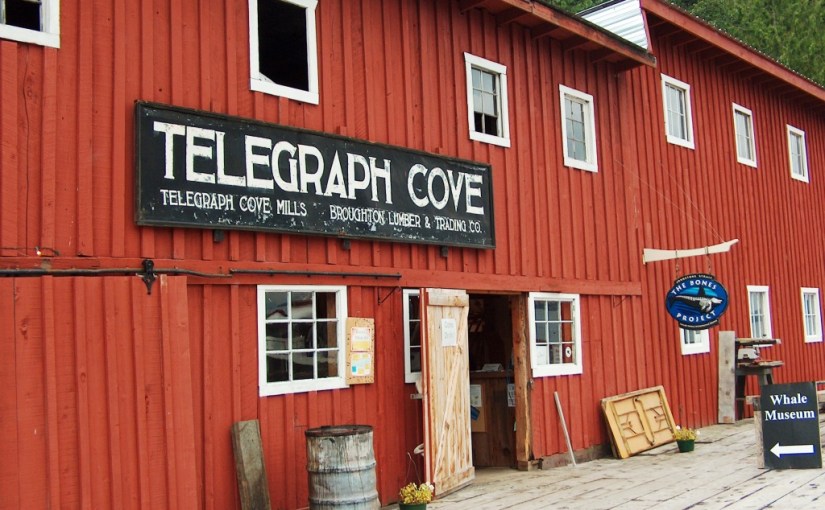
Before we reached Port McNeil though we decided to branch off at the Nimpkish Lake to the small community of Telegraph Cove which is about 130 miles northwest of Campbell River. Historic Telegraph Cove is British Columbia’s last boardwalk community. It grew out of a one-room station at the northern terminus of the Campbell River telegraph line in 1911 into a chum salmon saltery and later a small sawmill. It hasn’t changed much over the years. Its history is well-remembered and the homes reflect the original era. The sawmill closed in the mid 1980s and the only future seemed in tourism. Today its economy is primarily based on tourism with its proximity to the Robson Bight ecological reserve.

Whale watching, grizzly bear viewing excursions and kayaking are popular activities on the Johnstone Strait and Knight Inlet and most of the cabins on the picturesque boardwalk are holiday rentals or tourist shops and cafés. The Johnstone Strait and Broughton Archipelago are home to a bounty of nature’s magnificence including humpback whales, Steller sea lions, dolphins, porpoises, bald eagles and so much more. The sheltered cove and the chance to see a pod of killer whales have attracted many people to this delightful boardwalk village.

When we visited we encountered the Telegraph Cove Road Improvement project and had an interesting drive on gravel and unpaved diversions past logging yards and sawmills to reach the unique boardwalk resort. Now you will be pleased to hear it is a wide, realigned and paved road all the way. Although I actually quite liked the adventure of “off-roading”.

So here are a few pictures of Telegraph Cove and I will follow with a few posts about Alert Bay as it really is a gem of a find.

The Butchart Gardens

Although we didn’t visit the Butchart Gardens on this trip, it would be remiss of me not to mention it as it is possibly the most spectacular floral display on the continent. It began as a limestone quarry in 1904 established by Robert and Jennie Butchart. They created a family home nearby with sweetpeas and rose bushes. As Mr. Butchart exhausted the limestone deposits his wife began to create a sunken garden in the abandoned quarry and went on to develop other areas such as the Italianate, Japanese and Rose gardens. Successive generations of the family have cared for the gardens which attract  a million people annually. Continue reading The Butchart Gardens