Alert Bay IV: U’mista Cultural Centre

The Meaning of U’mista

In earlier days people were sometimes taken captive by raiding parties. When they returned home, either through payment of a ransom or by a retaliatory raid, they are said to have “u’mista”. The return of treasures from distant museums is a form of u’mista.

U’mista Cultural Centre is one of the longest-operating and most successful First Nations cultural facilities in BC, founded in 1980 as a ground breaking project and houses one of the finest collections of elaborately carved masks, depicting the Potlatch Ceremony of the Kwakwaka’wakw. It is now a modern museum and education centre in Alert Bay with an extensive art gallery.

The Potlatch Ceremony

Was a gathering which served to validate important events such as the naming of children, marriage, death and the exchanging of rights and privileges. (A Copper documented important events and transactions engaged in during the life of its owner and symbolised wealth. It increased in value every time it changed hands).

The ceremony was first outlawed in Canada between 1885 and 1951.  The masks and other regalia that you see in the cultural centre were all confiscated after an illegal potlatch in 1921.  After the ban was lifted, the Kwakwaka’wakw people fought for decades for the return of their sacred regalia that had ended up in museum and private collections around the world.

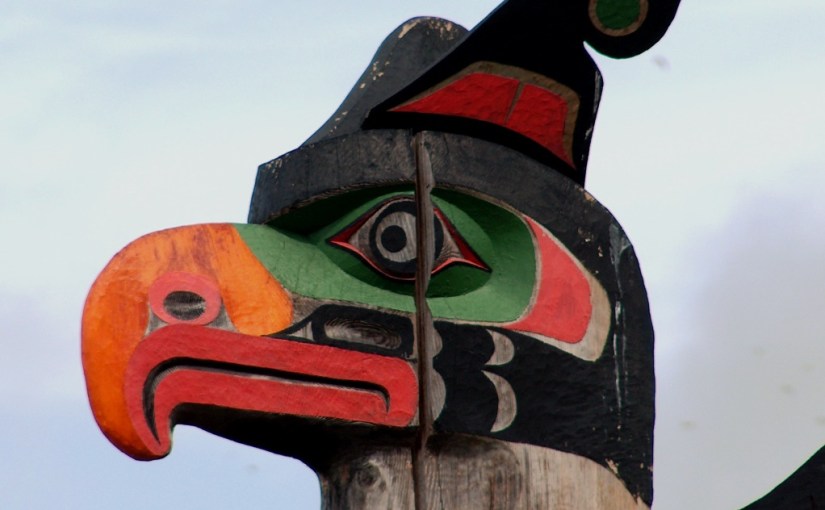
The design on the front of the centre is based on ‘Namgis Chief Tlakwudlas’ Big House c 1873 and depicts a Thunderbird and a Killer Whale.

Alert Bay III: Origin of the ‘Namgis

Long ago when the world was young, after the great flood, a giant halibut (so big you could stand on it) lived at Xwalkw (the mouth of the Nimpkish River). One day he swam ashore and transformed himself into a human. He built a house and made huge beams to be placed on top of the vertical poles, but he was unable to lift them into place. As he worried about his problem he heard a noise and turned around to see a Thunderbird alight on a huge rock.

This supernatural bird offered assistance and grasping a beam in its talons, flew into the sky and put the beam in position. Then he descended and removed the Thunderbird mask and costume and ordered them into the sky saying “You shall never flap your great wings to cause thunder, nor flash your great eyes to cause lightning, only when death comes upon a prince or princess of my descendants.”

He then announced that he would be the brother of the first man and began to build a house for himself. This is why the ‘Namgis have the right to display the Thunderbird and the Halibut as their crests.

Telegraph Cove

On our first visit to Vancouver Island, way back in 2005, we moved northwards after spending a week in the Comox Valley area to spend a few days in Alert Bay, a small settlement on the Cormorant Island which lies off the northeast corner of the Island in the Inside Passage, a 40 minute ferry ride from Port McNeil. (See the map on the Victoria 1 post). Our main reason for going there was to go on a boat trip to look for killer whales (Orcas – the lovely black and white ones).

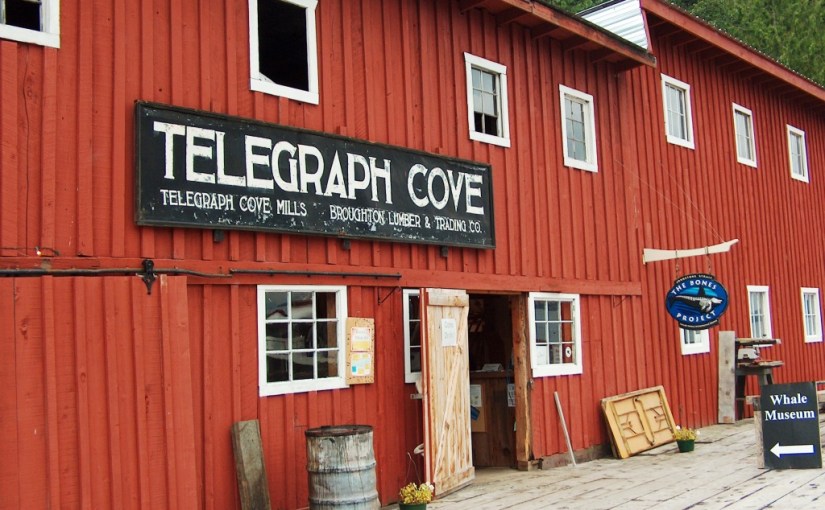
Before we reached Port McNeil though we decided to branch off at the Nimpkish Lake to the small community of Telegraph Cove which is about 130 miles northwest of Campbell River. Historic Telegraph Cove is British Columbia’s last boardwalk community. It grew out of a one-room station at the northern terminus of the Campbell River telegraph line in 1911 into a chum salmon saltery and later a small sawmill. It hasn’t changed much over the years. Its history is well-remembered and the homes reflect the original era. The sawmill closed in the mid 1980s and the only future seemed in tourism. Today its economy is primarily based on tourism with its proximity to the Robson Bight ecological reserve.

Whale watching, grizzly bear viewing excursions and kayaking are popular activities on the Johnstone Strait and Knight Inlet and most of the cabins on the picturesque boardwalk are holiday rentals or tourist shops and cafés. The Johnstone Strait and Broughton Archipelago are home to a bounty of nature’s magnificence including humpback whales, Steller sea lions, dolphins, porpoises, bald eagles and so much more. The sheltered cove and the chance to see a pod of killer whales have attracted many people to this delightful boardwalk village.

When we visited we encountered the Telegraph Cove Road Improvement project and had an interesting drive on gravel and unpaved diversions past logging yards and sawmills to reach the unique boardwalk resort. Now you will be pleased to hear it is a wide, realigned and paved road all the way. Although I actually quite liked the adventure of “off-roading”.

So here are a few pictures of Telegraph Cove and I will follow with a few posts about Alert Bay as it really is a gem of a find.

The Butchart Gardens

Although we didn’t visit the Butchart Gardens on this trip, it would be remiss of me not to mention it as it is possibly the most spectacular floral display on the continent. It began as a limestone quarry in 1904 established by Robert and Jennie Butchart. They created a family home nearby with sweetpeas and rose bushes. As Mr. Butchart exhausted the limestone deposits his wife began to create a sunken garden in the abandoned quarry and went on to develop other areas such as the Italianate, Japanese and Rose gardens. Successive generations of the family have cared for the gardens which attract  a million people annually. Continue reading The Butchart Gardens

The Saanich Peninsula

Our final day on the island and we awoke to rain – the first we had encountered during this trip and a forecast of worse to come. Well we’d done quite a lot – again – and not enough – again – so today would be a “quiet day”. We had contemplated a visit to the world-famous Butchart Garden, a must see if you have not been there and like gardens of course. Instead we decided on the little known Abkhazi Garden in Oak Bay, which has been designed around the glaciated rocky slopes and magnificent Garry oaks. Continue reading The Saanich Peninsula