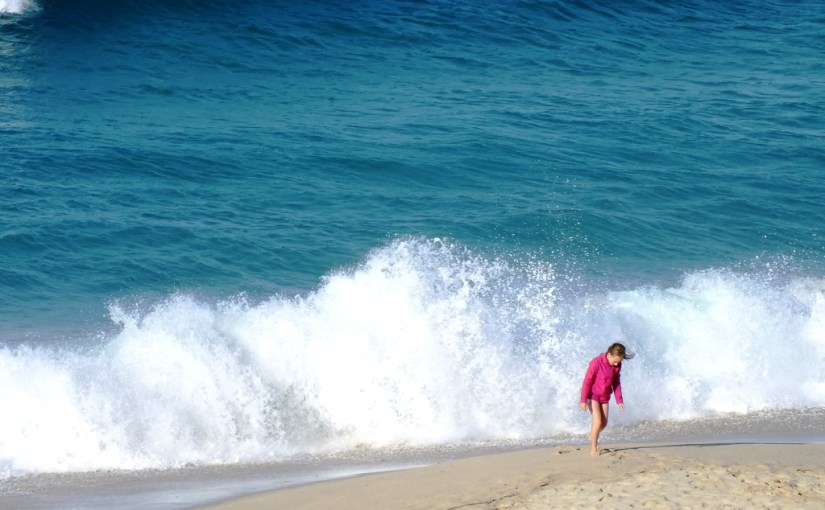
It’s hard not to fall in love with Cornwall where a magnificent coastline wraps itself around 300 miles of diverse landscapes. The big skies and wilderness of Bodmin Moor to the north with walking trails and prehistoric remains, further south the sun turns the sea turquoise and the land is scattered with Bronze age standing stones and Celtic crosses where the natural light is so blinding. In the west there is a special art scene and Cornwall is becoming a real foodie heaven with top-class chefs producing gourmet menus, daily offerings of fresh fish and seafood and local produce such as cheeses, wine and meat widely available from delicatessens, farmers’ markets and roadside stalls, not to mention Cornish pasties and well-loved clotted cream teas. Continue reading Cornish Harbours
Category: Europe

Lost in Venice
I have always yearned to visit Venice, the city that is sinking and often stinking, but which is unique – a sanctuary on a lagoon that is virtually unchanged for six hundred years and a monument to the glory days of the Renaissance. On a trip to Lake Bled in Slovenia in 2012 my husband and I were close enough to go there on a day trip – a long drive, but easier by a coach tour than trying to do it by public transport. Continue reading Lost in Venice
A Quiet Corner in Slovenia
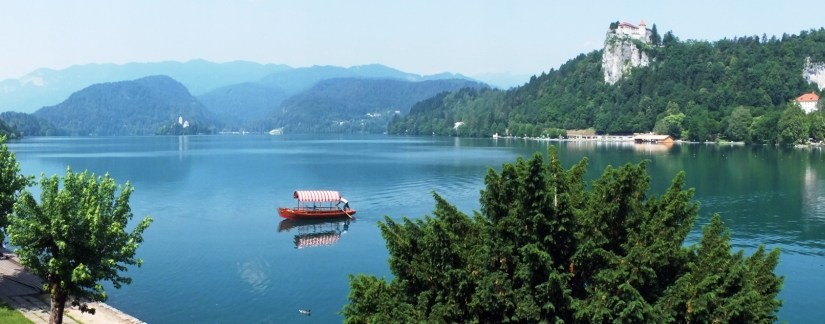
Bled and its perfectly formed lake located in the Julian Alps is in the Gorenjska region of Slovenia, not far from the Austrian and Italian borders. A lake just the right size for a comfortable stroll around its shores with spectacular views from all sides. We found ourselves there for a week in June 2012 when my OH attended a conference. Not far from the airport it was a quick transfer to the Hotel Golf, an ugly sugar-cube building above the lakeside, which had pluses and minuses.
The plus was a lakeside room with wonderful panoramic views. The minuses included no air-con, a steep climb back to the hotel from the lakeside, poor breakfasts and a noisy bar close-by where the natural amphitheatre of the lake basin amplified the sound.

Lake Bled

Pletna Boat

A large brood
The 6 km trail around the lake is long enough to take in the views of the island with the Church of the Assumption which demands a climb up the 99 stone-step staircase; visitors should ring the bell for good luck, and a local tradition at weddings is for the groom to carry his bride up these steps. Behind the island the background is of the Karavanke mountains. The castle is perched on the high limestone mass at the north of the lake and you will see the colourful traditional Pletna boats and boatmen who will row you over to the island; swans, ducks and fish swim in glacial waters so clear you can see the bottom. There are convenient benches for you to rest and absorb the beauty surrounding you.

Relax

Silver fishes

Island and Church

Pletna Boats

The Ninety-nine Steps

Sv Martin Church
The lakeside town is charming and popular with lovely cobbled streets in the old town, plentiful lakeside restaurants serving the famous Bled cake (kremna rezina), a delicious custard and cream confection, and the lovely neo-gothic St Martin’s Church below the Castle. The castle can be reached up a steep route from the Castle beach, or slightly less tortuous routes by road from behind the Bledec hostel. The castle offers magnificent views and is an interesting medieval fortress, well worth the effort of getting there.

Bled Castle

Castle details

View east from the castle
When you are tired of the scenery around the lake you can visit Vintgar Gorge, 4 km north-west of Bled. A public bus will get you there and back. The 1.6 km gorge carves its way through vertical rocks and you alternate between paths and boardwalks alongside the River Radovna and its waterfalls, pools and rapids crossing over wooden bridges. It is a lovely cool place to visit on a hot day.
The Triglav National Park covers almost the entire Julian Alps and offers a completely different experience. Majestic mountains, steep gorges, clear mountain streams and traditional farms. Take an exhilarating and spectacular drive up the hairpin bends of the Russian Road to the Vršič Pass which is on the border with Italy.
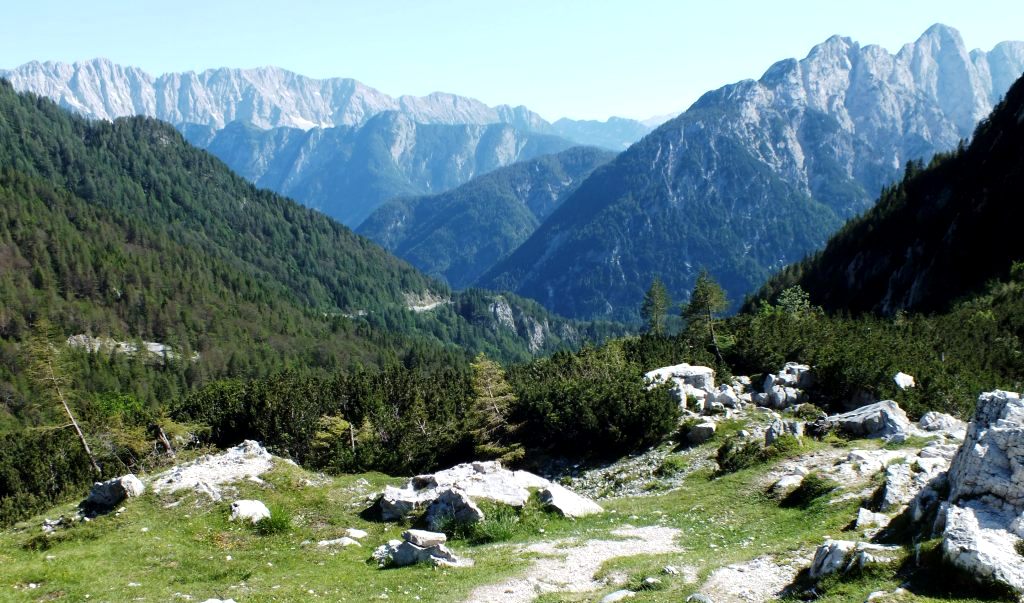
Not only is it special for the views and scenery, but there is a history behind its existence. It was built by Russian prisoners-of-war in 1915 and because the road had to be kept open all year round, prisoners were kept in camps to shovel off the snow. In 1916 an avalanche buried one of these camps killing around 400 prisoners and 10 guards. There is a small cemetery near hairpin 4 and a beautiful Russian Orthodox Chapel on the site of the camp at hairpin 8.

Hotel on route

Russian Road Info

Restaurant

Vrsic pass

Heading down the pass

Triglav National Park

Hindringham Hall
Hindringham Hall is privately owned, but the gardens are open to the public each Wednesday during the summer season and four times a year there is a tour of the house itself. We booked one of the two holiday cottages for a fortnight in the North Norfolk countryside, though I was worried that being four miles from the wild north coast, to which I am strangely drawn, would be too far. I should not have fretted, as it was an ideal location. Far enough away from the madding crowds, but close enough to visit regularly enough. And entering the five-barred gate, driving down the long gravel driveway and crossing the moat bridge leading to the hall was a lovely experience – for two weeks we could pretend to be Lord and Lady of the Manor 😉

View from the Moat Bridge

Stepped Gables

The Hall from the Bog Garden

Herbaceous Borders

Entrance to the west lawn

Statue

The West Lawn
The village of Hindringham is typical of many small villages in the countryside today (not only in Norfolk) where there are few, if any, amenities. There is no village store or post office, no butcher or baker or indeed a candlestick maker, and the only pub is a bar in the cricket pavilion – aptly called The Pavilion – which is run by the community and only open on a Friday evening! Oddly enough though there is a Primary School, a large village hall and the church so you might have expected a shop at least.
Parts of Hindringham Hall were probably built from some of the stone torn down from the nearby Binham Priory, but it has been extended over the generations. It is now a handsome stepped-gabled building with a complete moat and a characterful history. There are not many fully moated houses remaining in the county; Oxburgh Hall (which has historical connections with this hall) is another.
The gardens are in several different sections, some outside the moat and the more private areas within the same plot as the house and bordered by the moat. In late summer they were probably not showing at their best, but there is still enough of interest to spend an hour or two drifting around them and finishing with a nice cuppa on the lawn. The walled kitchen garden was impressive for its well-stocked soft fruit bushes, salads, potatoes, beans and fragrant herbs mingling with the sweet scent of the colourful jewel-like sweet-peas. The buddleias alongside the moat opposite our cottage were smothered in butterflies the whole time – Large Whites, Painted Ladies, Red Admirals, Commas and a profusion of Peacocks. Within the private, walled, west lawn to the side of the house various clematis clung to the walls or pergolas, stone urns frothed with Pelargoniums and beautiful Romneyas stole the show, their egg yolk centres gleaming within the startling white, crêpe petals.

Sweet-peas and Teas

Clematis

Pelargoniums

Buddlieas and Butterflies

Ligularia Dentata

Day Lilly

Romneya
Roses and clematis wound their way around the thick rope-hung poles bordering the gravel driveway near to the front of the house and vibrant blue African Lilies provided splashes of intense colour. The roses were already ‘gone over’ by the time of our visit, but I am sure they would have been lovely.

White Doves

View of the Countryside

Moat

Black Swan

Sunset
I needn’t have worried being away from the coast. Sitting, relaxing in the sunny, private garden of the cottage lazily watching the bright blue damselflies and red dragonflies flitting around, spotting the heron fishing in the moat, listening to the ducks and solitary black swan calling, seeing a sky streaked with oranges and lemons and stars shining from an inky background and drifting off to sleep with echoes of the soft hoot of a tawny owl is really what a holiday is all about.
The Priory Church of St Mary and the Holy Cross, Binham
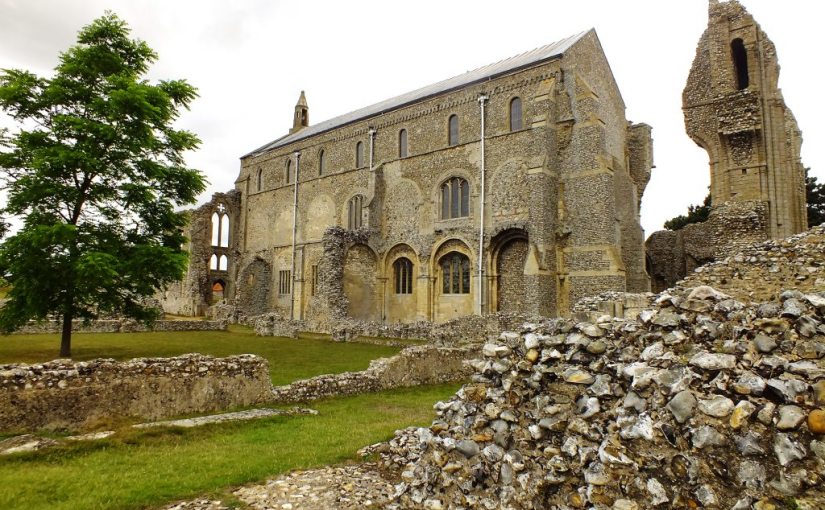
The Priory Church of St Mary and the Holy Cross, Binham was only a mile or so away from where we were staying so the first historical place we visited. The ruins of the 11th century Benedictine monastery are impressive, especially the nave which is now the parish church. The Reformation in 1539 saw the closure of the monastery and the buildings were dismantled. In fact the original building of Hindringham Hall where we stayed (in a cottage, not the actual hall) was built from stone from the monastery!
The most striking feature of the church at Binham Priory is the oddly blocked-up west front and windows which were bricked up between 1738 and 1780. It is an impressive building due to its size and the contrasting brick and stone work. It is also important from a historical aspect as an example of Early English gothic architecture in the 13th century. The west window (top) is thought to be an early example of ‘bar tracery’ in England. It certainly is very beautiful. In the spandrels and heads of the arches a variety of patterns are pierced into the stonework: quatrefoils, cinquefoils, trefoils and sexfoils, culminating in the octofoil at the head of the west window.
Foil = Lobe or leaf shape formed by joining of curved shapes in tracery: trefoil (three), quatrefoil (four), cinquefoil (five), sexfoil (six), octofoil (eight)

West Front

trefoil, cinquefoil and sexfoil

Headstone

Side of the nave

Octofoil (eight)

Quatrefoil (four)
Inside the church is light and bright. The font is perpendicular – 15th century – and has eight sides. It is known as a Seven Sacrament font because of the carvings around the bowl, each one of which illustrates one of the sacraments of the church. This is a particularly East Anglian design and none are known elsewhere; there are 16 in Norfolk and 12 in Suffolk remaining. It would have been brightly painted.

Misericord bench carving

A lion

A swaddled baby

The rood screen

The font

A lady

Poppy Head Pews

The Rood Screen

The Font
The Poppy Head Pews are another interesting feature of this church. During the fifteenth and sixteenth centuries, the benchends became more elaborately carved, with panelling and figures of people or animals, often humorous and frequently decidedly secular. Not all benches had backs to them (as in Cawston Church, Norfolk) and those which did had simple designs, some of which were added at a later date.
There are two misericord benches at the east end of the church decorated with a bearded head and foliage and the remains of the former rood screen which was painted over after the Reformation. The original medieval painted saints are now showing through.
In a beautiful quiet corner of the North Norfolk countryside, only a few miles from the coast, this former priory and church are well worth a visit and I was very impressed by the small museum inside and the information panels.

