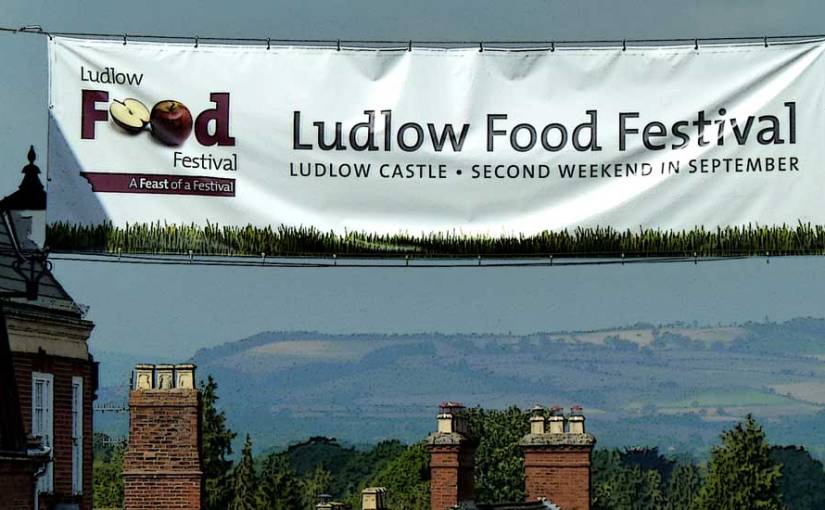
Monthly Photo Challenge: The Changing Seasons #9

Month number nine already and the summer is slipping away fast. Not that there has been much of a summer in this region, July and August proved to be wetter than average and colder too. No sitting outside on a warm evening sipping a cold Sauvignon blanc. More a case of looking for the bedsocks.
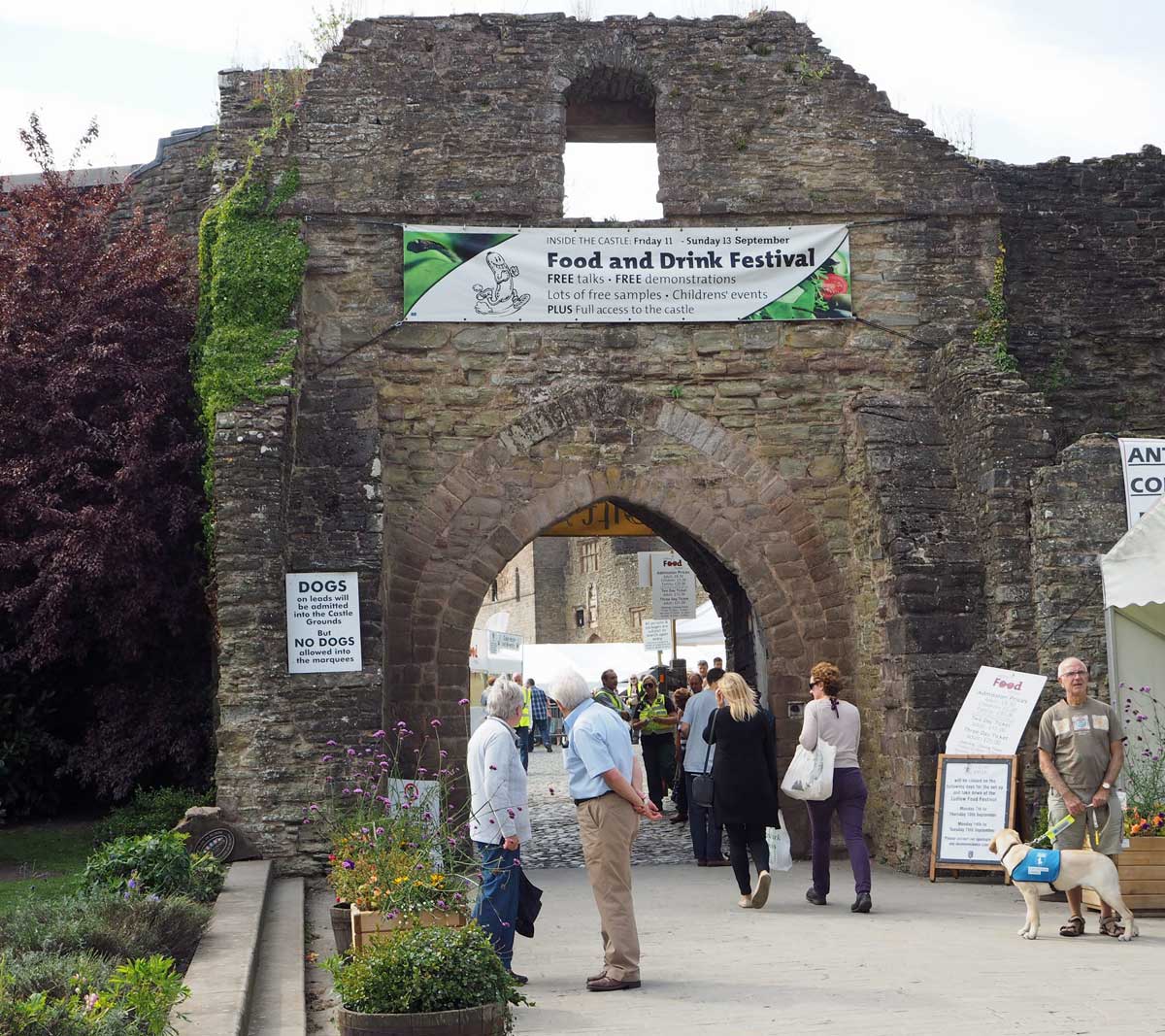
Entrance to Ludlow Castle

Date: September 11 2015
Weather: sunshine and overcast
Temperature: Mild (17°C)
Time: 12:30 – 14:30 PM
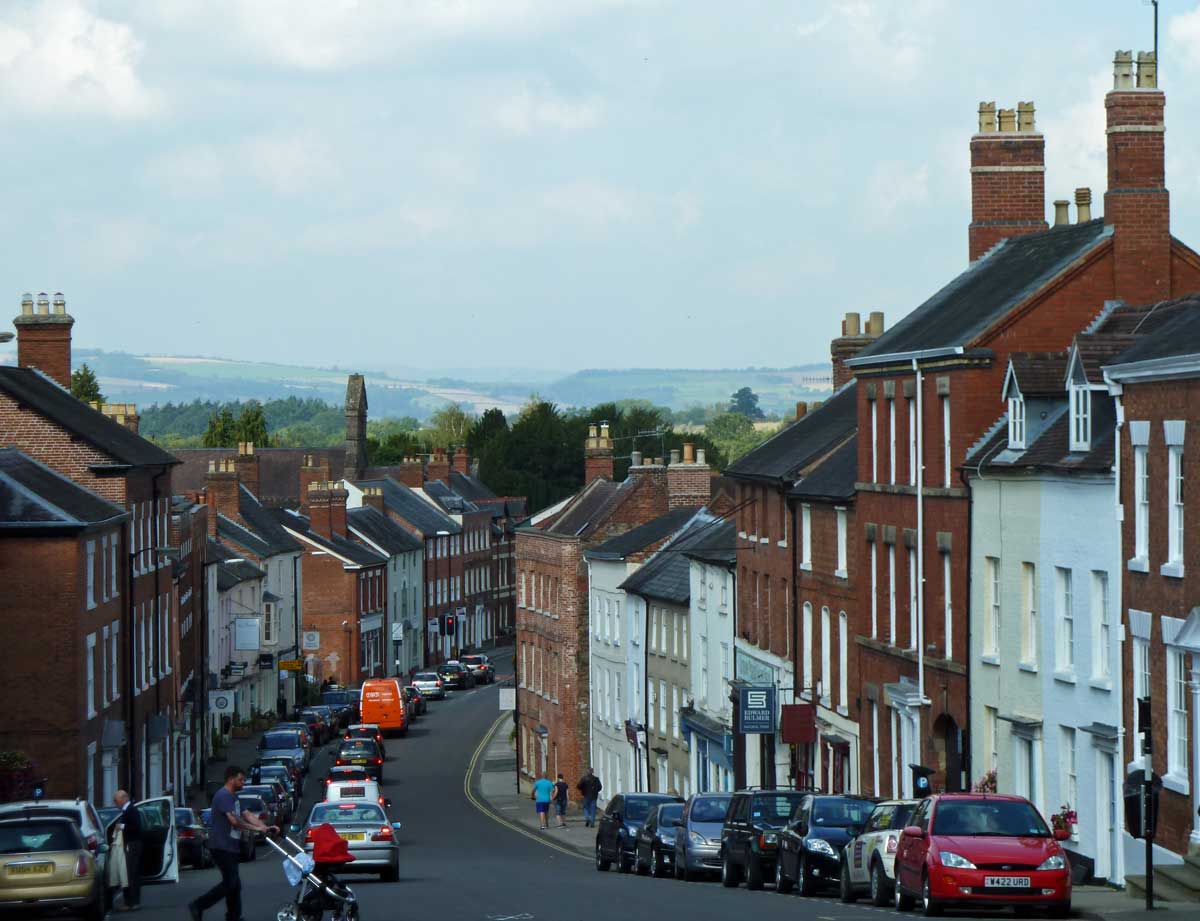
Corve Street – looking south to the Shropshire Hills

September in Ludlow is Food Festival time when the town is invaded by visitors seeking the perfect sausage on the sausage trail. The three butchers compete to create a new one each year. So far I have only tasted the boar, sage and red currant one but can report that it is VERY nice. In fact some are sizzling in the pan as I write this. If that doesn’t float your boat then there is a Real Ale Trail and Pudding Tastings too as well as many different exhibitors, demonstrations and free samples.

We’ll begin then with a few views of the festival and some of the interesting window displays that shops enter each year. I don’t agree with the results, but what do you think? And I shall link these to Dawn’s Lingering Windows.

First Prize: Harp Lane Deli

Second Prize: Jewellers

Third Prize: Emporos

Now for a wander around the town which is a lot quieter than I would have expected on this first day of the festival. But a class of excited youngsters queue up in Castle Square to stroke the ‘dog in the pram’ which makes its presence here every year to raise money for the Animal Hospital. Continue reading Monthly Photo Challenge: The Changing Seasons #9
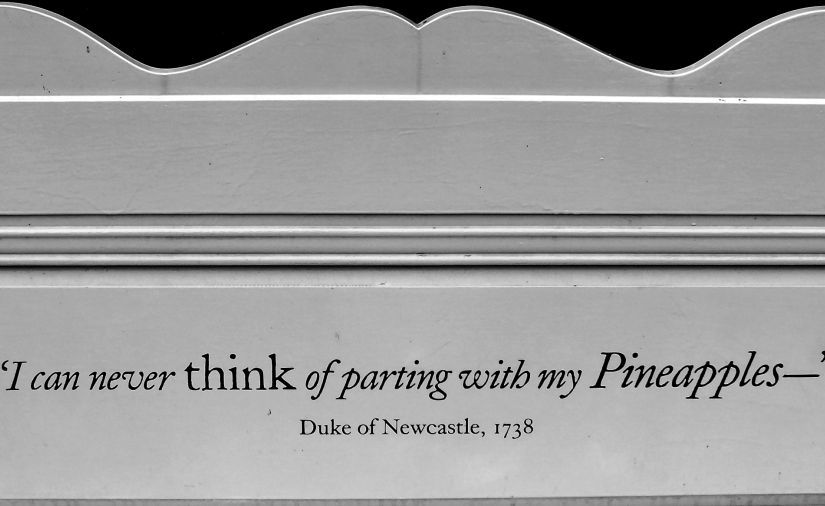
Bench series #37

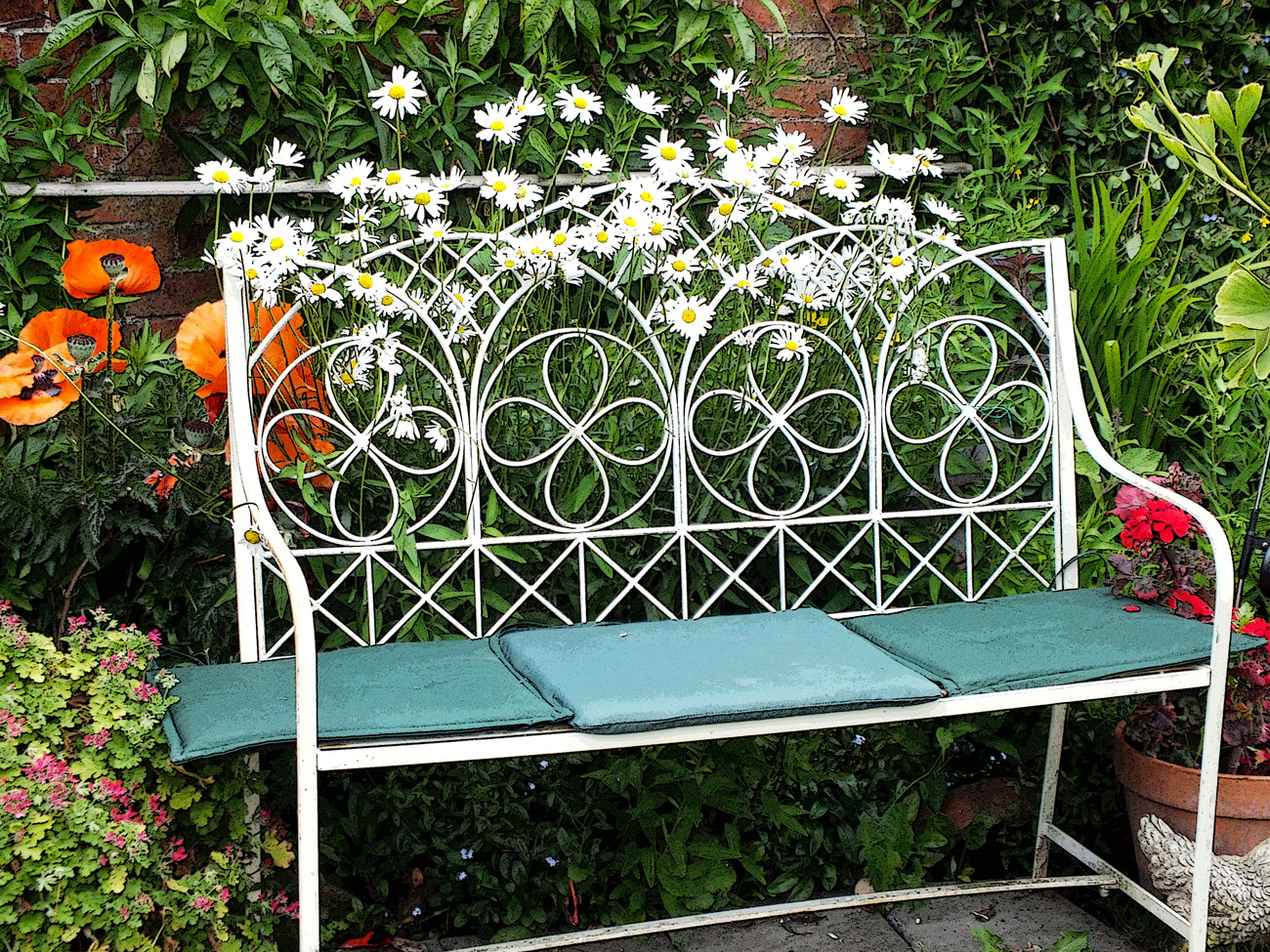
For the month of September I’m looking for a Metal bench

Daisy bench
Daisy Bench

If you would like to join in with the Bench photo challenge then please take a look at my Bench Series page. No complicated rules, just a bench and a camera required 🙂

  • Create your own post and title it Bench Series: September
  • Include a link to this page in your post so others can find it too
  • Add the tag ‘bench series’ so everyone can find the benches easily in the WP Reader
  • Get your post in by the end of the month, as the new bench theme comes out on the first Sunday in October.

My Picks of the Week:

Black and White from Tgeriatrix, the Spanish one is a beauty. An odd one from Meg which probably should have been in the unusual category, and please welcome Emma from South London with her unusual composition and London views. Lisa shows us a delightful view with her bench too.
Elaine captures a bench in Scotland with a very sober meaning and Anabel has benches with views from Scotland too. And do take a look at Ruth’s beautiful sculpture bench in Tasmania.

As always there are so many delightful benches to view, I hope you will check out the other links within the comment section.

Misericords of St Laurence – Part II

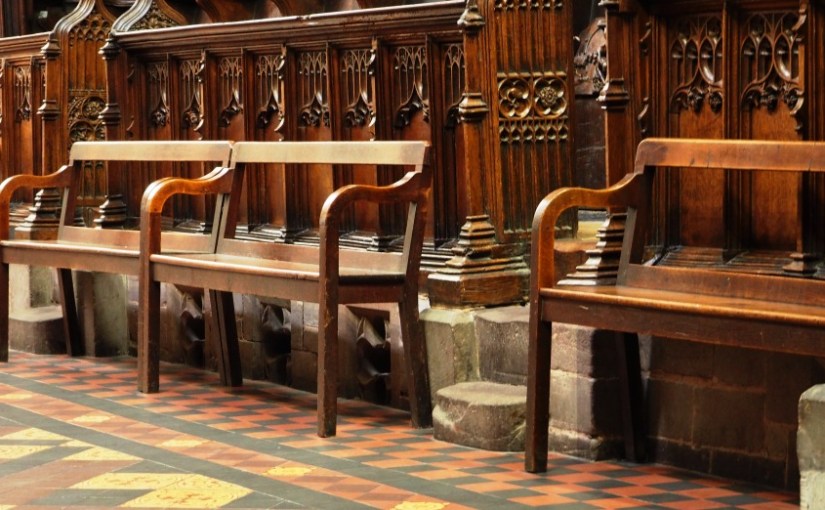
The Parish Church in Ludlow is famous for its 15th century misericords in the chancel stalls. These ignored carvings are found underneath choir stall seats and are mostly found in areas of the country whose wealth came from the medieval wool trade. The largest collection is housed at Salisbury Cathedral (106) compared to Hereford Cathedral (40) and the 28 intricately carved designs here in Ludlow.

Finally I have managed to get some decent photos of them all, so let me introduce you to them:

North Side 6 – 10

N6: The Antelope, gorged (the neck encircled by a coronet or collar) and chained is the personal badge of Henry VI in whose reign the misericords were carved. The grotesque masks either side are usually regarded as pagan imagery so an odd choice to accompany the Antelope. Leafed faces are often associated with the Green Man present at May Day celebrations. In a Christian context they are more likely to be a reminder against loose morals and sin.

N6
N6

N7: A bishop supported on either side by a mitre. Possibly a portrait of Thomas Spofford (1422-1448) during whose time the chancel was enlarged and whose name appears in the great east window.

N7
N7

N8: The three ostrich feathers have been the personal badge of the Prince of Wales since the mid sixteenth century. At the time of this carving it was the badge of the Black Prince, Edward of Woodstock who died in 1376 before he could succeed to the throne. He was father of Richard II (N10)

N8-PRINCE-OF-WALES
N8

N9: Here we have an ass preaching at the pulpit to a congregation of birds, geese and other farmyard animals. On the left two figures are whispering to one another having spotted the deception. The moral is about the gullible and foolish listening to false doctrine, a warning against the followers of Wycliffe, the Lollards.(John Wycliffe was concerned about the wealth of the clergy in the Middle Ages and not liked by the Church)

N9
N9

N10: The Hart at Rest is the badge of Richard II who was deposed by the first of the Lancastrian kings, Henry IV. The Yorkists regarded Richard as the last true legitimate monarch. In the heraldic version the Hart was white. The hounds on either side gave the idea of the chase.

N10
N10

Source of text: Historic Ludlow ” The Misericords and Choir Stalls” by Peter Klein (1986)

Misericords of St Laurence – Part I

The Parish Church in Ludlow is famous for its 15th century misericords in the chancel stalls. These ignored carvings are found underneath choir stall seats and are mostly found in areas of the country whose wealth came from the medieval wool trade. The largest collection is housed at Salisbury Cathedral (106) compared to Hereford Cathedral (40) and the 28 intricately carved designs here in Ludlow.

Finally I have managed to get some decent photos of them all, so let me introduce you to them:

North Side 1 – 5

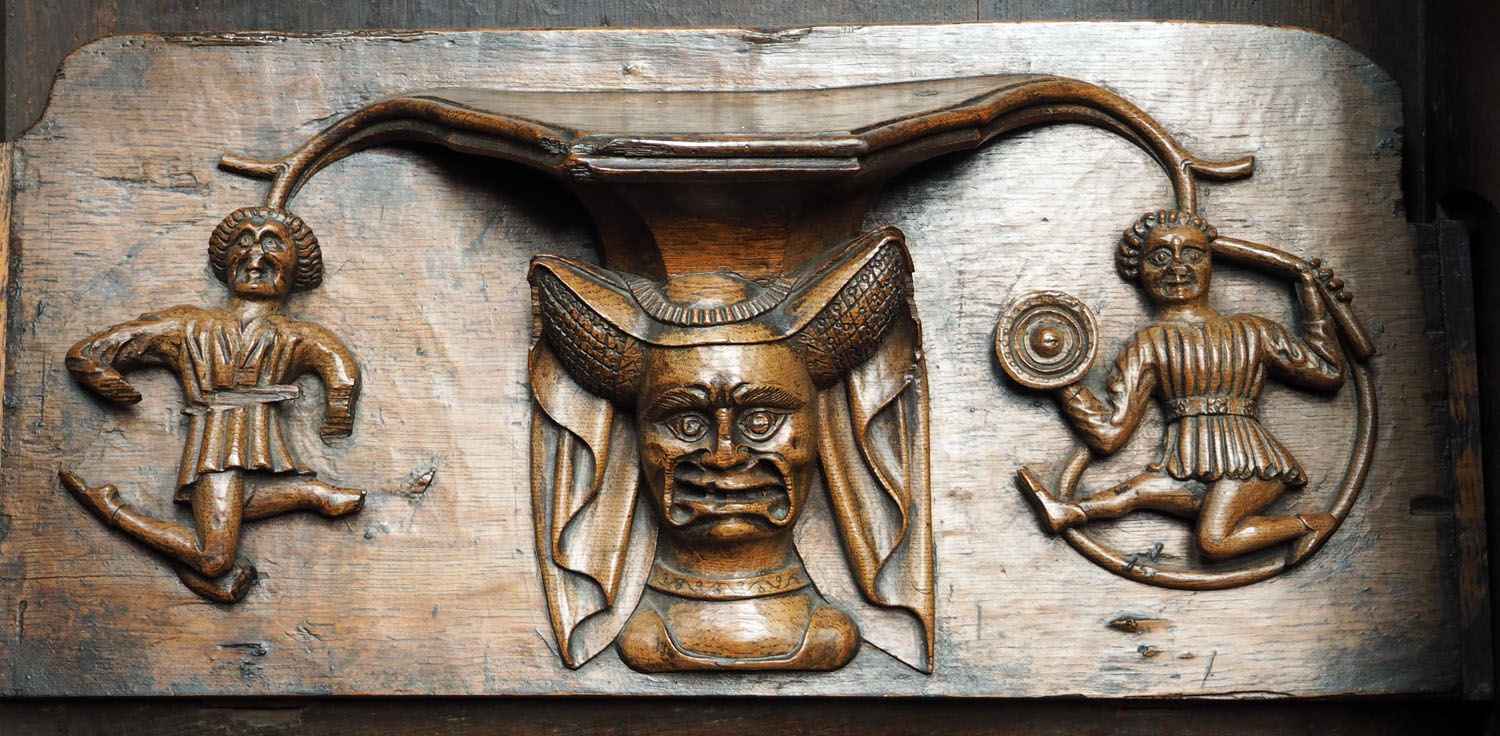
N1: There are several interpretations of this one. A scold wearing an outrageous horned head-dress or hennin being ridiculed, though the woman does not wear the scold’s bridle so it may represent street entertainment. It may also be a warning against misplaced vanity.

N1

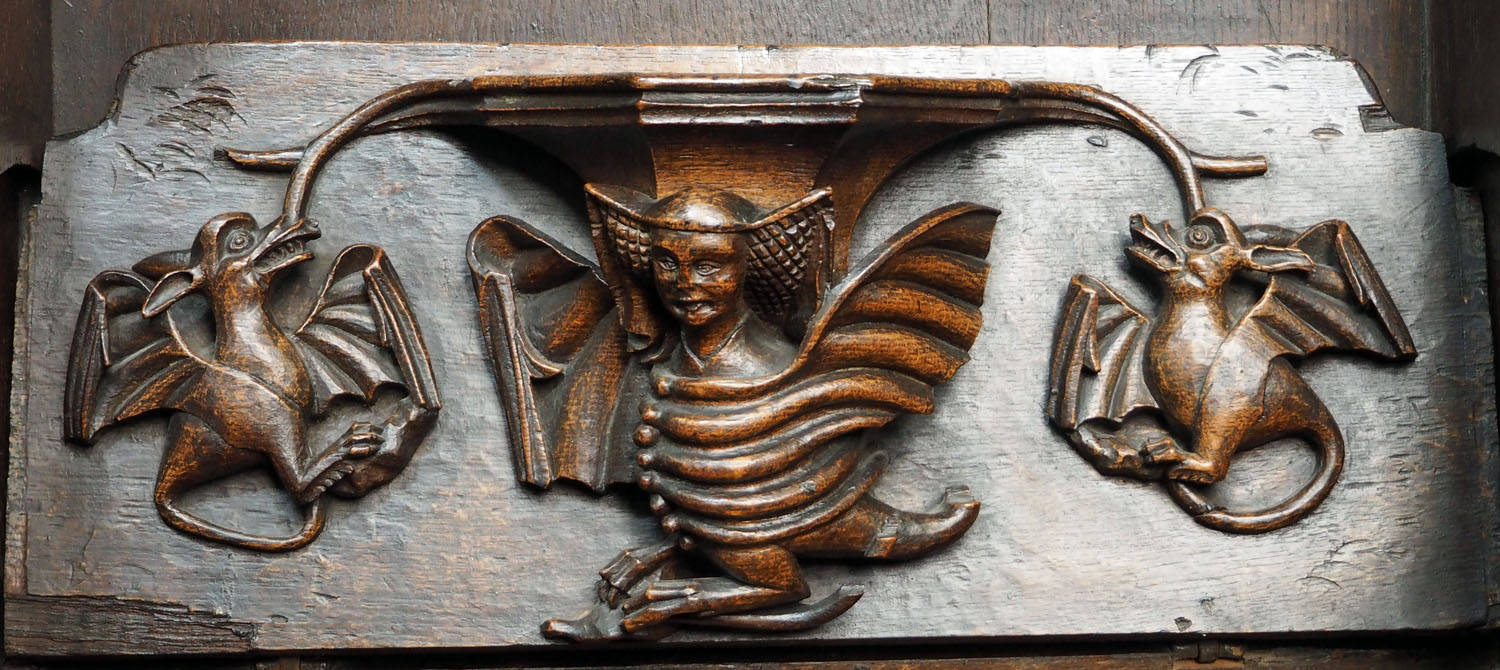
N2: The central corbel is the form of a Harpy, a young woman’s head being given the body and wings of a bat. Her supporters are bats – creatures of darkness and symbolic evil. This could be a cautionary tale about women using their charms to tempt a man aka Adam and Eve.

N2
N2

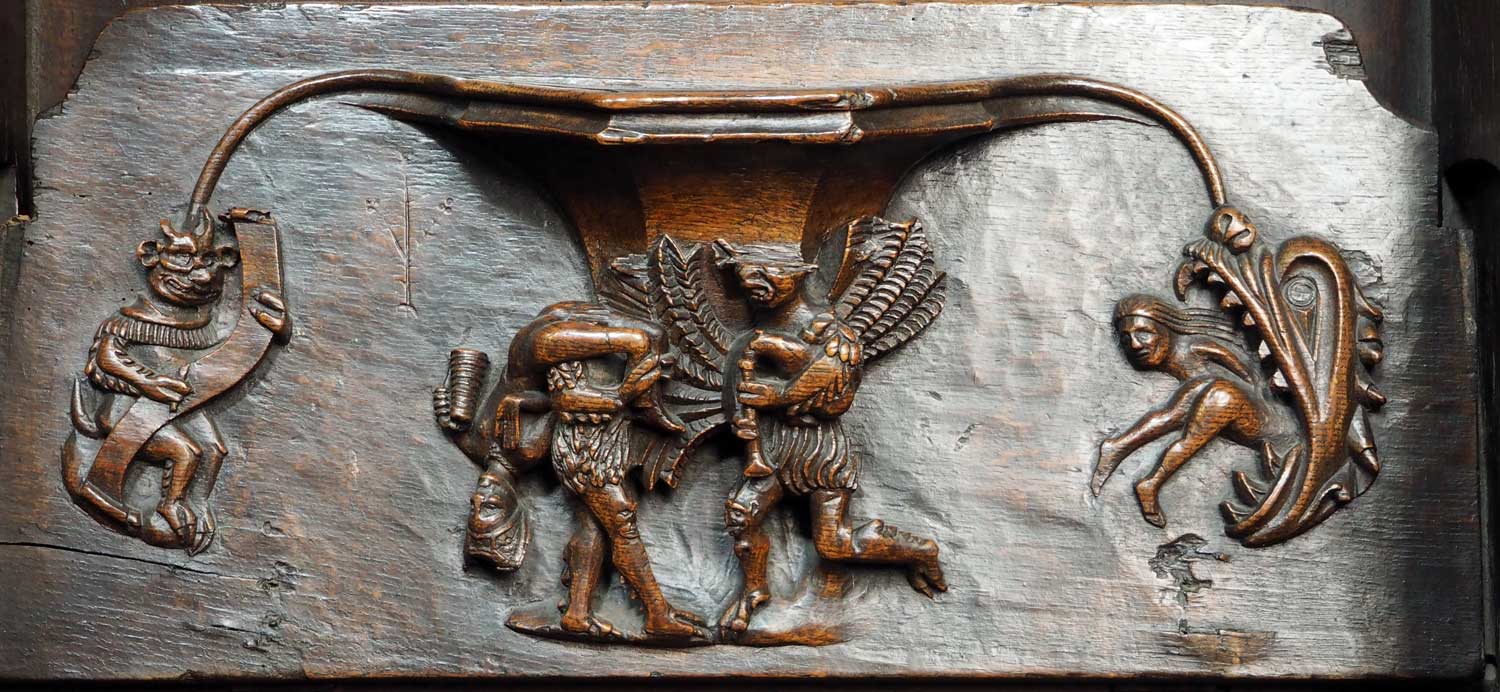
N3: This is Ludlow’s most famous one and shows a dishonest alewife who has given short measure and has been thrown over the shoulder of the devil. A demon, Tutivillus on the left reads a long list of her misdemeanours. Another devil  plays the bagpipes to serenade her journey to the gaping mouth of Hell shown on the right.

N3
N3

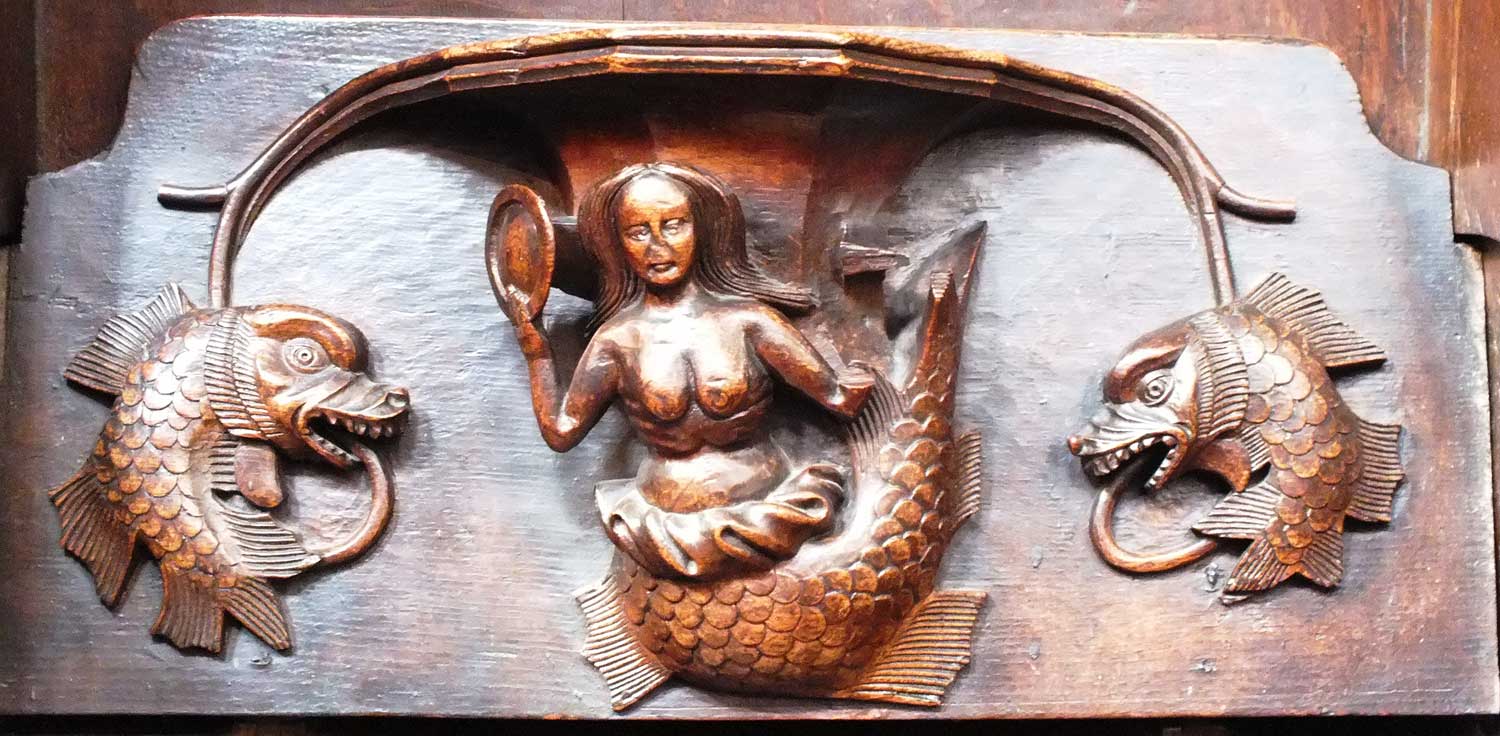
N4: My favourite. A mermaid holds a mirror in one hand and a now missing comb in her left. Two dolphins add to the theme. Yet another anti-feminine theme, the mermaid or siren being symbolic of the woman luring men away from the path of salvation.

N4
N4

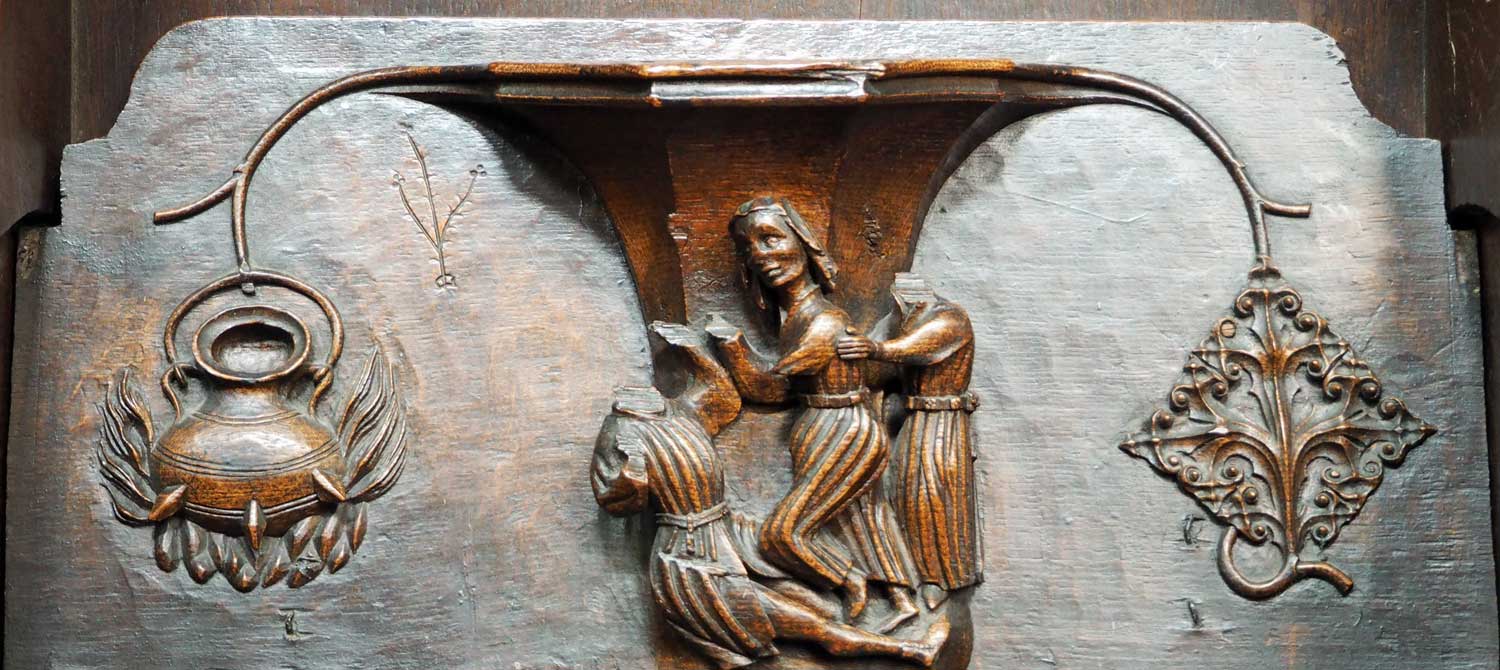
N5: A scene of domestic discord involving three male figures. The one on the right is trying to restrain the other two, whilst a cauldron bubbles away on the hearth. The kite-shaped leaf on the right is typically found on the Ludlow misericords and a stylised foliage often used in court manuscripts. The whole of the carving represents one of the seven sins – Anger.

N5
N5

Source of text: Historic Ludlow ” The Misericords and Choir Stalls” by Peter Klein (1986)

The Parish Church of St Laurence, Ludlow

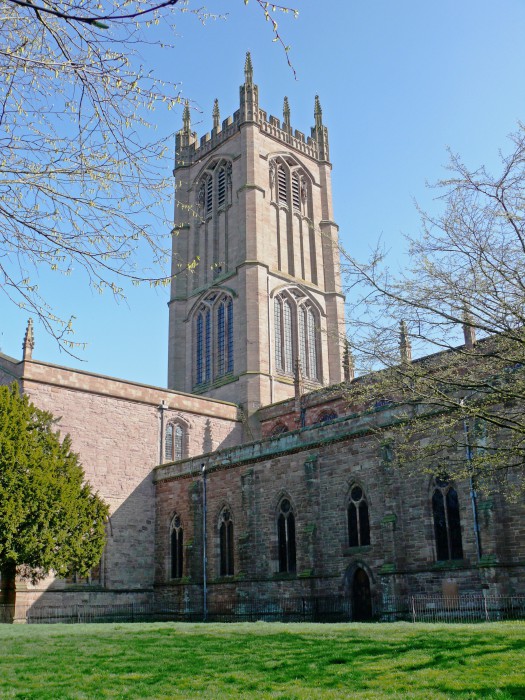
Ludlow’s church can be seen from miles around due to its large tower. The original church was started in 1199 and added to in the fourteenth century with a decorated hexagonal porch. The chancel and the nave were built in the perpendicular style in the early 15th century.  It was one of only 18 churches given a five-star rating in England’s Thousand Greatest Churches by Simon Jenkins (1999) and is described as the “Cathedral of the Marches

St Laurence Church

An important body in the town was the Palmers’ Guild which began around 1250 as a mutual benefit society, but later concerns were with provision for the after-life. By using the name Palmer, the Guild associated itself with pilgrimage to the Holy Land and a window in the Guild’s own chapel of St John the Evangelist depicts a legend that attributes the foundations of the Guild to Edward the Confessor. The town’s economy and medieval prosperity came from  wool.

I have been promising to show more images of the interior so let’s have a look around and you will see why I find this building so beautiful and how it connects the present town of Ludlow to its historical political importance (Wars of the Roses) and economical past.

Continue reading The Parish Church of St Laurence, Ludlow